Walleye Fishing Techniques: Complete Minnesota Guide
We’ve all been there: standing on the deck of a boat at 5:00 AM on a misty Minnesota morning, wondering why the walleyes that were stacked on the electronics yesterday have seemingly vanished into thin air. It’s a specialized kind of frustration that only a North Star State angler understands—the pursuit of the most elusive, delicious, and "finicky" fish in our 10,000 lakes. This guide is your definitive roadmap to cracking the code, covering every seasonal movement, technical presentation, and local secret you need to fill your livewell this year.
Understanding Minnesota Walleye Behavior and Seasonal Movements
To catch walleye consistently, you have to stop thinking like a fisherman and start thinking like a predator that is obsessed with two things: calories and comfort. In Minnesota, our lakes go through dramatic shifts, and the walleyes are always on the move to find the perfect intersection of forage and water temperature. If you aren't staying mobile, you’re fishing for ghosts.
Spring Post-Spawn Transitions and Shallow Water Tactics
When the ice finally retreats and we hit that legendary mid-May opener, walleyes are often still in a bit of a post-spawn funk. They’ve just finished the grueling process of spawning in rocky river inlets or shallow gravel bars, and now they’re looking to recover. During this window, you’ll find them surprisingly shallow. I’m talking three to eight feet of water, especially where the new weeds are starting to poke through the muck. The sun warms these shallows faster, kicking off the food chain.
The key here is stealth and patience. Since the water is often crystal clear in early spring before the algae blooms hit, these fish are spooky. If you’re crashing around with your big outboard, you’ve already lost the battle. This is the time for long casts and light jigs. You want to look for "walleye chop"—that perfect breeze that ruffles the surface and cuts down on light penetration, giving the fish the confidence to stay shallow even at noon. Before you head out for the opener, make sure you've sorted out your Minnesota Fishing License: Cost, Types & How to Buy (2026) so you're legal the moment the clock strikes midnight.
By late May, the "shiner run" becomes the main event on lakes like Mille Lacs and Winnibigoshish. Millions of spottail shiners move into the sandy shallows to spawn, and the walleyes follow them like a wolf pack. If you can find a sandy point with a bit of wind blowing into it, you’ve found the honey hole. A simple jig and minnow combo worked slowly across the sand is often all it takes. Just remember that seasons can vary slightly by region, so always double-check the Minnesota Fishing Seasons & Opener Dates (2026) before planning your trip up north.
Summer Deep Water Patterns and Structure Fishing
As June turns into July and the water temperatures climb into the high 60s and 70s, the shallow bite usually evaporates. This is when walleyes move to their "summer homes"—deep reefs, sunken islands, and the vast mud flats that characterize many of our glacial lakes. They are looking for stability now. The deep water stays cool, and the forage shifts toward perch, ciscoes, and bottom-dwelling invertebrates.
This is the era of the "structure fisherman." You’ll need to spend time behind your electronics, idling over mid-lake humps until you see those tell-tale "arches" hugging the bottom. On a lake like Leech or Vermilion, these fish might be in 20 to 30 feet of water. They aren't necessarily aggressive during the bright overhead sun, which is why the "golden hour" (the hour before and after sunset) becomes so critical. During the day, they might be tucked tight into the transition zones where the rock meets the mud.
If you’re struggling to find them during the dog days of summer, don’t ignore the deep weed edge. On many of our clearer lakes, cabbage weeds can grow out to 15 or 18 feet. These weed walls act as a massive oxygen factory and a buffet for baitfish. Big walleyes will often cruise the very edge of the greenery, darting in to grab a perch and then disappearing back into the shade. To stay on top of the rules for these deep-water giants, keep an eye on the Minnesota Fishing Limits: Bag & Possession (2026) to ensure you're within the legal take for the day.
Fall Turnover and the Feeding Frenzy
September and October are, in my humble opinion, the best months to be a walleye angler in Minnesota. As the surface water cools, it eventually becomes denser than the water below, causing the lake to "turn over." This mixes the oxygen and nutrients throughout the water column. While the actual week of turnover can be tough fishing because the fish are disoriented, the period immediately following it is a bonanza.
Walleyes know that winter is coming. Their metabolism tells them to bulk up, and they become much less picky about what they eat. They often move back toward shallower structures, like 10-to-15-foot flats, following the schools of perch that are also grouping up. This is the time for "power fishing"—using larger baits and faster presentations to trigger reactionary strikes. A large chub or a 5-inch paddle tail plastic can be deadly now.
The beauty of fall is that the "bite window" expands. You don't have to be out there at 4:00 AM to catch fish; often, the warmest part of the afternoon produces the best action. The crowds have thinned out, the jet skis are put away, and it’s just you and the crisp autumn air. If you're heading to one of the premier destinations, be sure to read our Mille Lacs Walleye Regulations (2026) as they often change specifically for the fall season to protect the spawning biomass.
Essential Gear for Minnesota Walleye
You don't need a $100,000 bass boat to catch walleyes, but you do need gear that allows for precision. Walleyes are famous for their "soft" bite; sometimes it feels like nothing more than a tiny change in weight or a subtle "tick" on the line. If your gear is too heavy or clunky, you'll never even know they were there.
Rod and Reel Setups for Sensitivity
For most Minnesota applications, a 6’6” to 7’0” medium-light power, fast-action spinning rod is the gold standard. The "medium-light" part is crucial—it gives you the tip flex needed to see the bite before the fish feels the resistance of the rod. The "fast action" means the rod has plenty of backbone in the lower half to drive a hook into a walleye’s bony jaw. I’ve found some great deals on high-quality graphite rods on Amazon that rival the big-name brands for half the price.
Pair that rod with a 2500-size spinning reel. You want a reel with a butter-smooth drag system. Walleyes aren't known for long, screaming runs like a salmon, but they are notorious for "head-shaking" right at the side of the boat. A sticky drag will result in a snapped line or a pulled hook every single time. Investing in Best Walleye Rods & Reels will pay dividends when you're tangling with a 28-inch trophy that decides to dive under the boat at the last second.
If you’re planning on doing a lot of trolling, you might want to look into a dedicated baitcasting setup with a line-counter reel. This allows you to know exactly how many feet of line you have out, which is the only way to consistently put your crankbait back into the "strike zone" once you’ve found the right depth. Many anglers find these specialized reels on Amazon, where you can compare features like gear ratios and line capacity easily.
Line Choice and Leader Materials
The debate between monofilament, fluorocarbon, and braid is eternal, but for walleyes, a hybrid approach is usually best. I highly recommend using 8lb or 10lb test braided line as your "main line." Braid has zero stretch, which means every vibration from your lure is transmitted directly to your hand. It also has a much thinner diameter than mono, allowing your jigs to sink faster and cut through the water with less resistance.
However, walleyes have incredible eyesight, and they can be "line shy" in clear water. That’s why you should always use a 3-to-5-foot leader of fluorocarbon. Fluorocarbon is nearly invisible underwater and has higher abrasion resistance against rocks and zebra mussels. A 6lb or 8lb leader is perfect for most situations. You can find bulk spools of high-quality fluorocarbon on Amazon to keep in your tackle bag for quick re-tying on the water.
In stained water, like what you’ll find on the Rainy River or Lake of the Woods, you can sometimes get away with straight monofilament. Mono has more stretch, which can actually be a benefit when you're using aggressive techniques like snap-jigging, as it provides a "cushion" that prevents the hook from tearing out of the fish's mouth.
Essential Lures and Live Bait for Every Situation
While we’d all love to catch fish on plastics every day, the reality of Minnesota fishing is that live bait is often king. You need to be prepared with a variety of "grocery options." In the spring, fathead minnows and shiners are the primary choice. As the water warms in June, leeches become the go-to, followed closely by nightcrawlers in the heat of the summer. Knowing the Best Live Bait for Walleye (Leeches, Minnows, Crawlers) for each specific month is the hallmark of a veteran angler.
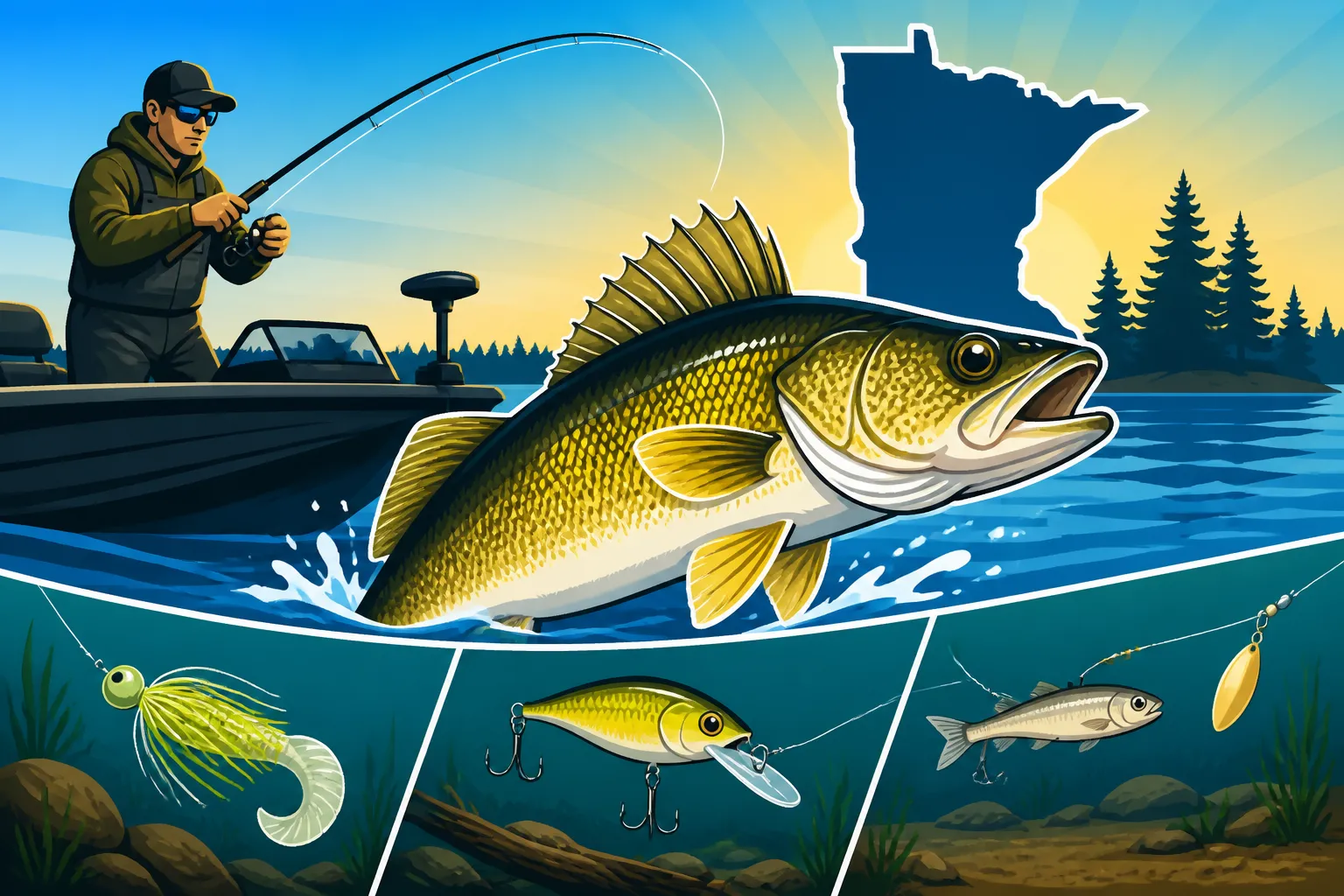
For artificials, your tackle box should be anchored by a selection of high-quality jigs ranging from 1/8 oz to 3/8 oz. Colors like chartreuse, orange, and "pink bubblegum" are staples in the muddy waters of the south, while natural silvers and blues work better in the clear northern lakes. Don't forget a few "search baits" like Lipless Crankbaits (Rappala Rippin' Raps) and deep-diving minnow imitators.
| Technique | Best Depth | Recommended Bait | Key Feature |
|---|---|---|---|
| Vertical Jigging | 10-25 ft | Minnow or Paddle Tail | Precision and "feel" |
| Lindy Rigging | 15-30 ft | Leeches or Crawlers | Finesse for neutral fish |
| Slip Bobbering | 5-20 ft | Jumbo Leech | Perfect for rock piles at dusk |
| Trolling Cranks | 12-20 ft | Shad Raps / Flickers | Covers massive amounts of water |
| Bottom Bouncing | 15-25 ft | Nightcrawler Harness | Speed and vibration |
Vertical Jigging: The Bread and Butter
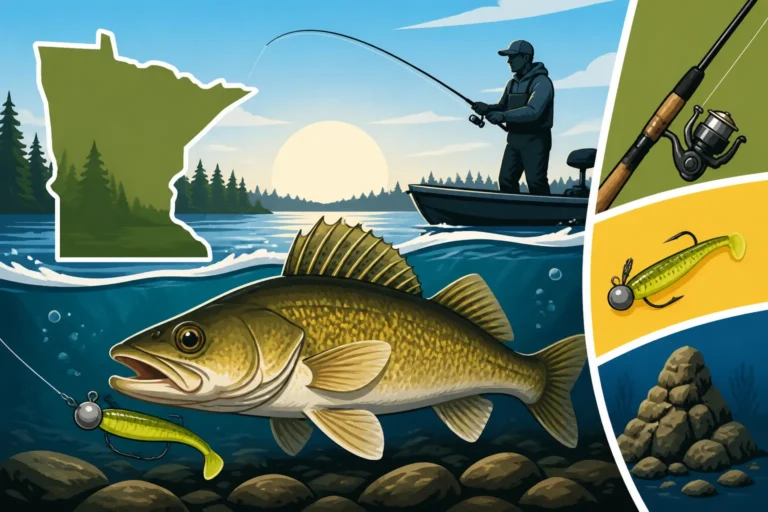
If you ask any old-timer at the bait shop in Garrison how they catch their fish, they’ll likely point to a jig. Vertical jigging is arguably the most productive way to catch walleyes in Minnesota because it allows you to keep your bait in the strike zone for the maximum amount of time. It is a game of inches and "the tick."
Snap Jigging vs. Subtle Presentation
There are two main schools of thought when it comes to jigging. The first is the "subtle" approach, which is vital when the water is cold or the fish are lethargic. This involves keeping your jig just an inch or two off the bottom and giving it the tiniest little twitches—hardly moving it at all. You want the minnow or the plastic tail to dance just enough to look alive, but not so much that it looks like a threat.
The second approach is "snap jigging," which has become incredibly popular on lakes like Mille Lacs and Leech Lake. This is an aggressive tactic where you let the jig hit the bottom and then sharply "snap" the rod tip up 2 or 3 feet, followed by letting the jig fall back on a semi-slack line. The strike almost always happens on the fall. This is a reactionary bite—the walleye sees something darting away and strikes out of pure instinct. It’s an exhausting way to fish, but it can trigger a school of fish that has ignored every other presentation.
Regardless of your style, the most important rule is to keep your line vertical. If the wind is blowing your boat faster than your jig can stay under you, you need to use your trolling motor to "back-troll" or move up to a heavier jig head. If your line is at a 45-degree angle, you lose all your sensitivity and your ability to set the hook effectively.
Baiting Your Jig: Minnows vs. Plastics
For decades, the minnow was the only thing people put on a jig. Hooking a fathead through the mouth and out the back of the head is still a deadly way to fish. However, modern soft plastics have changed the game. Brands like Berkley Gulp! and various paddle tails offer scent and action that can sometimes outperform live bait, especially when the fish are aggressive or when small "nuisance" fish like perch keep stealing your expensive minnows.
When using plastics, the key is the "tail action." You want a plastic that continues to wiggle even when you aren't moving the rod. In the fall, a large 4-inch or 5-inch jerk-shad plastic on a heavy jig head can account for some of the biggest fish of the year. If you're new to the technical side of things, our guide on How to Catch Walleye in Minnesota (Step by Step) breaks down the exact rigging for both live and artificial options.
Reading the Bottom Content
A jig isn't just a lure; it's a sensor. As you bounce your jig along the bottom, you should be paying close attention to what it feels like. A "mushy" feeling means you're in the mud or silt. A "sharp, clunky" feeling means you've found rocks or gravel. Walleyes love "transitions"—the exact spot where a mud flat meets a gravel bar.
If you can find a spot where the depth stays the same but the bottom composition changes, you’ve found a walleye highway. Use your jig to "scout" the area. If you start feeling "ticks" but aren't hooking up, it might be small perch, or it might be walleyes that are just nipping at the tail. That’s your signal to either downsize your bait or slow down your presentation significantly.
Trolling Strategies for Big Water
When you're faced with a massive body of water like Lake of the Woods or the vast "mud flats" of Mille Lacs, jigging can be like looking for a needle in a haystack. This is where trolling comes in. Trolling allows you to cover miles of water in a single day, searching for active pods of fish that are roaming the open water.
Crankbaits and Depth Control
Trolling with crankbaits is a science. Each lure has a specific "dive curve"—meaning at a certain speed and with a certain amount of line out, it will run at a specific depth. For example, a Rapala Shad Rap #7 might run 12 feet deep with 100 feet of line out at 2.0 mph. Mastering this math is how you avoid snagging the bottom while staying just inches above it.
Color choice is also critical when trolling. On cloudy days or in stained water, "firetiger" (bright green/yellow/orange) is a legend in Minnesota. On bright, sunny days, metallic silvers and "glass" finishes that mimic ciscoes are usually better. Many pros buy their trolling kits in bulk on Amazon to ensure they have every color and size imaginable before the big tournament season.
One of the most common mistakes is trolling too fast. For walleyes, 1.5 to 2.5 mph is the sweet spot. If you go faster, you’re in Northern Pike territory; slower, and the lures won't have enough "wiggle" to attract attention. Always check your Mille Lacs Lake Fishing Rules & Limits before you start a trolling run, as some lakes have restrictions on the number of lines you can run at once.
Bottom Bouncing with Crawler Harnesses
If the fish are pinned to the bottom and won't rise for a crankbait, it’s time to break out the bottom bouncers. An L-shaped wire weight (usually 1.5 to 3 oz) drags along the bottom, while a 3-to-5-foot "spinner rig" or "crawler harness" trails behind it. The spinning blade creates vibration and flash, while the trailing nightcrawler provides the scent and taste.
This is a fantastic "all-day" technique. It’s easy for beginners to learn because the weight does all the work—if you feel it thumping the bottom, you’re in the game. It’s also incredibly effective for "covering the flats." If you're fishing a 20-foot mud flat, you can just set your kicker motor and cruise at 1.2 mph until you run into a school.
Using Planer Boards on Large Lakes
On clear-water lakes, the sound of the boat passing overhead can actually push walleyes to the side, away from your lures. This is called "boat side spooking." To combat this, we use planer boards. These are small floating devices that attach to your line and "sail" out to the side of the boat, carrying your lure with them.
This allows you to present your baits 50 or 100 feet away from the boat's path. It also allows you to run more lines without them getting tangled. Watching a planer board suddenly "hop" or slide backward when a big walleye grabs the lure is one of the most exciting sights in fishing. If you're planning a trip to the big water, read our Lake of the Woods Fishing Guide for specific tips on how to rig boards for those giant northern basins.
Live Bait Rigging and Finesse
Sometimes, the walleyes are just plain "neutral." They aren't hungry enough to chase a crankbait, and they aren't aggressive enough to hit a snapped jig. This is when you have to slow down and feed them exactly what they want, exactly where they want it.
The Iconic Lindy Rig
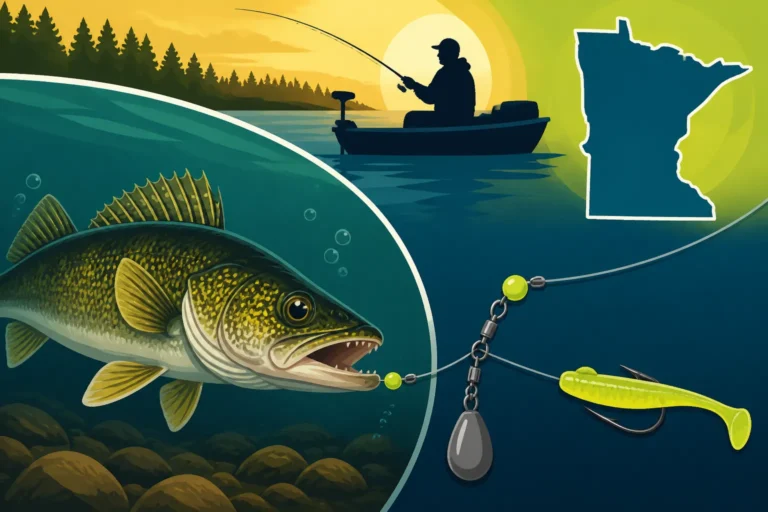
Invented right here in Minnesota by the Lindner brothers, the Lindy Rig is the ultimate finesse tool. It consists of a walking sinker, a swivel, and a long leader (sometimes up to 10 or 12 feet) ending in a single hook with a leech or a minnow. The goal is to let the bait swim as naturally as possible.
The "Lindy" technique involves leaving your bail open or using a "finger on the line" approach. When you feel that subtle "tap," you don't set the hook immediately. Instead, you feed the fish line—giving it 5 to 10 seconds to fully engulf the bait—before closing the bail and sweeping the rod for a hookset. It is a patient, meditative way to fish that has probably accounted for more Minnesota walleyes than any other method in history. For more on this, check out our Walleye Fishing Techniques: Complete Minnesota Guide internal deep-dive.
Slip Bobber Magic
There is nothing quite like the sight of a lighted slip bobber plunging under the surface in the dark. Slip bobbers are the best way to fish "specific" spots, like a small rock pile or a submerged tree trunk, where you can't troll or drag a rig without snagging. It allows you to suspend a leech or a minnow exactly six inches off the rocks.
This is the premier technique for the evening bite. As the sun goes down, walleyes move from the deep water up onto the tops of the rock reefs to hunt. You can anchor your boat a cast-length away and just wait for them to come to you. If you're new to this, learning How to Use a Slip Bobber for Walleye & Crappie is an essential skill for any Minnesota angler's toolkit.
Working the Mud Flats
On lakes like Mille Lacs, the "mud flats" are massive plateaus of silt and clay in 25 to 35 feet of water. In the summer, these flats are teeming with mayfly larvae and other bugs. Walleyes will roam these flats in massive schools. Rigging with a long leader and a "floating" jig head is a great way to keep your bait just above the soft mud where the fish can see it.
The key to the flats is GPS. Once you catch a fish, mark the spot. Usually, there isn't just one fish; there are fifty. You’ll often find that the fish are holding on the "edges" of the flats where they drop off into deeper water. Our Mille Lacs Lake Fishing Guide: Walleye, Bass & More covers the specific coordinates and names of the most famous flats for your next trip.
Ice Fishing for Minnesota Walleye
In Minnesota, we don't stop fishing just because the lakes have turned to granite. In fact, many people prefer ice fishing because it allows for a level of precision that you simply can't get from a boat. You are standing directly over the fish, and with modern technology, you can see their every move.
Prime Times and Peak Windows
Walleyes are "low-light" predators. Under the ice, this becomes even more pronounced. The vast majority of your fish will be caught in two small windows: the 90 minutes around sunrise and the 90 minutes around sunset. During the middle of the day, you can often "mark" fish on your flasher, but they will be belly-to-the-bottom and very difficult to entice.
This is why "sleeper houses" are so popular on lakes like Lake of the Woods. You can live on the ice for three days, ensuring you are "on the hole" during those critical dawn and dusk periods. If you're just starting out, our Ice Fishing in Minnesota: Complete Beginner-to-Pro Guide will help you understand the safety and gear requirements for a successful winter outing.
Using Modern Electronics: Flasher vs. Live Sonar
If you fish through the ice without a flasher, you are essentially fishing blind. A flasher (like a Vexilar or Humminbird) shows you your lure and the fish in real-time. You can see the fish rise to your bait, and you can adjust your jigging cadence based on their reaction. If they move toward it and then shy away, you know you need to change color or slow down.
The newest revolution is "Live Sonar" (like Garmin LiveScope). This allows you to see 100 feet in any direction under the ice. Instead of waiting for a fish to swim under your hole, you can actually "hunt" them, drilling holes exactly where the schools are moving. It has fundamentally changed how we target walleyes in the winter. You can find all the latest mounting hardware and battery upgrades for these units on Amazon.
Set Lines and Deadsticking
While you're actively jigging with one rod, Minnesota law often allows for a second "set line" or "deadstick." This is a rod that sits in a holder with a plain hook and a live minnow. Often, a walleye will be attracted by the "noise" and flash of your jigging lure but will actually decide to eat the "easy meal" of the stationary minnow on the other line.
A "deadstick" should have a very soft tip or a "bobber arm" so the fish doesn't feel any resistance when it bites. The "deadly" part of this duo is that it gives the fish a choice. On some days, they want the aggressive action; on others, they want the steak dinner that isn't moving. For the latest on how many lines you can legally use, refer to the Minnesota Fishing Regulations PDF: Where to Find It on the DNR website.
Top Minnesota Walleye Destinations
While you can find walleye in almost any lake in the state, there are a few "holy grail" destinations that every angler should visit at least once. These lakes are managed specifically for their walleye populations and offer the best chance at both numbers and trophy-sized fish.
The Big Three: Mille Lacs, Leech, and Winnibigoshish
These three lakes are the heart of Minnesota walleye fishing. Mille Lacs is famous for its massive average size; it’s not uncommon to catch multiple 25-plus-inch fish in a single evening. However, the regulations here are very strict and can change mid-season, so always check the latest updates.
Leech Lake offers a more diverse experience, with a mix of rocky points, massive weed beds, and the famous "Walker Bay" which reaches depths of over 100 feet. Winnibigoshish (or "Winnie") is known for its incredible "numbers" of eating-sized fish. It’s a great place to take kids because the action is often fast and furious.
Border Waters: Lake of the Woods and Rainy
If you want a true wilderness experience, head to the Canadian border. Lake of the Woods is a massive inland sea with over 14,000 islands. It is arguably the walleye capital of the world. The "Rainy River," which feeds the lake, is the site of a world-famous spring season where giant walleyes move out of the lake and into the river to spawn.
Rainy Lake, located near International Falls, is a "shield lake" with crystal clear water and breathtaking rock scenery. It requires a different approach—often involving deeper water and more natural-colored lures. Both of these destinations are bucket-list items for any serious angler.
Metro Gems and Southern Rivers
Don’t overlook the water right in the backyard of the Twin Cities. Lake Minnetonka and White Bear Lake have surprisingly robust walleye populations, thanks to aggressive stocking programs. The Mississippi, Minnesota, and St. Croix rivers are also walleye factories, especially below the lock and dam systems where oxygen levels are high.
River fishing is a different beast entirely. You have to deal with current, which means heavier jigs and "three-way rigs" to keep your bait in place. But the reward can be huge—river walleyes are often some of the hardest-fighting fish in the state.
Minnesota Fishing Regulations Disclaimer
Fishing regulations in Minnesota are subject to change based on annual surveys and conservation needs. Always consult the official Minnesota Department of Natural Resources (DNR) handbook or website before your trip. This guide is for informational purposes and does not replace official state laws. Ensure you have the correct stamps, such as a trout stamp if applicable, and adhere to all slot limits and possession rules for the specific body of water you are fishing. Safe and legal fishing ensures these resources remain available for generations to come.