Minnesota Fishing Regulations PDF: Where to Find It
We have all been there: standing in a bait shop near Brainerd or Garrison, frantically looking for a paper copy of the rules, only to find the rack empty. Navigating the legalities of our 10,000 lakes can feel like a full-time job. This guide shows you exactly where to find the Minnesota Fishing Regulations PDF to ensure you stay legal and confident on the water.
Why You Need the Current Minnesota Fishing Regulations PDF
It happens every year. You head out to your favorite honey hole, thinking you know the rules by heart because you’ve fished there since you were a kid. Then, a Conservation Officer (CO) pulls up, and suddenly you’re learning that the slot limit changed three months ago. The frustration of receiving a citation for a rule you didn't even know existed is a uniquely painful experience for any angler. Having the Minnesota Fishing Regulations PDF saved directly to your smartphone is the single best way to prevent this scenario.
Keeping Up with Annual Rule Changes
The Minnesota Department of Natural Resources (DNR) doesn't just set rules and walk away for a decade. They are constantly monitoring fish populations, water quality, and fishing pressure. This means that every spring, there are Minnesota Fishing Regulations Changes for 2026 that you need to be aware of. These changes can range from a specific lake's sunfish limit being cut in half to a complete overhaul of how we harvest Northern Pike in the North-Central zone.
If you are relying on a tattered paper booklet from 2024 that you found in the bottom of your tackle box, you are asking for trouble. The PDF version is updated as soon as the new rules are finalized, typically in late winter or early spring before the Minnesota Fishing Seasons & Opener Dates (2026) arrive. It serves as the "source of truth" for everything from legal bait to the specific dates of the muskie opener.
Avoiding Costly Fines and Equipment Seizures
Let’s talk reality: fishing fines in Minnesota are not cheap. Beyond the base fine for an over-limit fish, there are often restitution values attached to each fish. If you accidentally keep a trophy-sized walleye on a lake with a strict catch-and-release policy, you could be looking at hundreds of dollars in penalties. In extreme cases of "gross over-limit," the state has the authority to seize your gear, your electronics, and even your boat.
Knowing What Happens If You Fish Without a License in Minnesota? is one thing, but knowing the specific bag limits for the lake you are currently floating on is another. A CO will rarely accept "I couldn't find a paper booklet" as a valid excuse. The PDF is your digital shield, providing instant clarity when you are debating whether that 19.5-inch walleye is a "keeper" or a "release."
Where to Download the Official Minnesota Fishing Regulations PDF
Finding the PDF shouldn't feel like a scavenger hunt, yet the DNR website can sometimes feel like a labyrinth of menus and legacy links. To get the most current version, you want to head directly to the "Regulations" section of the Minnesota DNR website. Look for a prominent link or button labeled "Minnesota Fishing Regulations" accompanied by the current year.
The Minnesota DNR Official Website
The official site usually offers the regulations in two formats: a series of web pages and a single, comprehensive PDF download. While the web pages are okay for a quick glance, I always recommend downloading the full PDF. Why? Because cell service in places like the Boundary Waters or the middle of Mille Lacs can be non-existent. Once that PDF is saved to your "Files" or "Downloads" folder on your phone, you can access it without a single bar of LTE.
When you download it, make sure you are looking at the version that covers the 2026 season. The DNR usually releases the digital version a few weeks before the paper booklets hit the shelves at Fleet Farm or Cabela's. If you are a resident, you should also check if you have the correct Minnesota Fishing License: Cost, Types & How to Buy (2026) before you even worry about the limits, as the license and the rules go hand-in-hand.
Digital Alternatives and Mobile Access
While the PDF is the gold standard for accuracy, the DNR also integrates these rules into their mobile-friendly "LakeFinder" tool. However, the LakeFinder is better for looking up a specific lake's special rules rather than reading the broad, statewide laws. For example, if you are sitting on a boat in Alexandria and want to know the Minnesota Slot Limits: Which Lakes & Why, the PDF is easier to navigate because you can use the "Search" function (Ctrl+F on a computer or the magnifying glass icon on a phone) to find keywords like "Smallmouth" or "Night Fishing."
I tell every guest I take out: save the PDF to your home screen. It takes five seconds and saves twenty minutes of arguing over whether we can keep six walleyes or just four. It’s also a great way to pass the time during a slow mid-day bite—actually reading the definitions of things like "experimental waters" can make you a much more informed angler.
Navigating the Regulations Booklet Like a Pro
A 90-plus page PDF is intimidating. Most people scroll past the first forty pages of "General Information" and head straight for the maps, but that’s where mistakes happen. The booklet is organized logically, but you have to know what you’re looking for. Usually, the first section covers licenses, followed by general statewide limits, and then the "Special Regulations" section, which is sorted alphabetically by lake name.
Understanding Special and Experimental Regulations
This is the section that trips up veteran anglers the most. Most lakes in Minnesota fall under "Statewide" rules, but hundreds of our most popular destinations—like Mille Lacs, Winnibigoshish, and Leech Lake—have "Special Regulations." If a lake is listed in this section, those rules override the statewide defaults.
For instance, if you are targeting walleye, you might see a "17 to 26-inch protected slot" listed for a specific lake. This means any fish in that size range must be immediately returned to the water. If you aren't looking at the Mille Lacs Walleye Regulations (2026) specifically while on that water, you might assume the statewide limit applies and end up with a ticket. The PDF makes it easy to scroll to the "S" section, find "Special Regulations," and then find your lake name.
Deciphering Zone-Specific Rules
Minnesota is also divided into different management zones, particularly for species like Northern Pike. We have the North-East, North-Central, and Southern zones. Each has vastly different rules regarding how many fish you can keep and what sizes are legal.
| Species | Statewide Daily Limit | Possession Limit | Common Size Restrictions |
|---|---|---|---|
| Walleye | 6 | 6 | Often only 1 over 20" |
| Northern Pike | Zone Dependent | Zone Dependent | Check the North/Central/South zones |
| Crappie | 10 | 10 | No state-wide size limit |
| Sunfish | 20 | 20 | Many lakes now have a 5 or 10 fish limit |
| Largemouth Bass | 6 | 6 | Minnesota Bass Season (New 2026 Catch-and-Release) |
As you can see from the table, "Zone Dependent" is a common theme. The PDF contains maps that clearly show the boundaries of these zones. If you are fishing near a border—like the line between the North-Central and Southern pike zones—you need to be very certain of your GPS coordinates, or simply follow the more restrictive rule to be safe.
Vital Sections You Shouldn't Skip
Most anglers go straight to the fish limits, but there are two other sections in the PDF that are just as important for staying out of trouble. These involve how you treat the water and how you transport your catch.
Aquatic Invasive Species (AIS) Compliance
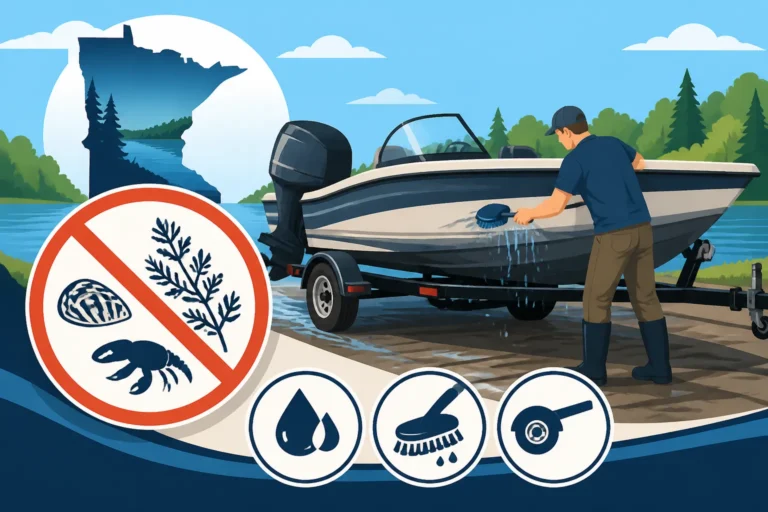
The DNR has become incredibly aggressive—and rightfully so—about preventing the spread of Zebra Mussels, Starry Stonewort, and Spiny Waterfleas. The Aquatic Invasive Species (AIS) Rules for Boaters section of the regulations PDF outlines exactly what you must do before leaving a boat ramp.
You must pull your drain plug, empty your livewell, and ensure no weeds are clinging to your trailer. Failure to follow the Minnesota AIS Drain Plug Law Explained can result in a hefty fine before you even get your boat on the highway. The PDF provides a checklist that is worth reviewing every season, as new infested waters are added to the list frequently.
Possession Limits vs. Daily Bags
This is perhaps the most misunderstood concept in Minnesota fishing. People often think they can catch their limit, eat them for dinner, and then go catch another limit the next day. While you can catch a "daily limit" each day, you can never have more than the "possession limit" in your physical control. This includes fish in your freezer at home, in your cooler at the cabin, or in your livewell.
The Minnesota Possession Limits Explained section of the PDF clarifies that if the limit for walleye is 6, and you have 4 in the freezer at your cabin, you can only legally keep 2 more today. Understanding Minnesota Fishing Limits: Bag & Possession (2026) is vital for multi-day trips to places like Lake of the Woods or the Rainy River. The PDF breaks down exactly how to "package" your fish for transport so that a CO can identify the species and count them accurately, which usually involves leaving a patch of skin on the fillet.
Summary of How to Use the PDF Efficiently
To make the most of the digital regulations, I suggest following this workflow every time you head to a new body of water:
- Open the PDF on your phone while you still have Wi-Fi or data.
- Use the search tool to find the name of the lake you are visiting.
- Check the "Special Regulations" section to see if your lake is listed.
- If it isn't listed, refer back to the "Statewide" limits for your target species.
- Double-check the "Zone Map" to ensure you know which Pike or Bass rules apply to your location.
By keeping the PDF handy, you aren't just following the law; you are participating in the conservation efforts that keep Minnesota a world-class fishing destination. It validates that you are a serious, respectful angler who cares about the longevity of our lakes. Whether you are chasing Mille Lacs Walleye Regulations (2026) or panfishing with the kids on a local metro pond, the data is all there in that one file.
Disclaimer
The information provided in this guide is for informational purposes only and is based on the most current data available at the time of writing. Fishing regulations in Minnesota are subject to change by the DNR and state legislature at any time. Always consult the official Minnesota Department of Natural Resources website and the most recent version of the Minnesota Fishing Regulations PDF before heading out on the water to ensure you are in full compliance with all current laws and local ordinances.