Dark House Spearing for Pike: How-To
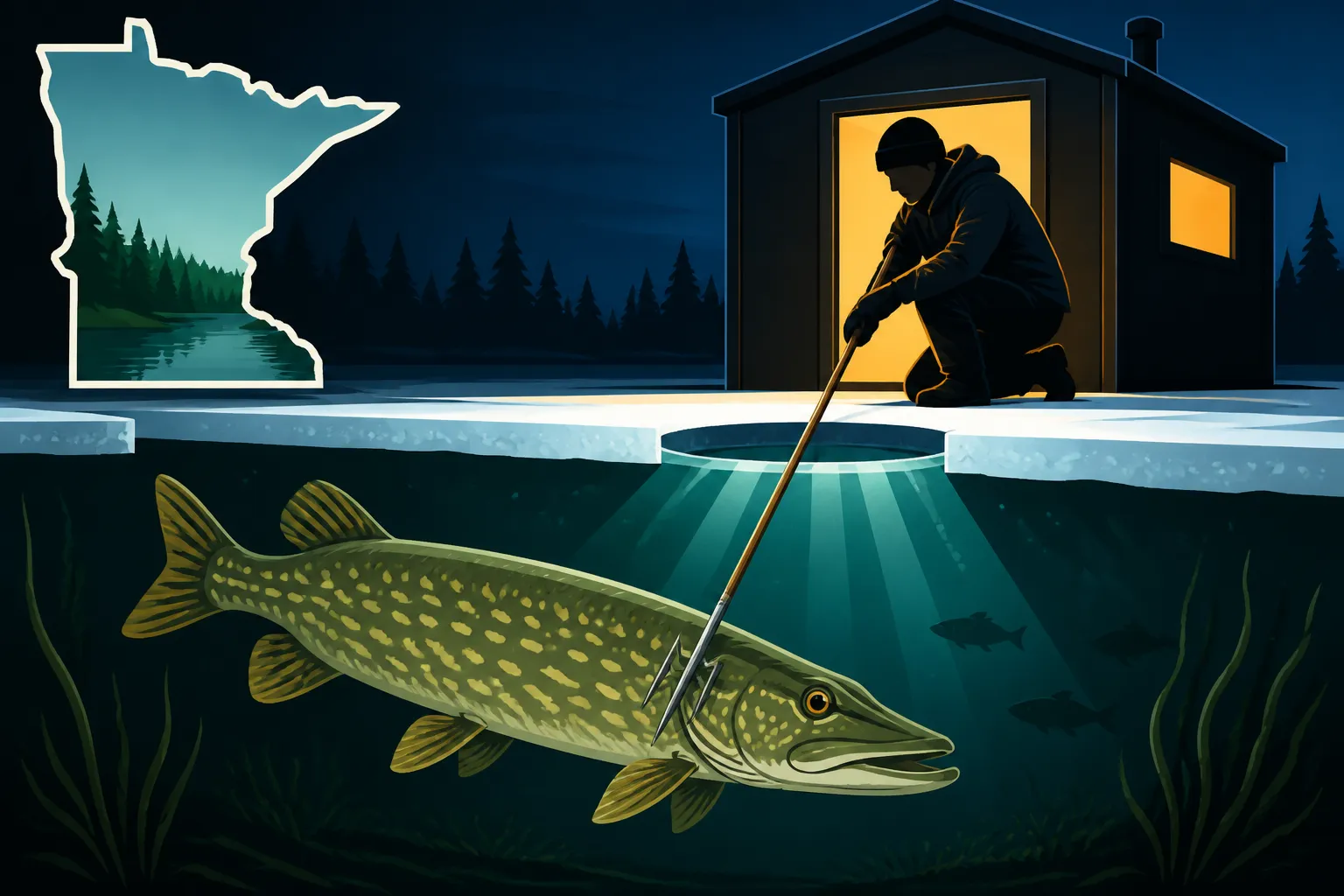
Sitting in a completely blacked-out shelter above a massive rectangle carved into frozen lake ice can feel eerie to the uninitiated, but dark house spearing for northern pike is one of Minnesota’s most thrilling winter traditions. The primary challenge beginners face is mastering the delicate balance of light control, decoy manipulation, and precise spear throwing while navigating complex state game laws. This guide provides a step-by-step masterclass on gear selection, location strategies, spearing techniques, and regulatory compliance to ensure your time on the ice is safe, legal, and successful.
Understanding the Dark House Spearing Setup
Dark house spearing relies on creating a dark chamber above clear ice so that ambient light penetrating the surrounding ice illuminates the water below. When light enters from beneath or around the hole while the interior of the shelter remains Pitch Black, the spearder looks down into a glowing aquatic stage.
To build this ideal environment, an angler needs specialized equipment designed specifically for winter spearing. Unlike standard ice fishing, where a small eight-inch auger hole suffices, spearing requires cutting large rectangular openings, managing heavy gear, and deploying oversized decoys that draw inquisitive northern pike directly beneath your feet.
The Anatomy of a Dark House Shelter
A dark house shelter must block out all external sunlight. Traditional dark houses were permanent wooden shacks painted black inside, but modern portable hub-style dark houses made with heavy-duty thermal canvas have largely taken over. These pop-up shelters feature heavy fabric skirts, blacked-in windows, and reinforced frames capable of standing up to bitter Northland winds.
When setting up a portable dark house, banked snow plays a critical role. Piling loose snow heavily along the outer fabric skirt prevents sunlight from bleeding under the edges, which would otherwise ruin your visibility into the water column. Any pinprick of light inside the shelter forces your eyes to adjust to the brightness, making it nearly impossible to spot a weed line or a cruising northern pike creeping in from the shadows.
Cutting the spearing hole requires care and the proper tools. Most spearers use a large ice saw or a specialized chain saw, often after drilling starter holes with an auger. To get gear delivered before the lakes freeze over, many anglers order heavy-duty ice saws and ice-clearing tongs through Amazon for fast home shipping. Once the ice block is cut, you either push it down under the ice sheet or pull it out using tongs, leaving a pristine window into the lake.
Essential Spearing Gear and Accessories
The center of your gear array is the spear itself. Traditional Minnesota spears feature four to seven steel tines equipped with sharp barbs that hold securely. The tines must be evenly spaced and heavy enough to drop straight through the water column without gliding or drifting to the side when released.
Connected to the top of the spear handle is a high-tensile braided spear line, usually constructed from thick nylon or Dacron. This line is secured directly to a structural pole inside the dark house or held coiled in hand. Never tie the line to your wrist, as an extraordinarily large fish or an unexpected slip on the ice could cause dangerous tangles or injury.
In addition to the weapon itself, every spearder needs an ice chisel, a heavy mesh skimmer to remove slush from the large spearing hole, and safety ice picks worn around the neck. Wearing high-grade personal protection like Best Ice Fishing Suits & Bibs (Float Suits) ensures warmth and provides crucial buoyancy should an accident occur near the edge of the large ice hole.
Choosing and Rigging Decoys
Decoys are the primary tool used to attract northern pike to your hole. They generally fall into two categories: artificial wooden or plastic carved decoys, and live bait rigs using suckers or chub. Artificial decoys feature adjustable fins that cause them to swim in broad, enticing circles when you gently pull and release the line.
Rigging an artificial decoy requires fine-tuning its balance point. Most decoys have line tie loops along their spine; tying your line forward makes the decoy nose-down, while tying further back forces the tail down. A perfectly balanced decoy sits level in the water and glides silently forward in a wide circle with every subtle twitch of the hand string.
When using live bait, spearers use a harness or a specialized single-hook rig attached to a live sucker minnow. The live bait provides natural movement, distress vibrations, and scents that can coax stubborn, pressure-wary pike into spear range when artificial decoys are ignored.
Note: Always clear away floating ice chips meticulously. Fine ice slush suspended in the spearing
hole refracts light, creating a cloudy haze that reduces underwater visibility by several feet.
Minnesota Spearing Regulations and Legal Preparation
Before heading onto frozen water with a spear, anglers must review local rules carefully. Minnesota has strict regulations governing legal species, shelter tagging, season dates, and zone-specific northern pike size regulations. Understanding these rules protects the fishery and keeps you on the right side of conservation officers.
For an overview of the legalities surrounding this traditional winter activity, check out our guide on Dark House Spearing in Minnesota: Rules & License.
Notice: Spearing rules vary significantly depending on whether you are on inland waters, border
waters, or specific designated muskie lakes where spearing is strictly prohibited.
Licensing Requirements and Legal Species
In Minnesota, residents and non-residents must hold a valid angling license in addition to a dark house spearing endorsement or license, depending on current state residency rules. Review the exact license structures using Minnesota Spearing License & Legal Species before making your trip to the bait shop or purchasing online.
It is critical to remember that spearing is primarily restricted to northern pike, rough fish like carp and suckers, and catfish in designated waters. Target species like walleye, largemouth bass, and muskellunge cannot be taken with a spear in Minnesota inland waters. Accidental strikes on game fish carry heavy fines and potential loss of equipment.
Misidentifying fish under the ice is a real hazard for beginners. Water refraction can distort fish size and subtle color patterns, so absolute certainty of species is mandatory before throwing the spear. If you cannot identify the fish creeping past your decoy with 100 percent certainty, keep the spear firmly in your hand.
Ice House Identification and Removal Rules
Any shelter left unattended on the ice—whether a sleeper house, a wooden dark house, or a pop-up shelter left overnight—must display proper identification. The owner’s Minnesota DNR license number or full name and address must be clearly painted or affixed to the exterior in weather-resistant lettering at least two inches high.
State regulations mandate strict deadlines for removing shelters from public waters as late winter approaches. These deadlines prevent sunken structures during early ice thaws and protect shoreline habitats. Make sure you are familiar with the seasonal deadlines outlined in Ice Shelter Removal Deadlines in Minnesota.
Leaving a dark house on the ice past the legal deadline can result in hefty recovery fees, citations, and impoundment of your house by local authorities. Keep track of spring weather patterns and ice conditions to remove your structure long before the ice becomes unsafe for vehicle or foot travel.
Zone Rules and Pike Slot Limits
Minnesota divides its northern pike management into three distinct zones: North, Central, and South. Each zone carries specific bag limits, possession rules, and slot limits designed to manage local pike populations effectively. Spearers must know which zone their chosen lake falls into, as a legal pike in one county might be illegal to take a few miles down the road.
Detailed breakdown of statewide harvest rules can be reviewed under Minnesota Northern Pike Limits by Zone. In many central and southern lakes, protected slot limits require releasing pike between 22 and 30 inches, or similar size bands designed to protect breeding females.
Critical Rule: Spearing is an absolute harvest method. Once a fish is struck with a spear, it
cannot be released. You must be completely sure the fish falls within legal size limits before
throwing.
| Zone / Fishery Category | Typical Daily Limit | Common Slot Limit Restrictions | Spearing Notes |
|---|---|---|---|
| North Zone | High bag limits (often 10) | Maximum 2 over 26 inches; all 22-26″ must be released | Excellent action for smaller eating-sized pike; deep clear lakes |
| Central Zone | Moderate limits (typically 3) | Protected slot: all 22-30″ must be released; 1 over 30″ allowed | High pressure area; careful size estimation is crucial |
| South Zone | Low limits (typically 2) | Minimum size limit (e.g., all kept must be over 24″) | Lower fish density, but high growth rates yield larger pike |
| Designated Muskie Lakes | Prohibited for Spearing | No spearing allowed for any species on these waters | Check DNR lake lists carefully before cutting a hole |
Location Strategy and Reading the Water
Success in dark house spearing is almost entirely determined by location. Unlike line angling where you can cast across wide areas or troll across open basins, spearing confines your vision to a single rectangular patch of water. Finding high-traffic pike corridors requires analyzing lake maps, bottom structure, and weed growth.
Northern pike are ambush predators that rely on cover and vision to stalk prey. Positioning your shelter where pike naturally hunt maximizes the number of fish that will swim through your field of view during a morning or afternoon soak.
Pro Tip: Scouting during open water in late autumn using side-imaging fish finders saves hours
of manual ice drilling. Mark green weed beds and sand-to-muck drop-offs on your GPS app.
Ideal Depths and Bottom Substrates
The most productive depth for dark house spearing typically ranges between 6 and 14 feet. In shallower water under 6 feet, pike can be skittish, and your spear may hit the bottom sand or rock before reaching full momentum. In water deeper than 15 feet, ambient light decreases, making it harder to spot fish cruising near the bottom substrate.
Seek out broad sand flats that transition into soft muck, or locate the edges of cabbage and coontail weed beds. Green, living weeds produce oxygen and host small panfish, yellow perch, and minnows—the primary food source for winter pike. Setting up right on the outer edge of a live weed bed creates a natural highway for cruising predators.
Hard sand bottoms provide excellent contrast for visual spearing. Against a light sand bottom, the dark green pattern of a northern pike stands out clearly. If your lake bottom consists of dark brown muck or rotting vegetation, consider spreading a thin layer of clean white gravel or laying down a white plastic sheet along the lake floor to make approaching fish easier to see.
Water Clarity and Visual Depth
Water clarity dictates how effectively you can hunt in a dark house. Lakes plagued by heavy summer algae blooms or dark tannin stain make visual spearing difficult. Choose clear, spring-fed lakes or glacial sand lakes where underwater visibility exceeds 8 to 10 feet during midwinter.
Snow cover on top of the lake ice affects clarity inside the house as well. A heavy blanket of snow blocks sunlight from penetrating the ice sheet surrounding your house, making the water beneath your shelter appear darker. Clearing snow off a 10-foot perimeter around your dark house allows ambient light to filter down through the ice, illuminating the underwater terrain like a skylight.
Keep your spearing hole completely clear of slush, foam, and debris. Any floating particulate reflects what little ambient light exists inside the dark house, obscuring your target. Use a fine mesh skimmer every 30 minutes to clean the surface of the water column thoroughly.
Seasonal Pike Movements Under Ice
Early ice is widely considered the prime period for dark house spearing. As ice forms across shallow bays, northern pike remain active in shallow weed beds, feeding heavily on remaining forage fish. During this period, fish move frequently, and depths of 6 to 10 feet yield high encounter rates.
As winter deepens into January and February, decaying vegetation consumes dissolved oxygen in shallow bays, driving forage fish and northern pike toward deeper weed edges, primary points, and sunken islands. Adjusting your location outward to 12 or 14 feet along main-lake drop-offs keeps you in contact with moving fish.
Late ice brings a resurgence in shallow-water activity. As melting snow drains oxygenated water into shallow bays, pike begin staging near mouth entrances, creek inflows, and shallow marshes in preparation for the spring spawn. Returning to shallow flats during late season can produce views of large fish.
Seasonal Insight: During midwinter cold fronts, pike often sit motionless on the lake floor for
hours. Gentle, slow decoy movement is required to trigger a curiosity response from dormant fish.
Execution and Technique: Calling and Throwing the Spear
Spearing northern pike is an art form that demands steady nerves, precise physical control, and deep patience. Watching a large pike emerge from the gloom, hold perfectly motionless beneath your decoy, and track your movements is an adrenaline-filled experience that tests even veteran outdoorsmen.
Understanding how pike react to motion, sound, and decoy presentation allows you to guide the fish into the optimal target zone directly under your feet before making the strike.
Masterful Decoy Management
The key to successful decoying is subtlety. Beginners often over-work their artificial decoys, violently yanking the string and making the decoy dart erratically. This aggressive action frequently spooks winter pike, sending them darting back into deep water.
Begin by dropping your decoy to within two or three feet of the lake bottom. Pull the line up smoothly by six to twelve inches, then allow the decoy to glide forward on its fins in a wide, sweeping circle. As the decoy glides, slowly yield string back to it. The motion should look like an injured or curious panfish lazily exploring the area.
- Lower the decoy gently to your desired operational depth, keeping it suspended at least two feet off the bottom substrate.
- Impart a smooth, steady upward pull of 6 to 10 inches on the hand line to initiate forward momentum.
- Release tension on the string, allowing the curved tail and side fins of the decoy to steer it in a smooth, continuous circle.
- Pause for 15 to 30 seconds between motion cycles, letting the decoy sit motionlessly suspended to entice cruising fish.
- If a pike approaches, reduce your movement speed immediately; slowly raise the decoy higher in the water column to draw the fish closer to the ice surface.
When a pike appears, stay completely still. Slowly guide the decoy upward toward the hole. Pike almost always follow the decoy as it rises, bringing the fish into closer range and creating a safer, more accurate angle for the spear throw.
Aiming and Throwing Mechanics
Throwing a spear at a fish submerged underwater requires accounting for optical refraction. Light bends as it passes from the air into the water, making the fish appear slightly higher and further away than it actually is. To compensate, always aim slightly below the target area.
Hold the spear immersed in the water column at all times if possible, or lower it slowly into the water before making your strike. Splashing the surface of the water when throwing sends a shockwave through the water column that causes the fish to react and dart away before the spear arrives.
Safety First: Keep your feet well clear of the edge of the ice hole. Wet ice around the hole
inside a dark house is extremely slippery; wear rubber-cleated boots for firm traction.
Aim for the shoulders just behind the gill plates. A strike in this dense muscular region anchors the fish immediately, preventing thrashing that could injure the fish or allow it to slip off the barbs. Never target the soft stomach area or tail, as tines can pull out easily from soft flesh.
Push or guide the spear toward the fish rather than throwing it like a javelin. With the spear tip already submerged a few inches below the surface, thrust smoothly down through the water column, allowing the weight of the heavy steel head to drive the tines deep through the fish. Maintain firm control of the spear rope with your non-dominant hand.
Safe Fish Handling and Harvesting
Once the spear connects, keep firm, upward tension on the spear rope. Do not pull violently; retrieve the line smoothly while keeping the spear vertical in the water column to prevent the fish from leveraging itself off the barbs.
Guide the fish up through the rectangular hole onto the ice sheet inside your house. Place your hand carefully behind the gill covers or secure the fish with a soft lip grip to control thrashing. Be extremely cautious around the northern pike’s sharp teeth and the razor-sharp edges of your spear tines.
Once secure, dispatch the fish humanely using a blunt tool, then immediately store it on clean ice outside your shelter to keep the meat fresh. Northern pike yield firm, delicious fillets when properly processed. Learning the technique to remove the Y-bones ensures bone-free meals for the table.
For detailed cleaning instructions, check out How to Fillet a Northern Pike (Remove Y-Bones) and learn more about their culinary value in Are Northern Pike Good to Eat? (Y-Bones Explained).
Comparing Spearing Gear and Traditional Angling Setups
Choosing between dark house spearing and traditional hook-and-line winter angling comes down to personal preference, target goals, and strategy. Both approaches have unique benefits and challenges on frozen Minnesota lakes.
While traditional anglers deploy tip-ups across broad lake flats, spearers invest in localized, highly visual hunting setups. Understanding how these approaches differ helps anglers choose the right method for their winter adventures.
If you are curious about combining both tactics on your winter trips, review our guide on How to Set Up Tip-Ups for Pike.
Dark House Spearing vs Tip-Up Fishing
Tip-up fishing is an active angling strategy spread across wide areas. An angler can set multiple tip-ups along a weed line, covering hundreds of yards of structure. When a pike strikes a live bait rig on a tip-up, a flag pops up, prompting the angler to run over and set the hook manually.
In contrast, dark house spearing is an intimate, localized hunting experience. You see every underwater detail in real time—panfish swimming past, weeds swaying in the current, and predators stalking your decoy. You witness the exact second a pike decides to strike, adding unmatched anticipation to the process.
| Feature / Metric | Dark House Spearing | Tip-Up Angling |
|---|---|---|
| Area Coverage | Fixed single location; limited to ice hole size | Broad coverage; multiple holes across acres of structure |
| Visual Engagement | High; direct visual observation of fish underwater | Low to Moderate; limited to watching flags pop up |
| Selectivity | Extremely high; pick exact fish size before harvest | Low; fish swallows hook before size can be confirmed |
| Gear Mobility | Lower; heavy canvas hub, snow banking, ice saws required | High; lightweight auger, tip-ups, bucket tackle |
| Cold Weather Comfort | High; heated, wind-protected dark chamber | Variable; exposed to wind and cold while checking flags |
| Catch and Release | Not possible once fish is speared | Possible with proper circle hooks and quick handling |
Wooden Decoys vs Plastic Decoys
Carved wooden decoys have been the gold standard in Minnesota dark house spearing for over a century. Wood provides a warm, classic aesthetic, and custom wood carvers build decoys with fine weight distribution. However, wooden decoys require metal ballast weights poured into their bellies to sink properly, and improper drying can cause paint to peel or wood to crack over time.
Plastic and resin decoys offer incredible durability, uniform buoyancy, and lower cost points. They withstand impacts with ice walls and spear tines without losing structural integrity. Many spearers order affordable molded plastic decoys and decoy tuning tools through Amazon to quickly build out a functional winter tackle kit without spending hundreds on custom wooden art pieces.
When deciding between decoy materials, consider whether you value traditional craftsmanship and unique swimming actions, or durability and budget-friendly utility. Keeping a mix of both in your gear box ensures you have options for changing light levels and fish moods under the ice.
Decoy Tuning Tip: Test new decoys at home in a full bathtub or livestock tank before taking them
onto the lake. Adjust the metal tail fins slightly using needle-nose pliers until the decoy floats
level and glides smoothly in consistent circles.
Power Equipment Choices: Augers vs Saws
Cutting a spearing hole requires moving significant volumes of ice. While a standard eight-inch ice hole involves removing a small cylinder of ice, a three-by-four-foot spearing hole involves removing hundreds of pounds of solid frozen surface.
Using a heavy manual ice saw paired with a starter auger hole remains an efficient, quiet way to cut clean rectangles. Power ice augers are used to drill a series of overlapping holes around the perimeter, or to drill corner posts before sawing out the block edges. If you need to upgrade your drilling setup, consult our comprehensive guide on Best Ice Augers for Minnesota: Electric vs Gas.
- Mark out your desired rectangular hole dimensions on the bare ice sheet using an ice chisel or toe line.
- Drill starter holes in each of the four corners of your marked rectangle using your ice auger.
- Insert an ice saw blade into a corner starter hole and cut slowly along the scored line toward the adjacent corner.
- Repeat the sawing process along all four sides until the large ice block floats freely within the cut frame.
- Push the heavy floating ice block underneath the surrounding ice sheet using a heavy chisel, or hoist it completely out of the hole using heavy ice tongs.
- Skim out all remaining floating ice chips, slush, and surface foam using a mesh skimmer until the water column is crystal clear.
Once your hole is cleared, your dark house positioned, and your banking complete, you are ready to drop your decoy, lower your spear into the water, and take part in one of the Northland’s oldest and most rewarding outdoors traditions.
Disclaimer
This article is for general informational purposes only and does not constitute professional advice. Laws, prices and regulations vary by location and change over time. Consult a qualified professional for guidance on your specific situation.