Fall Walleye Fishing: Turnover & Cold Water
Every year, Minnesota anglers face the same frustrating wall: the lake was on fire in September, but suddenly the water turns murky, the weeds die off, and the walleyes seem to have vanished into thin air. This guide solves the mystery of the dreaded fall turnover and provides a roadmap for finding and catching cold-water walleyes during the most challenging yet rewarding season of the year.
Understanding Lake Turnover: The Great Fall Reset
The phenomenon of lake turnover is perhaps the most misunderstood event in the Minnesota fishing calendar. Many anglers treat it like a localized myth, but it is a physical reality dictated by the unique density of water. During the summer, our lakes stratify into layers. You have the warm, oxygen-rich epilimnion on top and the cold, often oxygen-depleted hypolimnion on the bottom, separated by a sharp temperature change called the thermocline. As the autumn air cools, the surface water temperature drops. When that surface water hits approximately 39 degrees Fahrenheit—the point where water is at its heaviest and densest—it begins to sink.
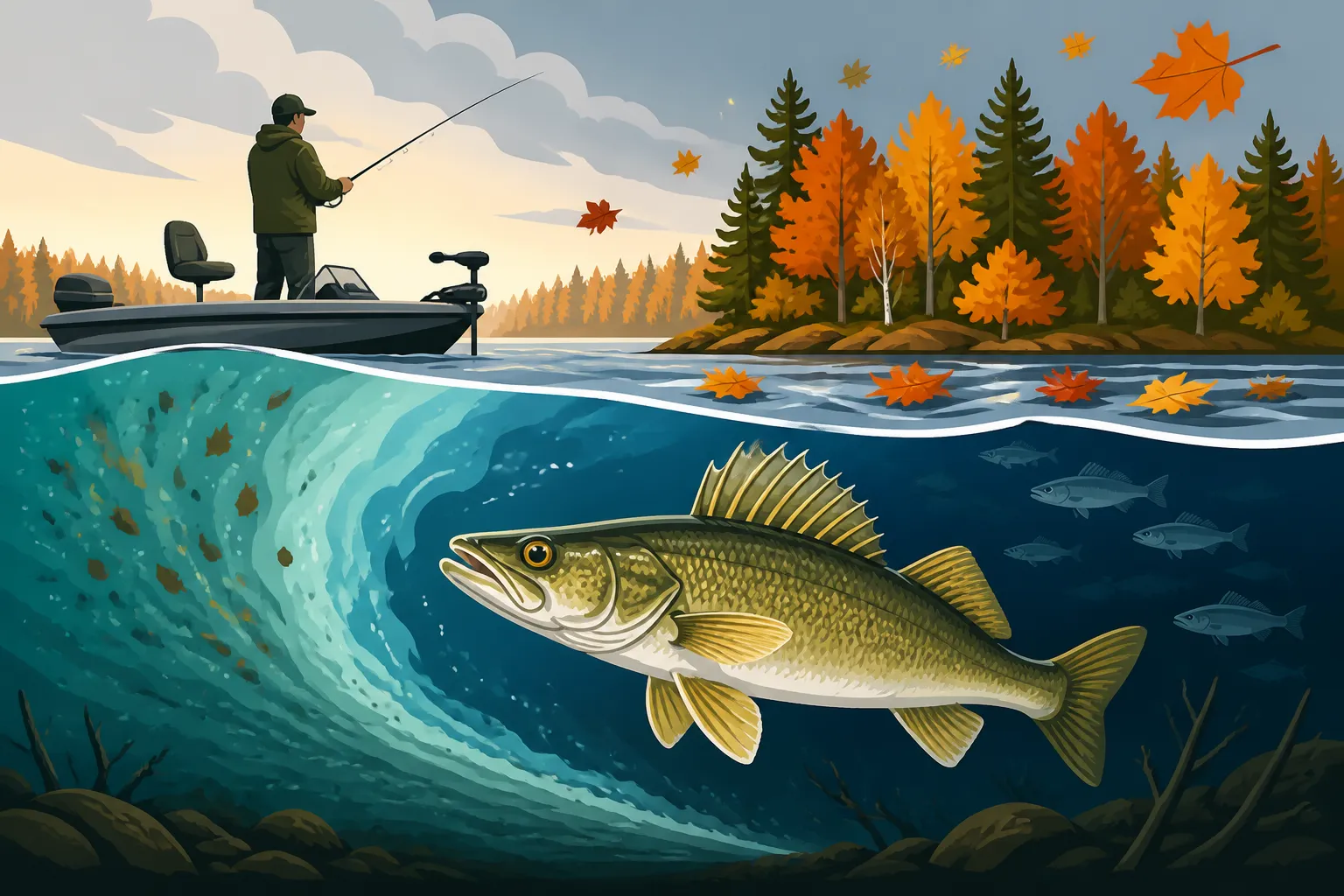
This sinking action forces the warmer, less dense water from the depths to rise. The result is a literal "turning over" of the entire water column. For a few days, the lake becomes a chaotic soup of decaying vegetation, sediment, and inconsistent oxygen levels. This is why your favorite mid-summer humps suddenly go dormant. The fish aren't just moody; their entire environment has been physically upended, and they often suspend or move to temporary holding areas to recalibrate their internal systems.
The Science of Density and Temperature
To truly master the Best Seasonal Pattern for Walleye in Minnesota, you have to think like a hydrologist. Water is one of the few substances that becomes less dense as it freezes, but its peak density is just above freezing. In the fall, as the wind whips across lakes like Mille Lacs or Winnibigoshish, it accelerates the cooling of the surface. Once the surface water matches the temperature of the deep water, the stratification breaks down. The wind then acts as a giant spoon, mixing the lake from top to bottom.
During this period, you might notice the water looks "dirty" or has a yellowish-brown tint. This is because the turnover is pulling up dead organic matter from the lake floor. For walleyes, this is a stressful transition. Their metabolism begins to slow down as the water temps drop from the 60s into the 40s. They don't need to eat as often as they did in July, but when they do eat, they want a substantial meal to carry them through the coming winter. Understanding this metabolic shift is the first step in adjusting your presentation.
Identifying When Turnover Is Happening
How do you know if your lake is turning over? The most obvious sign is the visual state of the water. If you see clumps of black, decaying weeds floating on the surface and the water clarity has dropped from ten feet to two feet overnight, you are likely in the thick of it. Another tell-tale sign is the smell. Turnover often releases gasses trapped in the bottom sediment, giving the lake a faint "swampy" or sulfur-like odor.
Check your electronics constantly. If you notice that the sharp thermocline line you saw on your sonar all summer has disappeared and the temperature is uniform from the surface down to 30 feet, the turnover has occurred. Generally, in Northern Minnesota, this happens in late September or early October, while Twin Cities metro lakes might not turn over until late October or even early November. Knowing the Minnesota Fishing Seasons & Opener Dates (2026) can help you plan your trips around these volatile windows to ensure you aren't hitting the water at the worst possible moment.
How Turnover Affects Walleye Behavior
During the actual turnover, walleyes often become "displaced." Because oxygen is now uniform throughout the lake, they aren't restricted to the upper layers anymore. They can be anywhere from 5 feet to 50 feet deep. This lack of structure-dependence makes them incredibly hard to pin down. Many veteran sticks will tell you that the fish often suspend in the middle of the water column over deep basins, gorging on pelagic baitfish like ciscoes or tullibee that are also reacting to the temperature change.
The good news is that once the turnover settles—usually within 5 to 7 days—the fishing can become legendary. The water clears, the fish stabilize, and they begin to congregate in predictable "wintering holes." This is when you can see some of the biggest fish of the year caught. If you are struggling to find fish during the turnover, it’s often best to switch to a different lake. Smaller, shallower lakes often turn over earlier and faster than deep, sprawling lakes. If the big lake is a mess, head to a 500-acre basin that has already stabilized.
Location Strategies for Cold Water Success
Once the lake has settled, the hunt begins. The "green weeds" rule is the most important concept in fall fishing. As the water cools, most aquatic vegetation dies, robs the water of oxygen, and becomes a "dead zone" for fish. However, certain patches of cabbage or coontail will remain green and healthy much longer than the rest. These patches are oxygen factories and magnets for perch and shiners. If you find the last remaining green weeds in a bay, you have found the walleyes.
Beyond the weeds, you need to look for steep transitions. In the summer, walleyes might linger on sprawling flats, but in the fall, they prefer the efficiency of a steep drop-off. They want to be able to move from 15 feet to 30 feet with minimal effort. Look for "points on points"—small secondary points that jut out from a major underwater peninsula. These are the ambush spots where a hungry walleye will sit and wait for a school of baitfish to be pushed past by the wind.
Finding Green Weeds in a Dying Landscape
Finding these elusive green patches requires a mix of high-end electronics and old-school observation. On your side-imaging sonar, green weeds will appear crisp and standing upright, whereas dying weeds look like collapsed, fuzzy piles on the bottom. If you don't have fancy electronics, look at your lure. If you snag a piece of weed and it’s bright green and crisp, stay in that area. If it’s brown, slimy, and breaks apart easily, move on.
On lakes like Leech Lake or Lake Bemidji, these green weed beds are often located in areas with slightly more current or near underwater springs where the water temperature stays just a bit more stable. Walleyes will often bury themselves inside these weed edges during the day and move to the tops of the weeds during the low-light periods. Using a Slip Bobber & Crawler Harness for Walleye approach can be a great way to pick fish out of these tight windows without constantly snagging the vegetation.
Transitioning to Steep Breaks and Hard Bottoms
As the water temperature dips below 45 degrees, the weed bite usually dies out completely, and the fish move to "hard bottom" transitions. This usually means areas where the lake floor switches from soft muck to gravel, rock, or compacted sand. Walleyes love these areas because they are often home to crayfish and bottom-dwelling forage. More importantly, these hard bottoms are usually found on the edges of deep basins where the fish will eventually spend the winter.
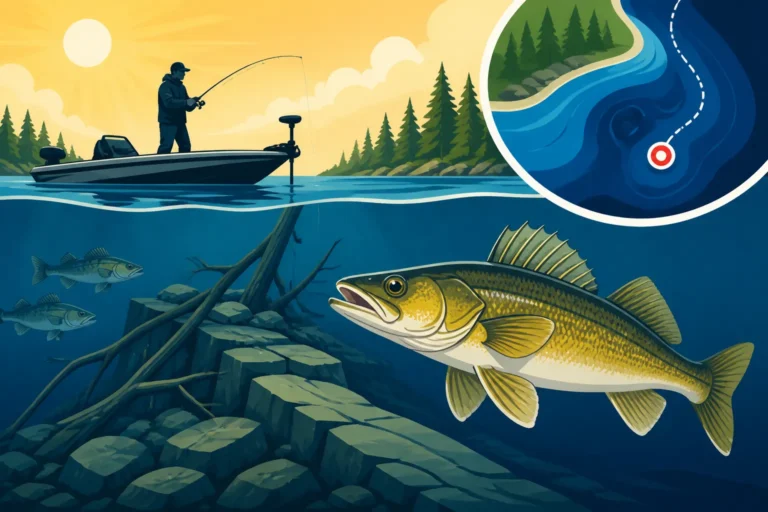
Target the base of the "first break." This is the first significant drop-off from the shoreline or a major reef. In many Minnesota lakes, this break occurs between 18 and 26 feet of water. Use your mapping software to find where the contour lines are closest together. This indicates a "cliff" underwater. Position your boat in the deep water and cast up into the shallow part of the break, dragging your jig down the face of the slope. This is a classic How to Catch Walleye in Minnesota (Step by Step) tactic that works year after year.
River Walleye: The Fall Migration
If the lake bite is too inconsistent, it’s time to head to the rivers. The Mississippi, St. Croix, and Minnesota Rivers see a massive influx of walleyes in the fall. These fish migrate upstream from larger reservoirs or downstream from smaller lakes to find deep wintering holes and eventually congregate near spawning dams for the following spring. River fishing in the fall is often more predictable because the fish are confined to the river channel.
Look for "holes" in the river—areas where the depth might drop from 10 feet to 20 feet. Walleyes will sit on the leading edge of these holes, waiting for minnows to wash over the lip. They also love "wing dams," which are man-made rock structures used to direct current. The slack water created behind a wing dam is a perfect resting and feeding spot for a cold-water walleye. If you are new to this, checking a Lake Pepin Fishing Report & What's Biting can give you a great starting point for river-run walleyes in the southern part of the state.
Tactical Shifts: Lures and Presentations for the Chill
In the summer, speed is your friend. You might troll crankbaits at 2.5 mph to trigger a reaction strike. In the fall, you need to slow down and "bulk up." As the water cools, a walleye’s digestive system slows, meaning they want a meal that is worth the energy expenditure. This is the season of the "big minnow." While a 3-inch fathead worked in June, a 5-to-7-inch redfin shiner or a large sucker minnow is often required to get a bite in October.
Verticality becomes the name of the game. As fish cluster on deep structure, hovering directly over them with a jig and minnow is the most effective way to stay in the "strike zone." This is also the time to break out the heavy metal—blade baits and jigging raps. These lures create a lot of vibration and flash, which can trigger a predatory response even from a lethargic fish.
The Power of Large Plastic Swimbaits
While live bait is king in the fall, large plastic swimbaits have become a "secret weapon" for many Minnesota pros. A 4-inch or 5-inch paddle tail swimbait on a 3/8 oz jig head allows you to cover water quickly and presents a profile that looks like a dying tullibee or a large perch. The key is the "thump." You want a plastic that has a heavy tail kick even at very slow speeds.
When fishing swimbaits, use a "lift and drop" retrieve. Throw it out, let it hit the bottom, and then slowly lift your rod tip to about 11 o'clock. As you lower the rod, keep a slightly taut line so you can feel the "tick" of a walleye hitting it on the fall. This technique is especially effective on the Mille Lacs Lake Fishing Report & What's Biting during those gray, windy October days when the fish are aggressive and shallow.
Jigging with Meat: The Fathead and Shiner Advantage
There is something about the smell and action of a real minnow that plastics just can't replicate in 40-degree water. In the fall, go to the bait shop and ask for "extra large" fatheads or, if you can find them, "blues" (spottail shiners). Hook the minnow through the mouth, out the gill, and then through the back to ensure it stays on during long casts. This is often referred to as "meat fishing."
The cadence should be subtle. Instead of the aggressive snapping motion you use in the spring, try "dragging" the jig. Move the boat slowly with your trolling motor and let the jig drag along the bottom, occasionally giving it a tiny hop. This keeps the bait in the fish's face for a longer period. If the bite is particularly light, consider using a How to Use a Slip Bobber for Walleye & Crappie setup with a large leech or minnow suspended just six inches off the bottom.
Slow-Rolling Crankbaits for Tardy Biters
Trolling doesn't end when the leaves turn color, but the strategy changes. Night trolling for walleyes in the fall is a legendary Minnesota pastime. As the sun goes down, large walleyes move into the shallows (3 to 6 feet) to hunt. Use a shallow-running, long-body crankbait like a Rapala Original Floater or a Smithwick Rogue.
The secret is speed—or the lack thereof. You want to troll as slowly as your motor will allow, often between 0.8 and 1.2 mph. This gives the lure a wide, lazy wobble that mimics a cold, disoriented baitfish. Many anglers use their electric trolling motors to achieve these "snail's pace" speeds. You can find many of these lures and even small trolling motor accessories on Amazon to help fine-tune your slow-trolling game. This is the best way to target the Minnesota State Record Walleye class of fish that roam the shallows under the harvest moon.
Fall Walleye Tactics Comparison Table
| Presentation | Best Depth | Water Temp | Key Benefit |
|---|---|---|---|
| Jig & Large Minnow | 18 – 30 ft | 40 – 50°F | Maximum scent and natural action for neutral fish. |
| Heavy Blade Baits | 25 – 40 ft | 38 – 45°F | Fast drop rate and high vibration to trigger reaction. |
| Shallow Crankbaits | 3 – 8 ft | 42 – 55°F | Best for night fishing and aggressive shallow feeders. |
| Large Swimbaits | 10 – 20 ft | 45 – 60°F | Covers water quickly and mimics large fall forage. |
| Vertical Jigging Raps | 20 – 35 ft | 35 – 45°F | Pinpoint accuracy for fish spotted on electronics. |
Mastering the Mental Game and Safety
Fall fishing in Minnesota is not for the faint of heart. It requires a level of mental toughness that summer fishing simply doesn't demand. You will deal with freezing spray, numb fingers, and days where you don't get a single bite for six hours, only to have a 15-minute window where three 28-inch fish hit the deck. Staying focused during those "dead" hours is what separates the veterans from the amateurs.
Safety is also a paramount concern. Falling into 70-degree water in July is an inconvenience; falling into 42-degree water in October is a life-threatening emergency. Cold water shock can incapacitate a person in seconds. Always wear a life jacket, and tell someone exactly where you are going. The fall is also when we see the Minnesota Ice Fishing & Shelter Rules start to become relevant as people prep for the transition, but the "open water" safety rules are just as critical right now.
Weather Windows: When to Be on the Water
In the fall, the "bluebird" days with clear skies and no wind are often the worst for fishing. The fish become spooked by the high light penetration in the cooling, clearing water. The best days are the ones that look the most miserable: overcast skies, a "walleye chop" on the water, and a steady barometric pressure. If a cold front is moving in, the 24 hours immediately preceding the front are often the most productive of the entire year.
Pay attention to the wind direction. A north wind in October usually brings a sharp drop in air temperature, which can shut down the bite. However, a steady south or west wind will push the warmer surface water and the baitfish toward the windward shorelines. These "pushed" areas are prime spots to hunt for active fish. Use weather apps and check the Lake Winnibigoshish Fishing Report & What's Biting to see how local conditions are affecting the movement of the schools.
Staying Warm and Dry for Extended Sessions
You cannot fish effectively if you are shivering. Investing in high-quality gear is the best way to extend your season. Layering is essential: a moisture-wicking base layer, a heavy fleece mid-layer, and a windproof/waterproof outer shell. Many anglers find great deals on high-quality merino wool socks and thermal liners on Amazon that can make a world of difference when the floor of the boat turns into an ice skating rink.
Don't forget your hands. Neoprene gloves are great for handling fish, but they can be cumbersome for casting. Many pros wear "fingerless" wool gloves with a fold-over mitten. Keep a couple of chemical hand warmers in your pockets to thaw out your fingers after releasing a fish. If you are comfortable, you will stay on the water longer, and in fall fishing, "time on water" is the biggest factor in success.
Essential Cold-Water Safety Gear
Beyond a PFD (Personal Flotation Device), you should carry a "dry bag" in your boat. Inside this bag, keep a full change of dry clothes, a space blanket, and a way to start a fire. If you or a partner gets wet, getting out of the wet clothes and into dry ones is the only way to stop hypothermia from setting in.
Check your boat's battery health before heading out. Cold weather is brutal on marine batteries, and the last thing you want is a dead engine five miles from the landing in a gale-force wind. It's also wise to carry a heavy-duty anchor with plenty of rope. If your motor fails, an anchor will keep you from being swept into dangerous rocks or out into the middle of a massive lake like Lake of the Woods Fishing Rules & Limits dictate for those big-water environments.
Gear Maintenance and Preparation for the Freeze
As the season winds down, your gear takes a beating. The sand and grit from fall boat ramps can get into your reel bearings, and the freezing temperatures can cause braided lines to hold water and freeze to your spool. This is the time to be meticulous with your maintenance. After every trip, wipe down your rod guides to ensure there isn't a build-up of ice that could fray your line.
This is also the transition period where you should start thinking about your Minnesota Ice House License & Rules if you plan on staying out once the hard water arrives. But before the lakes freeze, take the time to organize your tackle. Swap out the summer's rusted hooks for fresh ones. You can find bulk packs of high-quality treble hooks and split rings on Amazon to ensure that when that trophy walleye finally bites, your equipment doesn't fail you.
Choosing the Right Line for Cold Water
Not all fishing lines are created equal when the mercury drops. Monofilament has a lot of "memory," meaning it will stay in the shape of the spool (coiling) more intensely in cold weather. Fluorocarbon is better for invisibility in the clear fall water but can be brittle. Many Minnesota anglers prefer a high-quality braided line with a fluorocarbon leader.
The braid doesn't stretch, which is vital for feeling the light "thud" of a cold-water walleye. However, standard braid can absorb water and freeze. Look for "coated" braids that are specifically designed to shed water. If you are fishing in sub-freezing temperatures, you might even consider a specialized "ice braid" even while you are still in the boat. This level of detail is what you'll find in a comprehensive Walleye Fishing Techniques: Complete Minnesota Guide that covers the transition from boat to bucket.
Boat Care in the Danger Zone
One of the most common mistakes Minnesota boaters make in the fall is forgetting to drain their livewells and lower units. If water stays in your motor's cooling system and freezes overnight, it can crack the block or the lower unit housing. Always trim your motor all the way down after pulling the boat out of the water to let every drop of water drain out.
Similarly, be hyper-vigilant about Aquatic Invasive Species (AIS) Rules for Boaters. In the fall, certain invasive species like zebra mussels are looking for places to cling to for the winter. Drying your boat is harder in 40-degree weather than it is in July, so use a towel to manually dry the hull and the bilge area. Staying compliant not only protects our 10,000 lakes but also saves you from a very expensive ticket at the boat ramp.
Minnesota Fishing Regulations Disclaimer
The information provided in this guide is for educational and informational purposes only. Minnesota fishing regulations, including bag limits, size restrictions, and season dates, are subject to change by the Minnesota Department of Natural Resources (DNR) at any time. Always consult the most current version of the Minnesota Fishing Regulations booklet or the official DNR website before heading out on the water. Specific lakes, such as Mille Lacs or Red Lake, often have "special regulations" that differ from statewide rules. It is the responsibility of the individual angler to know and follow all local, state, and federal laws. Failure to comply with these regulations can result in significant fines, loss of fishing privileges, and seizure of equipment. Stay safe, be respectful of our natural resources, and tight lines.