How Many Lines Can You Use Ice Fishing in Minnesota?
Imagine you are sitting in your wheelhouse on a frozen Mille Lacs, the heater is humming, and you have your favorite jigging rod in hand. You look at the empty corner of the hole and wonder if you can legally drop a second line—or perhaps even a third—to increase your chances of seeing a walleye on your flasher. Understanding the specific line limits in Minnesota is a common source of anxiety because the rules change the moment the lakes freeze over, and getting it wrong can lead to a frustrating encounter with a conservation officer. This guide breaks down exactly how many lines you can use and the nuances of the "attendance" rule to keep your fishing trip stress-free.
The Fundamental Two-Line Rule for Minnesota Ice Anglers
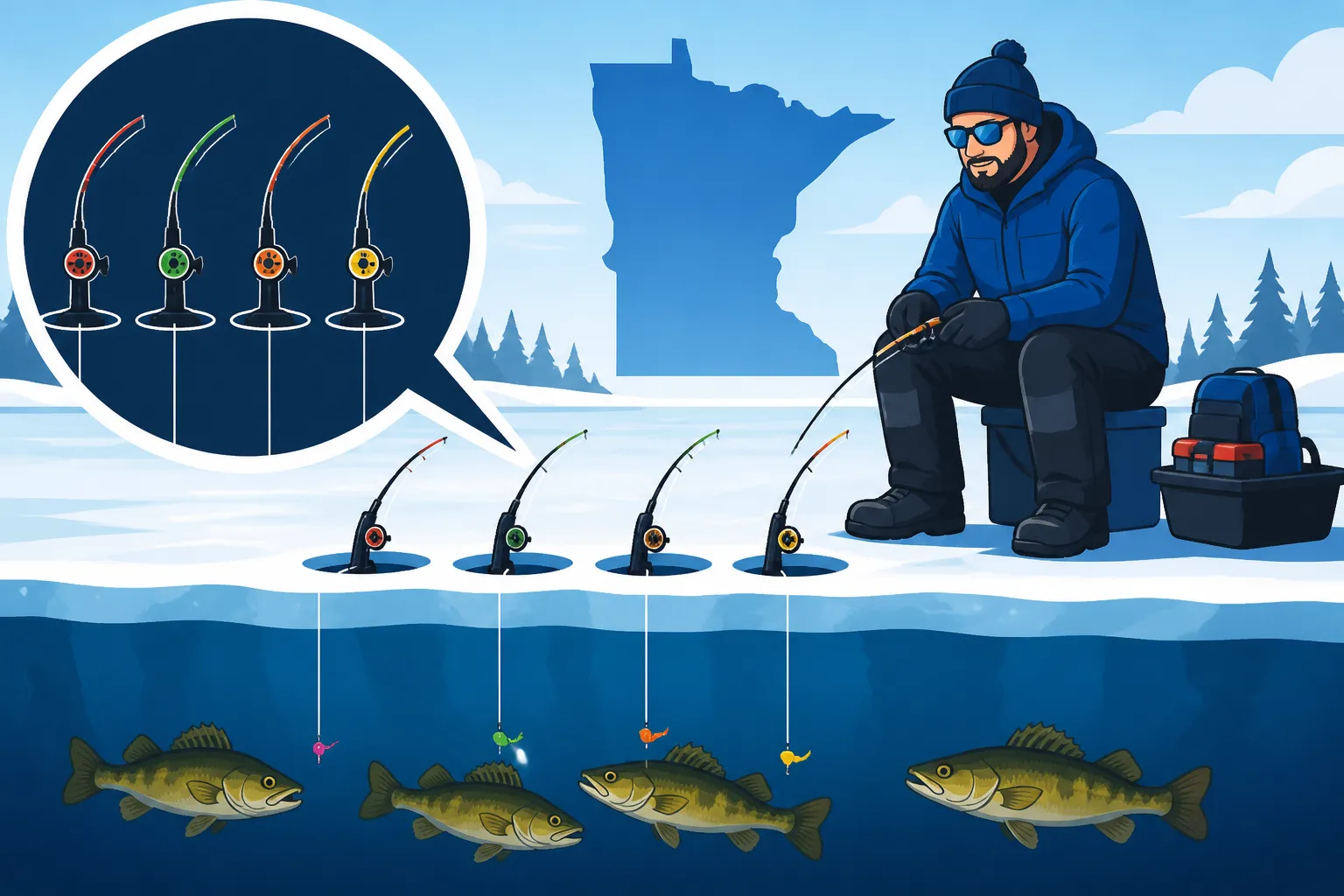
For the vast majority of people heading out to any of the 10,000+ inland lakes in our state, the magic number is two. While summer anglers are strictly limited to a single line in most inland waters, the Minnesota Department of Natural Resources (DNR) grants an exception once the ice takes hold. This allowance is a nod to the fact that ice fishing is inherently more stationary and challenging than open-water fishing. By allowing two lines, the state gives you a better opportunity to "pattern" the fish—perhaps using one line for an aggressive jigging presentation and the other as a passive "deadstick" with a live minnow.
However, it is vital to remember that this "two-line" rule applies specifically to "inland" waters. If you are fishing a lake that doesn't share a border with another state or province, you are capped at two lines per person. I have seen plenty of folks get turned around thinking that because they have a family of four in the shack, they can spread ten lines across the ice. It is a per-angler limit, and each person must be actively responsible for their own gear. If you are curious about how this compares to summer rules, you can look into How Many Lines Can You Fish in Minnesota? for a broader perspective on seasonal changes.
The definition of a "line" is also something that trips up beginners. In the eyes of the law, a line is any string or cord equipped with a lure or bait and intended to catch fish. It doesn't matter if it is attached to a high-end carbon fiber rod or a simple wooden tip-up. If it is in the water and has a hook on the end, it counts toward your two-line limit. This includes setups like the popular rattle reels found in many permanent ice houses. If you have two rattle reels down, you cannot legally hold a jigging rod in your hand.
The Logic Behind the Seasonal Increase
You might wonder why the state allows two lines in the winter but only one in the summer. The primary reason is efficiency and the "reach" of the angler. In the summer, a boat can cover miles of water, trolling lures or casting into weed beds. In the winter, you are limited to the diameter of the hole you drilled. To compensate for this lack of mobility, the two-line rule helps anglers cover a slightly larger vertical or horizontal area. It allows you to experiment with different depths or bait types simultaneously, which is often necessary when the fish are lethargic in the sub-freezing water.
Many veteran anglers use this to their advantage by placing one line in the "strike zone" near the bottom and another a few feet higher. On lakes like Leech Lake or Lake Winnibigoshish, walleyes often cruise at different depths depending on the time of day. Having that second line allows you to intercept fish that might be swimming right over the top of your bottom-bound jig. For more on specific lake rules, check out the Leech Lake Fishing Rules & Limits to see how these regulations play out on the water.
Managing Two Lines Effectively
Just because you can use two lines doesn't always mean you should if you aren't prepared to manage them. Things can get chaotic quickly if you hook into a big northern pike on your jigging rod while your tip-up flag pops twenty feet away. Effective line management involves keeping your holes far enough apart that lines don't tangle but close enough that you can reach them quickly. In a standard 8×16 wheelhouse, anglers often position their holes in opposite corners to give each line its own "territory."
If you are fishing outside on the "bucket," you have more room to spread out. However, you must stay within a reasonable distance. The state defines "attended" lines as those that are within your sight and within a range where you can respond immediately. If you walk 300 yards away to talk to a buddy, those lines are no longer considered legal. We see this often during the Minnesota Ice Fishing & Shelter Rules enforcement periods where people leave tip-ups out overnight while they sleep in a nearby cabin—that is a major violation that can lead to heavy fines.
Strategic Implementation of Multiple Lines
Maximizing your two-line limit is an art form in the Minnesota Northwoods. The most common "pro" setup is the combination of an active jigging rod and a passive "deadstick." The jigging rod is used to draw fish in from a distance using flash and vibration—think of lures like a Rippin' Rap or a heavy tungsten jig tipped with a minnow head. The noise and movement act as a dinner bell. Once the fish is close, it might be too intimidated by the aggressive jigging, but it sees your second line—the deadstick—hanging perfectly still with a live fathead minnow.
This "one-two punch" is incredibly effective on pressured lakes near the Twin Cities or popular destinations like Mille Lacs Lake Fishing Rules & Limits. The deadstick usually consists of a light-action rod with a sensitive tip or a "deadstick" specific blank that allows the fish to take the bait without feeling immediate resistance. When the rod tip starts to slowly load up, you know you've got a bite. It’s a game of patience and observation that makes the two-line allowance so valuable.
Tip-Up Strategies for Northern Pike
If you are targeting trophy pike, your two lines will likely look very different. Many anglers prefer to use two tip-ups set at varying depths along a weed line or a drop-off. Tip-ups allow you to cover more ground than you could if you were sitting over a single hole. In the northern part of the state, where Minnesota Northern Pike Limits by Zone dictate what you can keep, having two tip-ups allows you to set one deep for the big "gators" and one shallower for the "eaters."
When using tip-ups, the "line" is usually a heavy braided nylon that won't freeze to the spool. Because you aren't holding the line, the visual indicator—the flag—is your only way of knowing you have a fish. This is where the attendance rule is most critical. If you are inside a heated house and your tip-up is 100 yards away, you might miss the flag, or worse, a fish could swallow the hook so deep that it becomes impossible to release it safely. Always ensure you have a clear line of sight to any remote holes you have drilled.
The Rattle Reel and Jigging Combo
In the world of "hard water" luxury, nothing beats the wheelhouse. Most of these houses come equipped with rattle reels—devices mounted to the wall that "rattle" when a fish pulls the line. A popular strategy is to leave one rattle reel down with a plain hook and a shiner minnow while you sit in your chair jigging with a second rod. This allows you to relax and even watch a football game while still having two lines in the water.
However, you must be careful not to accidentally drop a third line. It is incredibly easy to forget that the rattle reel counts as one of your two. If a friend stops by and wants to drop a line, they must have their own license and stay within the house to claim that line as their own. If you want to know more about the legalities of who needs what, the Minnesota Fishing License: Cost, Types & How to Buy (2026) guide is a great resource for keeping your group legal.
| Location Type | Max Lines Allowed | Must Be Attended? | Typical Gear Used |
|---|---|---|---|
| Inland MN Lakes | 2 | Yes (Within 200 ft) | Jigging rod, Tip-up, Rattle reel |
| MN-WI Border Waters | 3 | Yes | Tip-ups, Deadsticks |
| MN-Canada Border | 2 | Yes | Jigging rod, Tip-up |
| MN-ND/SD Border | 2 | Yes | Standard ice gear |
Exceptions in Border Waters and River Systems
The biggest "gotcha" in Minnesota fishing regulations occurs when you move from an inland lake to a border water. Minnesota shares water with Wisconsin, North Dakota, South Dakota, Iowa, and the Canadian provinces of Ontario and Manitoba. Each of these borders has its own set of rules that often supersede the standard inland regulations. For example, on the Minnesota-Wisconsin border waters (like the Mississippi River or the St. Croix River), you are often allowed to use three lines while ice fishing.
This extra line can be a massive advantage when fishing the expansive backwaters of the Mississippi near Red Wing or Wabasha. Having three lines allows you to set a spread that covers different current seams or depth transitions. However, you must be certain you are actually in the border water zone. If you move into a tributary or a lake that is entirely within Minnesota's borders, you must immediately reel in that third line. For a deep dive into these tricky areas, check out Border Water Fishing Rules (Minnesota-Ontario, Wisconsin).
Lake of the Woods and the Canadian Border
Lake of the Woods Fishing Rules & Limits are some of the most strictly enforced in North America. While it is a border water, the rules here are very specific. On the Minnesota side of Lake of the Woods and the Rainy River, the limit remains at two lines during the ice season. However, if you cross the invisible line into Ontario waters (assuming you have an Ontario license and have cleared customs), the rules change again. Ontario generally allows two lines for ice fishing as well, but their bait regulations—especially regarding live minnows—are much stricter than Minnesota's.
It is a common frustration for anglers in the Northwest Angle to keep track of which side of the border they are on. If you are caught with two lines in the water on the Minnesota side but you have exceeded the "possession limit" allowed by Minnesota law because you've been fishing in Canada all day, you could face significant trouble. Always verify your GPS coordinates and ensure you are following the rules of the specific water you are currently standing on.
The Red River and North Dakota Border
On the western side of the state, the Red River of the North serves as the boundary between Minnesota and North Dakota. For ice fishing, the limit on the Red River is two lines. While this is consistent with Minnesota's inland rules, the key difference is often in the species-specific regulations and the types of bait allowed. Anglers targeting channel catfish or walleye on the Red need to be aware that while the line count is the same, the Minnesota Fishing Regulations PDF: Where to Find It will provide the specific "reciprocal" agreements that allow you to fish the entire width of the river with either state's license.
Compliance, Attendance, and Ethical Angling
The most common ticket written during the Minnesota ice season isn't for having too many fish—it's for "unattended lines." Minnesota law is very clear: you must be in "close proximity" to your lines. While the DNR doesn't always put a specific foot-measurement in the general handbook, conservation officers generally look for "immediate response" capability. If your tip-up flag goes up and you are 300 yards away inside a resort's bar, you are in violation.
This rule exists for the health of the fishery. When a fish takes a bait on an unattended line, it has time to swallow the hook, causing internal damage. If that fish is a "slot-limit" walleye that must be released, its chances of survival drop significantly if it has been "gut-hooked" for twenty minutes while you were away. Staying near your lines is part of being an ethical angler. If you find yourself on a lake with specific size restrictions, like those mentioned in Mille Lacs Walleye Regulations (2026), being there to set the hook quickly and release the fish safely is paramount.
What Happens During a DNR Check?
If a conservation officer knocks on your fish house door or approaches you on the ice, they will first count the number of people and the number of lines in the water. If they see three holes with lines going into them and only one person in the house, that's an automatic conversation about a citation. They will also check to ensure you have a valid license. If you've lost yours or need to grab one quickly, you can learn How to Get a Minnesota Fishing License Online to avoid a headache on the ice.
Officers also check for "phantom" lines—situations where an angler has a rod in a holder but is also "jigging" another rod. Even if you aren't touching the second rod, if it's in the water, it counts. They also look for compliance with Aquatic Invasive Species (AIS) Rules for Boaters and ice anglers, such as ensuring you aren't transporting lake water in your minnow bucket. Being polite, organized, and knowing your line count is the fastest way to get through a check and back to fishing.
Special Gear and Exceptions
There are a few niche scenarios where line counts can feel blurry. For example, if you are Dark House Spearing in Minnesota: Rules & License, you are allowed to have a "decoy" in the water to attract northern pike. This decoy—whether it's a live sucker minnow on a string or a wooden carving—does not count as a fishing line because it does not have a hook intended to catch the fish. You are there to spear the fish, not hook it. However, if you decide to also put a tip-up down in a hole next to your spearing hole, that tip-up counts as your one allowed line (if you are also spearing).
Always remember that the goal of these regulations is to balance the fun of the sport with the sustainability of our lakes. Whether you are chasing "jumbo" perch on Lake Winnibigoshish or trophy walleyes on the Rainy River, sticking to the two-line limit ensures that everyone has a fair shot at the state's incredible natural resources.
Minnesota Fishing Regulations Disclaimer
This guide is intended for informational purposes and reflects general fishing regulations in Minnesota as of the 2026 season. Fishing laws are subject to change by the Minnesota Department of Natural Resources and may vary based on specific lake experimental regulations, border water agreements, or emergency closures. Always consult the official Minnesota Fishing Regulations handbook or the DNR website before your trip to ensure you are in full compliance with the most current laws. Navigating these rules is the responsibility of the individual angler.