Penalties for Keeping Over-Limit Fish in Minnesota
We’ve all been there: the sun is setting over a glassy bay on Lake Winnibigoshish, the walleye are stacked like cordwood, and the bite is so hot you lose track of time—and your count. This guide dives deep into the high stakes of "over-limiting" in Minnesota, detailing the steep fines, restitution costs, and potential loss of equipment that can turn a record-breaking day into a legal nightmare.
Understanding Over-Limit Violations in Minnesota
The excitement of a hot bite can sometimes cloud an angler's judgment, but in the eyes of the Minnesota Department of Natural Resources (DNR), the rules are black and white. To understand the penalties, we first have to understand what constitutes a violation. Minnesota law distinguishes between your daily limit and your possession limit, and falling foul of either can land you in hot water with a Conservation Officer.
The Difference Between Daily and Possession Limits
Many folks get confused about the distinction between what they can catch in a single day and what they can have in their freezer at the cabin. A daily limit is the maximum number of a specific species you can take in one calendar day. If you catch your limit of walleye by noon, you are legally done for the day, even if you plan on eating them for dinner and going back out.
The possession limit, however, is the total number of fish you can have at any one time, whether they are in your livewell, your cooler, or your freezer back home. For most species in Minnesota, the daily and possession limits are the same. This is a common trap for visitors who think they can keep a limit every day of a week-long trip. You must check the Minnesota Possession Limits Explained guide to ensure you aren't stockpiling fish illegally, as "double dipping" is one of the most common reasons for citations in the Brainerd Lakes area and beyond.
How Conservation Officers Conduct Inspections
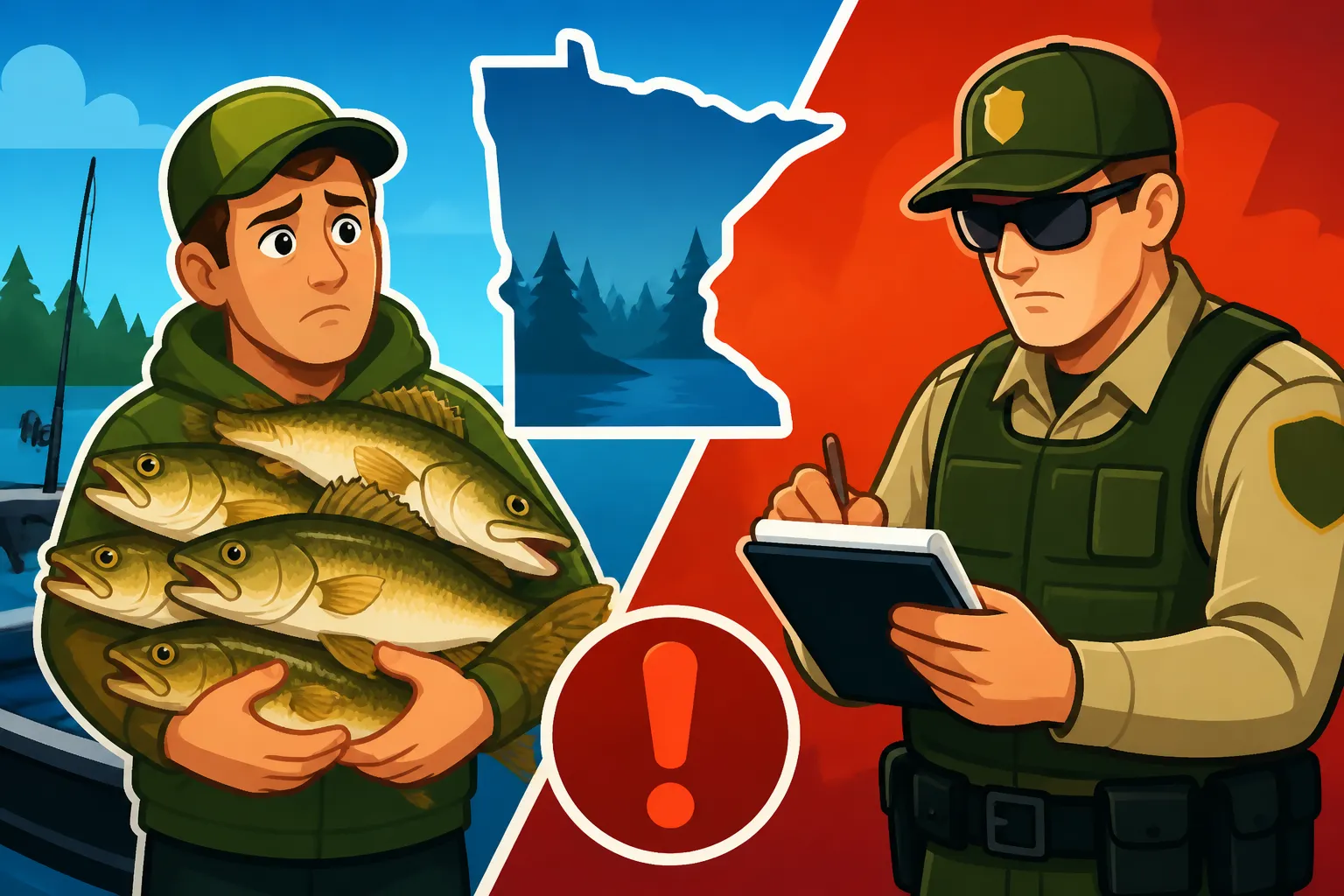
Minnesota Conservation Officers (COs) are highly trained and often use more than just a simple boat-side chat to enforce regulations. They may observe from a distance using high-powered optics or wait at public landings like those on Mille Lacs or Lake Minnetonka. When an officer approaches, they are looking for more than just your Minnesota Fishing License: Cost, Types & How to Buy (2026). They will check livewells, coolers, and even hidden compartments if they have probable cause.
In many cases, COs also perform "creel surveys" or compliance checks at resorts and fish cleaning shacks. If you are found with fish that have been filleted in a way that prevents identification or measurement, you could be cited just as if you were over the limit. This is why understanding Minnesota Walleye Limit & Size Rules is crucial before you ever pick up a fillet knife.
Common Scenarios Where Anglers Accidentally Over-Limit
Accidents happen, but the DNR rarely accepts "I lost count" as a valid excuse. A frequent scenario involves a group of three anglers in a boat. If the boat has 18 walleyes (a six-fish limit per person), but one person actually caught ten of them, that individual has technically violated the law. Limits are individual, not "boat limits."
Another common pitfall occurs when fishing lakes with special regulations. For instance, Mille Lacs Walleye Regulations (2026) often involve very specific "slots" where only one fish over a certain length can be kept, or perhaps no fish at all during certain windows. If you keep a fish that falls within a protected slot, it counts toward an illegal harvest just as surely as keeping a seventh fish would.
The Financial and Legal Fallout
When a CO writes a ticket for an over-limit violation, the initial fine is often just the tip of the iceberg. Minnesota utilizes a system of "restitution," which is essentially a bill sent to the angler to "repay" the state for the loss of a public resource. These costs are non-negotiable and can escalate quickly depending on the species and the size of the fish.
Fines and Restitution Costs for Specific Species
The base fine for a fishing violation is set by the county where the offense occurred, but the restitution values are statewide. If you are caught with an extra walleye on Lake of the Woods, you aren't just paying a $100-$200 court fine; you are also paying a per-fish restitution fee.
For common species, the costs are significant. A single walleye might carry a $30 restitution fee, but that price jumps significantly for "trophy" sized fish or protected species. If you find yourself in a situation where you've kept multiple fish over the limit, those $30 increments add up. Imagine a scenario where a "bucket fisherman" keeps 20 extra crappies; the restitution alone would be $100, on top of court fees that can easily double or triple that amount.
| Species | Standard Restitution (Per Fish) | Potential Trophy/Special Surcharge |
|---|---|---|
| Walleye | $30 | Increases for fish over 28 inches |
| Northern Pike | $30 | Significant jump for fish over 30 inches |
| Muskie | $500 | Can reach $1,000+ for trophy class |
| Lake Sturgeon | $500 | High value due to slow growth rates |
| Crappie/Sunfish | $5 | Per fish, but easily accumulated |
| Trout (Stream) | $30 | Varies by species and location |
Court Costs and the Impact on Your Record
A fishing violation is generally classified as a misdemeanor in Minnesota. While it might not seem as serious as a felony, it still creates a criminal record. When you receive a citation, you typically have the option to pay the fine (which acts as a plea of guilty) or appear in court. If you choose to fight the ticket and lose, you may be saddled with additional court costs and library fees.
Furthermore, these violations are tracked by the DNR's Licensing and Law Enforcement divisions. If you have a history of "minor" infractions, such as not having a Minnesota Trout Stamp & Trout Regulations properly sorted, a CO is much less likely to give you a warning for an over-limit situation. They can see your entire history on their mobile terminals, and a pattern of disrespect for the law usually leads to the maximum possible penalties.
Confiscation of Gear and Property
This is the part of the law that truly terrifies most veteran anglers. Under Minnesota Statute 97A.221, Conservation Officers have the authority to seize "all gear and equipment used in the commission of a violation." This isn't just limited to the fish and the bucket. In extreme cases—specifically those involving gross over-limits or commercialization of game fish—the DNR can and will seize your rods, reels, electronics, and even the boat and trailer.
While the seizure of a $60,000 fiberglass walleye boat is rare for keeping one extra fish, it is a very real possibility for "poachers" who are caught with dozens of fish over the limit. Even if you eventually get your gear back, the legal fees to fight for its return can be astronomical. Often, the fish themselves are confiscated immediately and donated to local food shelves or senior centers, meaning you don't even get to keep the evidence of your "great" (and illegal) day on the water.
Losing Your Privilege: License Revocation
In Minnesota, fishing is considered a privilege, not a right. The DNR has the power to take that privilege away for a significant amount of time if you prove you cannot play by the rules. This is often the most painful penalty for a true outdoorsman, as it bars you from the water during the best seasons of the year.
Points and the Three-Year Rule
Minnesota operates on a system where certain violations trigger an automatic revocation of your fishing privileges. For most over-limit violations, if the restitution value of the fish seized exceeds $500, you face an automatic one-year revocation of your license. However, if you are a repeat offender, the stakes get higher.
If you accumulate multiple violations within a three-year period, the DNR can revoke your right to fish, hunt, or trap for three to five years. Imagine missing three years of the Minnesota Walleye Opener 2026 or being unable to take your kids out during the Free Fishing Weekends in Minnesota. The social and personal cost of losing your license often outweighs the financial burden.
The Interstate Wildlife Violator Compact
Many out-of-state anglers think that if they lose their license in Minnesota, they can just head back to Iowa or Wisconsin and keep fishing. Unfortunately for them, Minnesota is a member of the Interstate Wildlife Violator Compact (IWVC). This is an agreement between 48 states to recognize the suspension of hunting and fishing licenses across state lines.
If your license is revoked in Minnesota for a gross over-limit on the Rainy River, that information is uploaded to a national database. When you go to renew your license in your home state, the system will flag the revocation, and you will be denied. This "national blacklist" ensures that poachers cannot simply hop across the border to escape the consequences of their actions. This makes the Nonresident Fishing in Minnesota: Licenses & Rules even more critical to follow, as the consequences follow you home.
Reinstatement Procedures
Getting your license back isn't as simple as waiting for the calendar to flip. After your revocation period ends, you often have to pay a reinstatement fee. Furthermore, you must ensure that all court-ordered fines and restitution payments have been settled in full. If you haven't paid your "debt to the state," the revocation will remain in place indefinitely.
During the period of revocation, you cannot even "assist" someone else in fishing. You cannot bait a hook, net a fish, or operate the trolling motor for a buddy. If you are caught on a boat while someone else is fishing during your revocation, you can be charged with "fishing after revocation," which carries even steeper criminal penalties and can lead to jail time in some jurisdictions.
How to Stay Legal on Minnesota Waters
The best way to avoid the heartbreak of a DNR citation is to be proactive. Ignorance of the law is never a defense, especially when the Minnesota Fishing Regulations PDF: Where to Find It is available for free at every bait shop from Duluth to Luverne.
Best Practices for Keeping Track of Your Catch
When the fishing is fast and furious, it’s easy to lose track. Professional guides often use a simple tally system. Keep a physical clicker in the boat or use a dedicated app on your phone to log every fish that goes into the livewell. If you are fishing with a group, ensure that everyone knows exactly how many fish they have personally kept.
It’s also wise to practice "conservative" fishing. If the limit is six, many veteran anglers stop at five. This provides a "buffer" in case of a counting error or if a fish is later found to be just shy of a legal measurement. Remember, it is your responsibility to have a calibrated measuring board. A "guestimate" against the side of the boat won't hold up when the CO pulls out a certified tape measure. Always follow Catch and Release Best Practices in Minnesota for those fish you don't intend to keep or that fall outside the legal limit.
Understanding Special Regulations and Slot Limits
Minnesota is famous for its "experimental" and "special" regulations. A lake across the road from another might have completely different rules. For example, Minnesota Slot Limits: Which Lakes & Why explains why certain bodies of water require you to release all walleyes between 18 and 24 inches.
Always check the signs at the public water access. The DNR does a great job of posting the specific rules for that body of water. If you are unsure, err on the side of caution and release the fish. No single meal is worth a $500 fine and a year off the water. If you are targeting panfish, be aware that many lakes have reduced limits to protect size structure, so consult the Minnesota Crappie & Sunfish Limits guide before you start filling the bucket.
Utilizing DNR Resources
The DNR isn't just there to hand out tickets; they are there to help you stay legal. The "Minnesota Fishing Regulations" booklet is your bible. It contains maps, species identification guides, and a breakdown of all the laws you need to know. You should also consider whether a Minnesota Conservation vs Regular License is right for you; the conservation license has lower limits but is a great way to support the resource if you don't plan on keeping a full limit anyway.
If you ever find yourself in a situation where you realize you've accidentally over-limited—perhaps you found a fish at the bottom of the livewell you forgot about—the best course of action is often to contact a CO immediately. While they aren't required to give you a pass, honesty and proactive communication can sometimes lead to a warning rather than a full-blown citation.
Disclaimer
This guide is for informational purposes only and does not constitute legal advice. Fishing regulations and penalty structures in Minnesota are subject to change by the Department of Natural Resources and the State Legislature. Always consult the official Minnesota Fishing Regulations handbook and the Minnesota Statutes for the most current and legally binding information. If you are facing legal charges, please contact a qualified attorney.