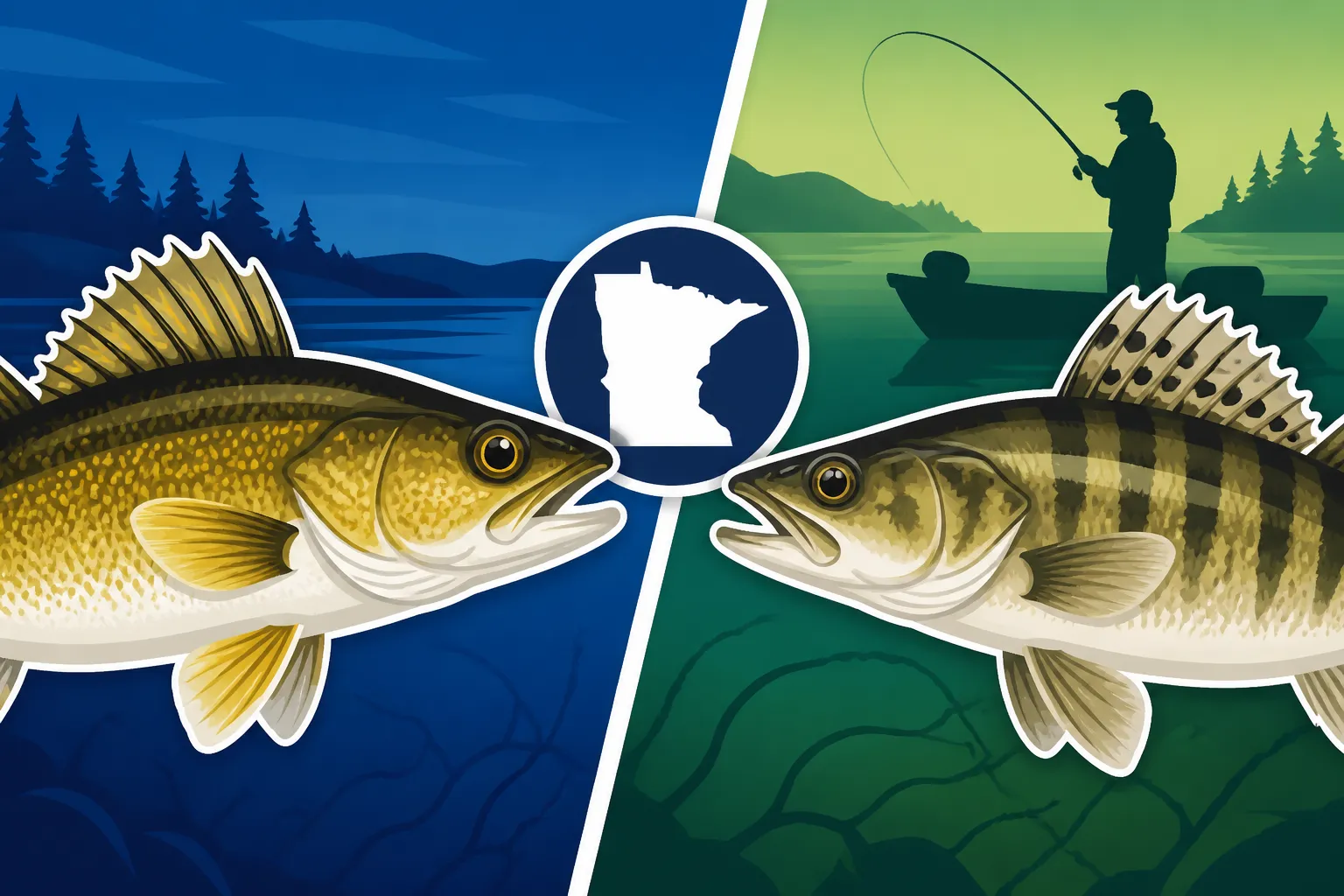
How to Identify a Walleye vs Sauger
It's happened to every Minnesota angler: you're out on the water, reeling in a beautiful fish, and then you pause. Is it a walleye, or is it a sauger? The two species can look incredibly similar at first glance, leading to confusion, especially when fishing regulations often differentiate between them. This guide is here to clear up that common confusion, offering practical tips and clear distinctions to help you confidently identify whether you've landed a prized walleye or a feisty sauger.
Why Distinguishing Walleye and Sauger Matters for Minnesota Anglers
Anglers often chuckle about the "walleye vs. sauger" debate, but it's more than just an academic discussion for us Minnesotans. In the land of 10,000 lakes, knowing precisely what's on the end of your line can be critical for both legal compliance and maximizing your fishing success. Trust me, nobody wants a conversation with a conservation officer that starts with "Are you sure that's a sauger?" when it's actually an over-limit walleye.
Legal Implications and Bag Limits
The primary reason to master walleye and sauger identification is purely practical: the rules are different. While both are highly sought-after, delicious fish, the Minnesota DNR sets specific bag and possession limits for each species. If you're on a lake or river where both are present, like the mighty Mississippi River or even parts of Lake of the Woods, you need to know which is which.
Imagine this scenario: you've had an incredible day, and you think you've caught your limit of sauger. You head back to the ramp, feeling great, only to have a DNR officer perform a creel check and point out that three of your "sauger" are actually walleye, putting you over the limit for one species. Suddenly, a great day on the water can turn into a hefty fine and a confiscated catch. For instance, understanding specific rules like the What Is the Walleye Possession Limit in Minnesota? or checking the general Minnesota Fishing Limits: Bag & Possession (2026) for your specific body of water becomes absolutely paramount. It’s not just about avoiding penalties; it’s about being a responsible steward of our precious fisheries. The regulations are designed to protect fish populations, and our compliance helps ensure healthy fishing for years to come.
Habitat and Fishing Strategies
Beyond the legalities, knowing the difference can genuinely improve your fishing game. While walleye and sauger often share the same waters, they do have some distinct preferences that can guide your strategy. Thinking of them as interchangeable can sometimes lead you to fish the wrong spot or with the wrong presentation if you're trying to target one over the other specifically.
Walleye, for instance, are often found in clearer waters, near structure like rocky reefs, points, and weed lines, especially in larger, open basins. They can be very light-sensitive, which is why they're so active at dawn, dusk, and even How to Catch Walleye at Night. Sauger, on the other hand, tend to prefer murkier, deeper water with a bit more current. You'll often find them tucked into deeper holes or along river channels, shying away from bright light even more than their walleye cousins. If you're drifting a jig and minnow in a deep river channel, you're more likely to encounter sauger. If you're casting crankbaits on a shallow, windy reef in a big lake, walleye are probably your main target. Understanding these nuances, which you can learn more about in a Walleye Fishing in Minnesota: Complete Guide or specifically for Yellow Perch & Sauger in Minnesota, helps you put your bait where the fish are.
Culinary Differences and Taste
While both walleye and sauger are undeniably delicious – ranking high on any Minnesotan's list of Best Eating Fish in Minnesota Lakes – some anglers and chefs will tell you there are subtle differences in their flesh. Walleye are famous for their flaky, white, delicate fillets. They have a mild, sweet flavor that's hard to beat.
Sauger also offer firm, white meat with a mild flavor, but sometimes it's described as being slightly stronger or perhaps a tad less flaky than walleye, especially from river systems. These differences are often subtle, and many people wouldn't notice unless tasting them side-by-side. However, for those who truly appreciate the nuances of a fresh fish fry, distinguishing between the two means knowing exactly what culinary delight you're preparing. After a long day of fishing, there's nothing quite like knowing you're about to enjoy the fruits of your labor, perfectly identified and prepared.
Key Identification Features: Head and Mouth
When you pull a fish out of the water, the first place your eyes usually go is its head. And thankfully, the head region offers some of the most reliable tell-tale signs to differentiate between a walleye and a sauger. Pay close attention to these details; they are your best friends in the identification game.
Spiny Dorsal Fin Spotting
This is, hands down, the most consistent and easiest way to tell these two apart. It's the feature I always check first, and it rarely lies.
- Walleye: Look at the spiny dorsal fin (the one closer to the head, with the sharp rays). A walleye will have a very distinct, dark, often black, blotch or spot on the rear portion of the spiny dorsal fin. This spot is usually quite prominent and isolated, sitting right above where the fin attaches to the body. The rest of the fin might be clear or subtly mottled, but that single, bold black spot is the giveaway. It's like a signature mark.
- Sauger: Now, for a sauger, their spiny dorsal fin is covered in multiple rows of distinct dark spots or blotches that stretch across the entire fin. It looks speckled or barred, like a leopard print rather than a single black thumbprint. There's no single, concentrated dark spot at the rear; instead, the spots are distributed more or less evenly across the fin.
When you're holding the fish, spread that spiny dorsal fin gently and take a good look. That pattern will tell you almost instantly what you've got. This difference is so reliable that even new anglers can quickly learn to spot it.
Cheek Scales
Another great feature, although sometimes a bit trickier for beginners, is the presence or absence of scales on their cheeks. This refers to the operculum, the bony flap covering the gills, just behind the eye.
- Walleye: Generally, walleye have very few or no scales on their cheeks. The area will often feel smooth and fleshy, or if there are scales, they will be sparse and embedded. It's not completely bare, but it's certainly not fully scaled like the rest of their body.
- Sauger: Sauger, on the other hand, typically have full or nearly full scaling on their cheeks. If you gently run your finger over the cheek area, you'll feel distinct scales, much like the rest of their body.
To check this, gently press your thumb or finger against the cheek flap. You can often feel the texture difference. Sometimes, a careful visual inspection, especially if the fish is wet and shiny, can also reveal the presence or absence of these scales. It’s a good secondary characteristic to confirm what the dorsal fin is telling you.
Mouth and Teeth
Both walleye and sauger belong to the perch family and are known for their formidable teeth, particularly their canine-like fangs. These sharp choppers are excellent for grasping slippery baitfish. While their mouths are generally similar, there aren't many distinct differences here that reliably separate them for identification purposes.
Both have sharp teeth along their jaws, designed for their predatory lifestyle. You'll want to be careful when unhooking either species, as those teeth can do a number on an unsuspecting finger! So, while impressive, the mouth and teeth aren't your go-to features for telling a walleye from a sauger. Stick to the dorsal fin and cheek scales first.
Body Markings and Coloration
Beyond the head, the overall appearance of the fish – its color, patterns, and even the tail – offers crucial clues. These are often the first things people notice, and they can strongly suggest whether you have a walleye or a sauger. While coloration can vary slightly based on water clarity, diet, and even individual fish, the patterns remain relatively consistent.
Body Pattern and Mottling
This is where the general "look" of the fish comes into play. You'll notice distinct differences in how their bodies are patterned.
- Walleye: Walleye typically have a more uniform body coloration. Their backs are usually an olive-gold to dark green, transitioning to lighter, often brassy or yellowish-gold sides, and a distinct white belly. They might have some faint, indistinct vertical barring along their sides, but these bars are usually not sharply defined or highly contrasted. The overall impression is smoother, more streamlined, and less "busy." Think of a walleye as having a sleek, golden-green appearance.
- Sauger: Sauger, conversely, are known for their very distinct, dark blotches or saddle-like markings along their sides and back. These markings often create a mottled or tiger-striped pattern that is much more pronounced than any subtle barring on a walleye. Their coloration tends to be browner, brassier, or even a grayish-brown, giving them a camouflaged look often suited for the murkier waters they frequent. The pattern is broken up and irregular.
When you see a sauger, you'll immediately notice those blotches and patches that give it a more "calico" or marbled appearance compared to the walleye's more solid coloring. This is a great visual cue, especially if the dorsal fin spot isn't immediately clear.
Tail Fin Tip
This is another incredibly reliable and easy-to-spot feature, right up there with the dorsal fin spotting. The tail fin, or caudal fin, has a distinct difference that can instantly identify your catch.
- Walleye: The most unmistakable characteristic of a walleye's tail is the prominent white tip on the lower lobe of the caudal fin. This white patch is usually quite clear and bright, almost like it's been dipped in white paint. It's consistently present and a key identifier.
- Sauger: Sauger, on the other hand, lack this distinctive white tip. Their tail fin is typically speckled or barred with dark spots, and the lower lobe will not have that bright white coloration. The entire tail will usually match the mottled pattern of their body, or at least lack any distinct white marking.
So, after checking the dorsal fin, flip the tail out and look for that white tip. If it's there, you've got a walleye. If it's absent and the tail is speckled all over, you're holding a sauger. It's a simple, quick check that offers high confidence.
Size, Shape, and Habitat Preferences
While not as definitive as fin patterns or cheek scales, the general size, body shape, and typical haunts can also offer helpful context when trying to identify your catch. These observations, combined with the primary visual cues, help paint a complete picture.
General Size and Build
There's a reason walleye are often considered the "king" of Minnesota's gamefish – they tend to grow quite a bit larger than sauger.
- Walleye: These fish have a more torpedo-shaped body, generally appearing robust and elongated. While they start small, they have the potential to grow to impressive sizes, with 20-inch fish being common and trophy walleye often reaching well over 25 inches, sometimes even into the low 30s. The Minnesota State Record Walleye stands as a testament to their growth potential. Their larger size and girth are usually noticeable when compared to sauger of similar age.
- Sauger: Sauger are typically smaller and more slender than walleye. While they can reach respectable sizes, a sauger over 20 inches is considered quite large, and most are in the 12- to 18-inch range. Their body tends to be less robust and more delicate in appearance compared to a walleye. If you catch what you think is a small walleye, take an extra moment to check its features, as it might actually be a sauger.
Of course, a juvenile walleye might be smaller than a large sauger, so size alone isn't a foolproof identifier. But in general, larger fish that you suspect are walleye are more likely to actually be walleye, while smaller, more slender fish are prime candidates for closer sauger inspection.
Preferred Habitats
As briefly touched upon earlier, walleye and sauger, while often coexisting, do have slightly different preferences for where they hang out. Knowing these tendencies can help you make an educated guess even before you get the fish into the boat. This also helps when considering Where Do Walleye Live in a Lake? (Structure) versus sauger haunts.
- Walleye: Walleye are adaptable and can be found in a wide variety of waters across Minnesota, from large, clear glacial lakes like Mille Lacs and Leech Lake to major river systems. They often prefer areas with defined structure – think rocky reefs, points, humps, sharp drop-offs, and even dense weed edges. They tend to be more active in shallower waters during low light conditions or under overcast skies, but will retreat to deeper structure during bright daylight. They appreciate oxygen-rich, cooler waters. You'll find strong walleye populations in many of Minnesota's most popular fishing lakes.
- Sauger: Sauger have a stronger affinity for turbid (murky) waters, deep river channels, and lake basins with significant current. They are often found deeper than walleye, preferring the bottom where light penetration is low. Lakes with extensive deep, soft bottom areas and major river systems like the Mississippi or Rainy River are prime sauger territory. They tolerate higher turbidity and current better than walleye. If you're fishing a deep hole in a major river, your chances of hooking a sauger go up significantly. For an angler, understanding these preferences can inform your choice of fishing spots and even the Best Walleye Fishing Tactics in Minnesota you employ.
Quick Reference Guide: Walleye vs. Sauger Table
To make identification a breeze, here's a handy table summarizing the key differences we've discussed. Keep this in mind next time you're on the water, and you'll be identifying your catch like a seasoned pro in no time!
| Feature | Walleye | Sauger |
|---|---|---|
| Spiny Dorsal Fin | Single, distinct dark spot on the rear | Multiple rows of distinct dark spots across the entire fin |
| Cheek Scales | Few to no scales (smooth) | Fully scaled (rougher feel) |
| Body Markings | More uniform, olive/gold/green, faint bars | Distinct dark blotches/saddle markings, mottled brown/brass |
| Tail Fin Tip | Prominent white tip on the lower lobe | No white tip, often speckled/barred throughout |
| General Size | Typically larger and more robust | Typically smaller and more slender |
| Preferred Habitat | Clearer lakes, reefs, points, weed lines | Turbid rivers, deep channels, murky lake basins, current |
This table should be your go-to reference when you're in doubt. Just run through these points, and you'll usually get a clear answer. Remember, checking multiple features is always better than relying on just one.
Hybridization: The "Saugeye"
Just when you think you've mastered the art of identification, nature throws a curveball: hybrids! In some regions, a fish called a "saugeye" exists, which is a cross between a walleye and a sauger. While they are far less common in Minnesota's natural waters compared to states where they are actively stocked, it's worth knowing about them, just in case.
What is a Saugeye?
A saugeye is a hybrid fish resulting from the crossbreeding of a female walleye and a male sauger. These fish are often created in hatcheries for stocking programs in states where they thrive, particularly in turbid reservoirs and rivers, because they combine some of the best characteristics of both parents: the growth potential of a walleye and the tolerance for turbid water and current of a sauger. They tend to grow faster and are often easier to catch than pure walleye in certain environments.
In Minnesota, naturally occurring saugeye are rare, but not impossible. The Minnesota DNR primarily manages for pure walleye and sauger populations. However, on occasion, where both species are abundant and their spawning grounds overlap, a natural hybrid could potentially occur. It’s not something you’ll encounter every day, but it’s part of the biological complexity of our waters.
Identifying a Saugeye
Identifying a saugeye can be a bit more challenging because they exhibit a mix of features from both parent species. They're often described as having intermediate characteristics.
Here’s what to look for:
- Dorsal Fin: A saugeye's spiny dorsal fin might have some spotting, but it typically won't be as dense or cover the entire fin as completely as a pure sauger. It will likely be more extensive than a walleye's single rear spot, but perhaps not distinct rows across the entire fin. It's a "between" state.
- Cheek Scales: Their cheeks will also show intermediate scaling. They might have more scales than a walleye but less complete coverage than a sauger.
- Body Markings: Saugeye often display some mottling or blotching, similar to a sauger, but it might be less pronounced or extensive. Their body color could lean more towards the walleye's golden tones, but with the sauger's broken pattern elements.
- Tail Fin: This is one of the trickiest features for a saugeye. They may have a faint or partial white tip on the lower caudal fin, but it won't be as bright and distinct as a pure walleye's. It might be a hazy white or just a suggestion of white.
Given their rarity in Minnesota, if you catch a fish that looks like a walleye or a sauger, it almost certainly is one of those two species. When in doubt, it’s always best to err on the side of caution, especially if you're close to a limit. For regulations, saugeye caught in Minnesota are generally considered and managed as walleye. If you truly suspect you’ve caught a saugeye and are concerned about regulations or simply curious, consider taking a clear photo and releasing the fish if possible, or contacting the DNR for clarification. Knowing Catch and Release Best Practices in Minnesota is always a good idea when dealing with uncertain identifications or if you've already met your How Many Walleye Can You Keep in Minnesota? limit.
Confident Identification for Better Fishing
Mastering the skill of identifying walleye versus sauger isn't just about avoiding a ticket; it's about becoming a more knowledgeable and confident angler. It enhances your understanding of the aquatic ecosystems you're exploring and allows you to better appreciate the diversity of Minnesota's fish species, which you can delve into further with our Minnesota Fish Species: Identification Guide.
Take the time to examine your catch carefully. Practice makes perfect. The more fish you encounter, the quicker and more accurate your identification will become. Soon, you'll be able to tell the difference at a glance, allowing you to focus on the pure joy of fishing, whether you're targeting big walleye on Lake of the Woods during Walleye Season & Limit in Minnesota or pulling sauger from a river current during Sauger Season & Limit in Minnesota. By sharpening your identification skills, you contribute to responsible angling and ensure our incredible Minnesota fisheries remain vibrant for generations to come.
Disclaimer
The information provided in this guide is for general informational purposes only and is not a substitute for official Minnesota DNR regulations. Fishing regulations can change frequently. Always consult the most current official Minnesota Fishing Regulations handbook or the Minnesota DNR website before heading out on the water. Non-compliance with fishing regulations can result in penalties.