Muskie vs Northern Pike: How to Tell the Difference
It's a classic Minnesota fishing dilemma: you've got a long, slender, toothy predator on the end of your line, and for a split second, you wonder, "Is it a muskie or a northern pike?" Many anglers, even seasoned ones, find themselves pausing to distinguish between these two formidable freshwater giants. While they share a similar torpedo-shaped body and a penchant for aggressive strikes, misunderstanding their differences can lead to anything from misidentifying a potential trophy to running afoul of specific regulations. This comprehensive guide will meticulously break down the unique characteristics of muskie and northern pike, ensuring you'll know exactly which toothy critter you've landed on your next fishing adventure.
The Core Differences: A Quick Look
Let's be honest, at a glance, a muskellunge and a northern pike can look remarkably similar, especially when they're flopping in the bottom of your boat or thrashing at the surface. But just like telling the difference between a walleye and a sauger, it comes down to paying attention to some key, often subtle, anatomical markers. Forget the guesswork and focus on these critical distinctions that will instantly tell you if you've hooked a "fish of 10,000 casts" or a feisty "water wolf."
Spots vs. Bars
This is often the first and easiest visual cue when trying to differentiate between a muskie and a northern pike. While both fish have markings, their patterns are distinct.
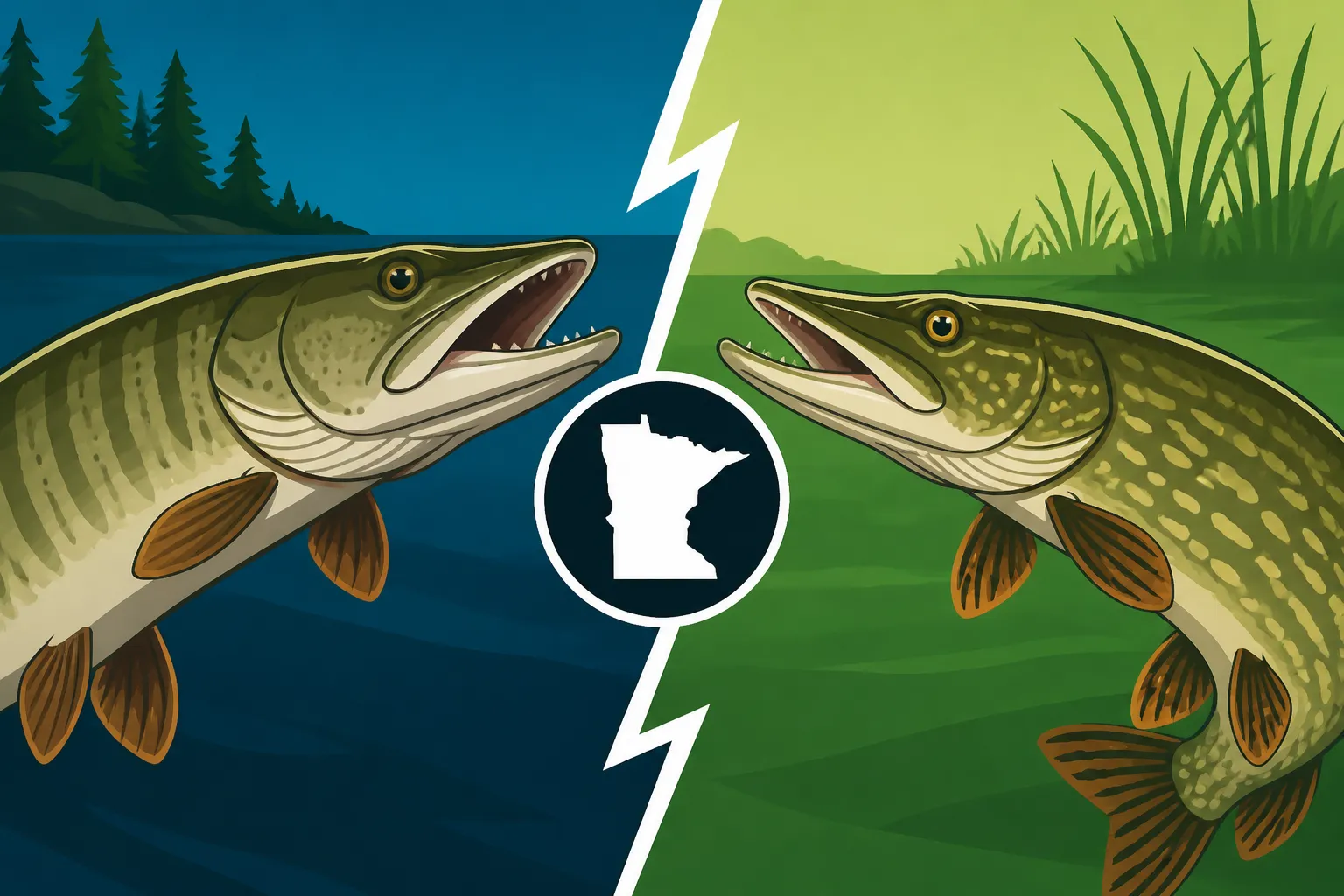
Northern pike typically display light, bean-shaped spots or markings against a darker, olive-green to dark brown body. Think of it like a dark canvas with lighter brush strokes. These spots can sometimes merge into irregular horizontal rows, but they are almost always lighter than the background color. If you're looking at a fish with prominent, lighter splotches or spots on a darker body, odds are it's a northern pike. These markings help them blend into the weedy, shallow cover they often inhabit, making them ambush predators par excellence.
Muskellunge, on the other hand, usually exhibit dark markings on a lighter body background. Their patterns can vary quite a bit, from distinct dark spots to irregular vertical bars or even a tiger-striped pattern, but the key is that these darker markings are on a lighter background color. The base color of a muskie tends to be a lighter green, silver, or even yellowish, with the darker spots or bars laid over it. It's like looking at a pale canvas with darker, more deliberate strokes. This coloration also aids in camouflage, often in deeper water or against different types of structure. The variability in muskie patterns means you might encounter "spotted" muskies, "barred" muskies, or even relatively "clear" or un-patterned individuals, but the dark-on-light rule generally holds.
Tail Shape and Fin Structure
Beyond the body markings, the shape of the tail fin (caudal fin) and other fins can offer a definitive way to tell these two species apart. This requires a closer look but provides a very reliable indicator.
A northern pike's tail fin typically has a more rounded or bluntly pointed lobe. If you were to draw a line connecting the tips of the upper and lower lobes, it wouldn't be perfectly straight; there would be a slight curve or bluntness to each tip. The overall impression is often described as slightly concave or even somewhat "scooped" in appearance, though this can be subtle. The fins themselves are often a greenish or yellowish hue, sometimes with reddish or orange tints on the lower fins, especially as the fish matures.
Muskellunge, conversely, are known for their distinctly pointed tail fin lobes. When you hold a muskie, the upper and lower lobes of its tail fin will come to sharp, defined points, making the entire fin look more deeply forked or v-shaped. The fin edges often appear almost razor-sharp. Additionally, the muskie's fins, particularly the anal and dorsal fins, tend to be more rounded at their tips than a pike's. The coloration of a muskie's fins is typically darker, often matching the darker markings on its body, without the vibrant yellow or orange seen on pike fins. Observing these differences, especially the pointed tail lobes, is a very strong identifier for a muskie.
Lateral Line Appearance
The lateral line system, a sensory organ running along the side of the fish, can also hold clues, though it's a bit more subtle than the other markers. Both fish have a lateral line, but its visual prominence and associated pores can differ.
On a northern pike, the lateral line often appears as a relatively smooth, less interrupted line of sensory pores along its side. While it's certainly present and functional, it doesn't typically stand out as a highly contrasted feature. The scales surrounding it usually blend in with the overall body coloration and patterning without any dramatic breaks.
For muskellunge, especially larger individuals, the lateral line can sometimes be more pronounced. It may appear as a series of small, distinct pores, occasionally surrounded by slightly different-colored scales, making it stand out a bit more against the body. However, this isn't always a foolproof method, as it can be hard to see clearly, especially on a fish that's not cooperating. It's best used as a secondary confirmation rather than a primary identifier.
Anatomy Up Close: What to Look For
If you're still not 100% sure after checking the markings and tail, it's time to get a little more scientific. The most reliable way to tell a muskie from a northern pike involves counting scales, specifically on their head and gill covers. This might sound intimidating, but once you know what to look for, it's a relatively quick and definitive check.
Cheek and Opercle Scales
This is the gold standard for differentiating muskie from northern pike. It requires you to look at the gill cover (opercle) and the cheek area directly behind the eye.
A northern pike will have scales completely covering its cheek and only the upper half of its gill cover (opercle). Imagine a vertical line down the middle of the opercle; the bottom half will be bare, while the top half is scaled. This full cheek, half opercle scaling pattern is consistent and easily visible once you know where to look. Run your finger over the bottom half of the gill cover, and you'll feel smooth, unscaled skin.
A muskellunge, on the other hand, has scales only on the upper half of both its cheek and its gill cover (opercle). So, both the cheek and the opercle will have scaled upper halves and bare lower halves. This "half cheek, half opercle" pattern is the definitive muskie signature. This difference is so reliable that it's often the first thing fisheries biologists will check when identifying a specimen. It's a key biological distinction, and once you get the hang of it, you'll be able to identify these fish with confidence every time. This is especially useful for Northern Pike in Minnesota: Identification & Where to Catch as well as for understanding Muskie Fishing in Minnesota: The Fish of 10,000 Casts.
Mouth Shape and Dentition
While less definitive than the scaling pattern, the mouth and teeth can offer supplementary clues. Both species are formidable predators, equipped with impressive dental arrays.
Northern pike generally have a slightly broader, more duckbill-shaped snout. Their teeth are numerous and needle-sharp, designed for grasping and holding prey. They have teeth on their jaws, tongue, and roof of their mouth. The overall impression is a mouth that is wide and powerful, built for swallowing prey whole.
Muskies tend to have a more elongated, slightly more pointed snout compared to a pike. Their teeth are also incredibly sharp and numerous, but they can sometimes appear larger and more prominent. What's truly notable, however, is the sheer power and depth of their jaws. A muskie's mouth can open incredibly wide, allowing it to engulf surprisingly large prey items. Both fish require extreme caution when handling due to their teeth, but the muskie's jaw structure often feels even more robust and powerful.
Eye Placement and Coloration
The eyes of these fish, while not a primary identifier, can sometimes provide a subtle distinction in their overall appearance.
Northern pike typically have eyes that are a bit smaller in proportion to their head size, and they can sometimes have a yellowish or golden iris. Their placement is fairly standard for a predatory fish, offering good binocular vision for hunting.
Muskies often have larger eyes that can appear more prominent, giving them a slightly more intense gaze. The iris color can vary but often has a darker, more amber or brownish hue. Their eyes are also positioned to provide excellent predatory vision, crucial for their ambush tactics. Again, this is a minor detail, but combined with other features, it can contribute to a more complete picture.
Habitat and Behavior Clues
Beyond physical appearance, where and how these fish behave can also give you a strong hint about which species you're encountering. While there's certainly overlap, they do have some distinct preferences that influence their distribution and fishing tactics.
Preferred Water Types and Cover
Both muskie and northern pike are freshwater apex predators, but their typical haunts can differ, especially in larger Minnesota lakes.
Northern pike are incredibly adaptable and are found in a vast array of water bodies across Minnesota. They thrive in lakes, rivers, and even larger ponds. They have a strong preference for shallow, weedy areas with abundant submerged vegetation, fallen timber, or reeds. These areas provide perfect ambush points for them to surprise unsuspecting prey. You'll often find them lurking at the edges of weed lines, in lily pad fields, or tucked against shoreline cover. This preference for cover is why they're often the first toothy fish many anglers encounter, particularly in more accessible, shallower areas.
Muskies, while also loving structure, tend to prefer larger, clearer lakes with abundant deep-water forage and a mix of submerged structures like rock reefs, expansive weed beds, and points that drop off into deeper water. While they will use shallow cover, particularly during certain seasons, they often relate to more open water and deeper transitions than pike. Lakes like Mille Lacs Lake, Lake Vermilion, and Leech Lake are prime Minnesota Muskie Lakes: Where to Find Them known for their healthy muskie populations, showcasing their preference for expansive and diverse aquatic environments. They use these diverse habitats to hunt larger prey like ciscoes, whitefish, and even ducks.
Spawning Habits and Timing
The timing and location of their spawning rituals also differ, offering another layer of distinction.
Northern pike are early spawners, often beginning their reproductive activities right after ice-out, sometimes even while there's still ice in shaded bays. They prefer shallow, marshy areas with flooded vegetation. The water temperature is usually in the low 40s to low 50s Fahrenheit. The eggs are broadcast over submerged plants, where they stick until hatching. This early spawning helps their young get a head start on other species, contributing to their widespread abundance.
Muskies spawn a bit later than pike, typically when water temperatures are in the mid-50s to low 60s Fahrenheit, often several weeks after the pike have finished. They also seek out shallow, vegetated areas but often prefer slightly deeper or more expansive spawning grounds than pike. Like pike, muskie eggs are scattered over aquatic vegetation and woody debris. The later spawning period means that muskie fry emerge when more small forage fish are available, providing ample food for their rapid early growth. Understanding Muskie Season & Limit in Minnesota is crucial, as they are typically protected during their spawning period.
Feeding Patterns and Aggression
Both are highly aggressive predators, but their typical feeding behaviors can differ, influencing how anglers target them.
Northern pike are opportunistic and notoriously aggressive feeders. They're often described as "water wolves" because of their fierce strikes and willingness to hit almost any offering that moves near them. They feed on a wide variety of fish, frogs, ducklings, and even small mammals. Their aggression makes them a popular target for many anglers, and they are often caught when fishing for other species. They can be found actively hunting throughout the day, though dawn and dusk often produce peak activity.
Muskies are also incredibly aggressive, but their feeding can sometimes be more methodical or driven by specific conditions. They are known for their "moody" nature, often following lures for long distances without striking. When they do strike, it's usually with immense power and speed. They primarily feed on other fish, favoring larger prey items. Muskie anglers often talk about "feeding windows" – specific times when muskies are most active, often influenced by barometric pressure, light conditions, and moon phases. Their reputation as the "fish of 10,000 casts" isn't just about their rarity, but also their often selective and challenging feeding patterns.
Size, Growth, and Minnesota Records
Another way to distinguish these incredible fish, especially when you're dreaming of a trophy, is by looking at their potential for size and the records they hold. Both species can grow to impressive dimensions, but the upper limits are vastly different.
Average Size and Growth Rates
While both start small, their growth trajectories and maximum average sizes diverge significantly.
Northern pike are fast growers in their early years, quickly reaching sizes of 18-24 inches. Most adult pike caught in Minnesota range from 24 to 36 inches, weighing anywhere from 3 to 10 pounds. While fish exceeding 40 inches and 15 pounds are certainly caught, they are considered trophy-class. A 20-pound pike is a truly remarkable fish in most waters. They reach sexual maturity fairly quickly, contributing to healthy populations across many lakes and rivers. Learn more about Northern Pike Size & Trophy Waters to find where the giants lurk.
Muskellunge have a much slower growth rate but compensate by living longer and achieving much larger sizes. While a 30-inch muskie is a good catch, true trophies often start at 40 inches and can easily exceed 50 inches in length, pushing weights well over 30 or even 40 pounds. It's not uncommon for a large muskie to be over 15 years old, representing a lifetime of growth. These slow-growing, long-lived fish are a testament to their position at the top of the food chain. The pursuit of these colossal fish is often a lifelong passion for dedicated anglers, highlighted in articles like How to Catch Muskie for the First Time.
Trophy Potential and State Records
Minnesota is home to some truly monstrous fish for both species, but the state records clearly illustrate their different growth potentials.
The Minnesota state record northern pike weighed an astounding 45 pounds, 12 ounces, caught in Basswood Lake in 1929. This is an exceptional fish, far exceeding the typical size of even large pike. While fish in the 20-30 pound range are considered once-in-a-lifetime catches for many, it shows the potential of these powerful predators.
For muskellunge, the Minnesota state record is a phenomenal 58 pounds, caught in Lake Winnibigoshish in 1957. This record, along with many released fish that approach or exceed 50 inches annually, truly earns the muskie its "trophy fish" status. Catching a muskie over 50 inches is considered the ultimate angling achievement for many in the state, fitting perfectly into the Trophy Fish in Minnesota: Master Angler Program. The size and fighting prowess of these fish make them an incredible challenge. Even the Leech Lake Muskie Strain Explained highlights how different populations can contribute to these massive fish.
Fishing Challenges and Conservation
The differing growth rates and trophy potential also impact how these species are managed and fished.
Northern pike, due to their abundance and faster growth, have more liberal regulations in many parts of the state. However, the Minnesota DNR has implemented zone-based regulations to manage pike populations for quality, quantity, or a mix of both. This is why it's vital to check the Northern Pike Season & Limits in Minnesota for the specific lake you're fishing, as limits can vary dramatically (e.g., a "trophy" zone might have a lower possession limit with a higher protected slot).
Muskies, given their slower growth and high value as a trophy species, are almost exclusively managed as a catch-and-release fishery in Minnesota. The minimum size limits are generally very high (often 48-54 inches), making it highly unlikely that most anglers will legally harvest a muskie. This management strategy emphasizes the sporting challenge and the conservation of these magnificent fish for future generations. Knowing the Muskie Season & Limit in Minnesota is crucial, but more important are responsible catch and release practices to protect these giants.
Geographical Distribution in Minnesota
Minnesota is a land of 10,000 lakes, and both muskie and pike call many of them home. However, their distributions are not entirely uniform, and some lakes are renowned for one species over the other.
Prime Muskie Waters
Minnesota boasts several world-class muskie fisheries, known for producing both numbers and massive trophy fish. These lakes often have specific ecological characteristics that allow muskies to thrive, including ample forage and diverse habitat.
Lakes like Mille Lacs Lake, Lake Vermilion, Leech Lake, and Lake Winnibigoshish are consistently ranked among the best muskie lakes in the state and even the country. These large bodies of water offer extensive habitat, abundant forage like ciscoes, and a variety of structural elements that appeal to muskie. For instance, Lake Vermilion is famous for its clear waters and numerous islands, bays, and reefs, while Leech Lake is known for its extensive sand and rock structure. Other notable muskie lakes include Cass Lake, Lake Bemidji, and some sections of the St. Croix River. Anglers seeking a muskie often specifically target these waters, dedicating considerable time and effort. If you're looking for that fish of 10,000 casts, these are the places to start your quest.
Abundant Northern Pike Lakes
Northern pike are far more widespread than muskies in Minnesota, found in nearly every fishable body of water. They are the quintessential Minnesota game fish for many anglers, providing consistent action and a good meal.
Virtually any lake, pond, or river system in Minnesota with suitable forage and habitat will hold northern pike. From the smallest backcountry lakes to the sprawling waters of Lake of the Woods, you'll find pike. They are particularly abundant in the shallower, weedier lakes of central and northern Minnesota. Lakes in the Brainerd Lakes Area, Park Rapids Area, and the vast expanses of the northern wilderness all hold healthy pike populations. Lakes like Upper Red Lake, Lake Winnibigoshish, and Lake of the Woods are excellent for pike, often producing impressive numbers. Even many metro lakes around the Twin Cities offer great opportunities for pike fishing. If you're looking for consistent action and don't want to travel far, there's likely a northern pike fishery close to you. For those seeking truly large pike, check out the Best Lakes for Big Northern Pike in Minnesota to plan your next outing.
Why Identification Matters for Anglers
Beyond simply satisfying curiosity, correctly identifying a muskie versus a northern pike has real-world implications for responsible angling, enjoyment, and conservation. Mistaking one for the other can lead to legal issues or missed opportunities.
Understanding Regulations and Limits
This is perhaps the most critical reason for proper identification. Minnesota's fishing regulations often differ significantly between muskie and northern pike, particularly concerning size limits and possession.
For northern pike, regulations vary by zone (Northern, Central, and Southern) and can include different bag limits and slot limits. For example, a lake in the Northern Zone might allow a possession limit of 10 pike, but only one can be over 30 inches, and all fish between 22 and 26 inches must be immediately released. Catching and keeping a pike that falls within a protected slot limit can result in a significant fine. Furthermore, you might be interested in whether Are Northern Pike Good to Eat? (Y-Bones Explained) and knowing the difference is key if you plan to keep one for dinner and need to know How to Fillet a Northern Pike (Remove Y-Bones).
Muskies, on the other hand, are almost universally managed as trophy, catch-and-release fisheries. Minimum size limits are typically very high, ranging from 48 inches to 54 inches on specific lakes. The chances of catching a legal-sized muskie that you can keep are extremely low for most anglers. Mistaking a 35-inch muskie for a large pike and attempting to keep it would be a severe violation of fishing regulations, leading to substantial penalties. It's imperative to consult the current Minnesota fishing regulations booklet or website every season before you head out, especially if you're targeting or expecting to encounter either of these species.
Tailoring Your Fishing Approach
Knowing which species you're targeting, or which one you've hooked, can also inform your angling techniques and equipment choices.
If you're specifically targeting northern pike, you might use smaller, more readily available lures like spoons, spinnerbaits, or smaller jerkbaits. Your gear might consist of medium-heavy spinning or baitcasting setups with 15-20 pound test line. Pike are often found in thick cover, so tactics like casting weed lines or shallow trolling might be effective.
Muskie fishing, by contrast, is a highly specialized pursuit. It typically involves much heavier gear: stout baitcasting rods, large reels, 80-100 pound braided line, and heavy fluorocarbon or wire leaders. Lures are often massive, including foot-long crankbaits, huge bucktails, and oversized topwater baits, all designed to appeal to a large, predatory fish. Tactics include power trolling deep structure, casting large baits over expansive weed flats, or working rock reefs. The pursuit of Walleye Fishing Techniques: Complete Minnesota Guide would be vastly different than that of a muskie. Understanding these differences not only enhances your chances of success but also ensures you're properly equipped for the fight and can safely handle and release these incredible fish.
| Feature | Northern Pike ( Esox lucius ) | Muskellunge ( Esox masquinongy ) |
|---|---|---|
| Body Markings | Light spots/bars on a dark body | Dark spots/bars on a light body |
| Tail Fin (Caudal) | More rounded or bluntly pointed lobes | Sharply pointed, deeply forked lobes |
| Cheek Scales | Fully scaled | Scaled only on the upper half |
| Opercle Scales | Scaled on the upper half | Scaled only on the upper half |
| Snout Shape | Broader, "duckbill" shaped | More elongated, slightly pointed |
| Average Adult Size | 24-36 inches (3-10 lbs) | 36-50+ inches (10-40+ lbs) |
| Primary Habitat | Shallow, weedy areas; wide distribution | Large, clear lakes; varied deep structure |
| Spawning Timing | Early spring (post ice-out) | Mid-to-late spring (after pike) |
Disclaimer
Fishing regulations can change frequently. Always consult the most current Minnesota Department of Natural Resources (DNR) fishing regulations handbook or website before heading out on the water. This guide is for informational purposes only and should not be used as a substitute for official regulations. Be safe, fish smart, and always prioritize conservation.