Minnesota Fish Species: Identification Guide
You've just reeled in a beauty, and your heart is pounding! But then the classic Minnesota angler dilemma hits: "Is this a walleye or a sauger?" Or maybe you're staring at a big toothy critter, wondering if it's a pike or a true trophy muskie. It's a common frustration, especially with Minnesota's incredible diversity of fish species. With over 160 different kinds of fish swimming in our 10,000+ lakes and countless rivers, identifying your catch can sometimes feel like a pop quiz. This guide is here to help you confidently identify the most common and sought-after fish species you'll encounter on your Minnesota fishing adventures, so you can spend less time guessing and more time enjoying your catch.
Minnesota's Iconic Walleye and Sauger
There's no doubt about it, the walleye holds a special place in the hearts of Minnesotans. It's our state fish, after all! But it shares many similarities with its close relative, the sauger. Distinguishing between the two is crucial, not just for bragging rights, but because regulations and size limits often differ. Many anglers find themselves squinting at a fish, trying to remember those subtle differences. We've all been there, trust me.
Walleye: Minnesota's Golden Standard
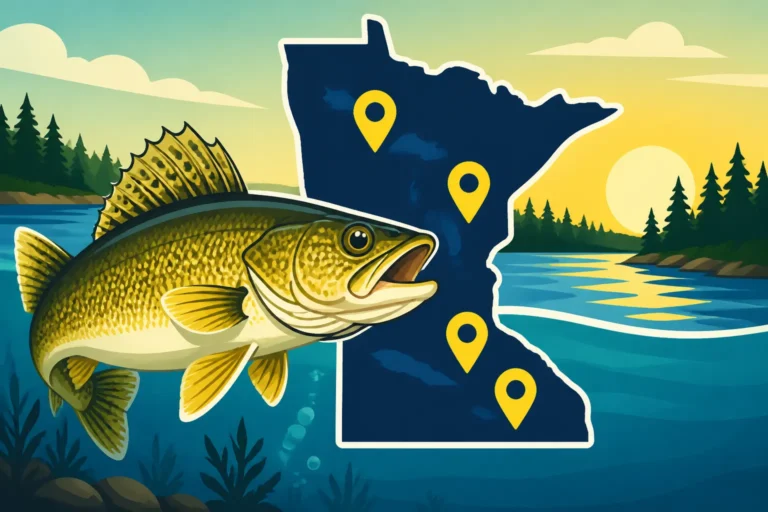
Ah, the walleye. Just saying the name conjures images of tranquil evenings, slip bobbers dancing, and that distinctive metallic thump on your line. These fish are renowned for their delicious, flaky white meat and their preference for low-light conditions, thanks to their large, light-sensitive eyes. When you're out fishing for walleye in Minnesota, you're participating in a beloved tradition. Understanding their key features will help you quickly identify them once they're in the net.
A typical Minnesota walleye has a long, slender body, usually olive-green to golden-brown on its back, fading to white on its belly. The sides often have subtle dark blotches or bars, but these aren't always super prominent. The most definitive feature to look for is the distinct white tip on the lower lobe of its tail fin. This "white boot" is almost always present and is your first go-to identifier. Their dorsal fins (the ones on their back) are separate, with the first being spiny and the second soft-rayed. The spiny dorsal fin will also typically have a dark blotch at its base. Another key characteristic is the walleye's large, glassy eyes, which are adapted for hunting in dim light and give them their name. You can learn more about specific tactics by checking out our guide on Walleye Fishing in Minnesota: Complete Guide.
Sauger: The Walleye's Smaller Cousin
While walleye tend to steal the spotlight, the sauger is a fantastic sport fish in its own right, often found in the same waters, especially in larger rivers like the Mississippi and the Rainy River. Sauger generally don't grow as large as walleye, but they put up a respectable fight and are equally delicious. They are often overlooked, but a savvy angler knows that a stringer of sauger is nothing to scoff at. The challenge, of course, is telling them apart from walleye, which can be tricky at first glance.
Sauger share the walleye's general torpedo shape and mottled brown-gold coloration. However, their coloration is usually more pronounced, with distinct dark spots or blotches across their sides, giving them a more "speckled" appearance compared to the walleye's often subtle bars. The real giveaways are on their fins. Unlike the walleye, sauger do not have a white tip on their tail fin. Instead, their tail might have a darker spot at the base of the caudal fin, but never that clean white edge. More importantly, look at their spiny dorsal fin. A sauger's spiny dorsal fin will be distinctly spotted with several rows of small dark spots, and it lacks the large dark blotch found at the base of a walleye's spiny dorsal fin. These smaller spots are often described as having a "zebra stripe" pattern.
Key Differences: Walleye vs. Sauger
This is where the rubber meets the road! Knowing these subtle differences will save you from potential confusion and ensure you're compliant with regulations, especially since Minnesota Walleye Limit & Size Rules can be quite specific to certain bodies of water. Here’s a quick breakdown to help you distinguish between these two popular species.
| Feature | Walleye | Sauger |
|---|---|---|
| Tail Fin | Distinct white tip on lower lobe (the "white boot") | No white tip, sometimes a dark spot |
| Dorsal Fin | Spiny dorsal fin has a large dark blotch at its base, otherwise clear or faintly barred | Spiny dorsal fin has distinct rows of small black spots (zebra pattern) |
| Body Markings | Often subtle dark blotches or bars on an olive-green/golden-brown body | More pronounced, distinct dark blotches or "saddles" on a brassy/brown body |
| Pyloric Caeca | Usually 3 long caeca (internal, requires dissection, not for field ID) | Usually 7-9 short caeca (internal, not for field ID) |
| Size | Generally larger, commonly 15-25 inches, can exceed 30 inches | Generally smaller, commonly 10-18 inches, rarely exceeds 20 inches |
The most reliable field identifiers are the tail fin's white tip for the walleye and the spotted dorsal fin for the sauger, coupled with the sauger's more pronounced body mottling. It's genuinely helpful to know these characteristics, especially when you're fishing in a river system where both are prevalent. For a deeper dive, check out our guide on How to Identify a Walleye vs Sauger.
The Mighty Muskie and Northern Pike
These two apex predators often get confused, especially by newer anglers or when encountering smaller specimens. Both are long, sleek, and toothy, but they are distinct species with different growth potentials and, often, different fishing regulations. The thrill of hooking either a northern pike or a muskie is undeniable, but it's important to know what you've caught.
Northern Pike: The Water Wolf
Northern pike are abundant throughout Minnesota, inhabiting almost every lake and river system. They're aggressive, fun to catch, and can grow to impressive sizes, though they generally don't reach the gargantuan lengths of muskies. Often referred to as "water wolves" due to their predatory nature and sharp teeth, pike are a staple for many anglers, especially during the colder months when they remain active. You'll find them lurking in weed beds, along drop-offs, and near any structure where they can ambush prey.
Pike have a distinctive elongated body, typically dark green to olive on the back, with light, bean-shaped spots or bars scattered irregularly along their sides. Their belly is usually white or cream-colored. The most crucial identification feature is found on their head: the pike has fully scaled cheeks and scales covering the upper half of its gill covers. Another key is the number of pores on the underside of their jaw – a northern pike will typically have 5 pores on each side. Their dorsal fin is set far back on the body, closer to the tail than to the head, giving them that classic arrow-like profile. These fish are a blast to catch, and you can learn more about them in our guide, Northern Pike in Minnesota: Identification & Where to Catch.
Muskie: The Fish of 10,000 Casts
The muskie, or muskellunge, is truly the fish of a thousand casts – or ten thousand, as the saying goes! This elusive giant is the ultimate freshwater predator in Minnesota, known for its incredible size, strength, and finicky nature. Catching a muskie is often considered the pinnacle of freshwater angling. While they share the same predatory torpedo shape as pike, muskies are built for true trophy proportions, with some individuals exceeding 50 inches in length and weighing over 50 pounds in our waters. Think of them as the ultimate challenge.
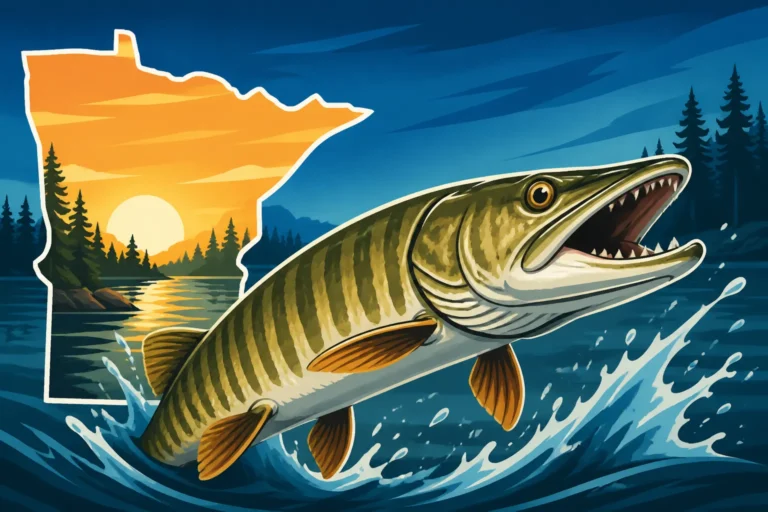
Muskies also have an elongated body, but their coloration is often lighter, ranging from silvery-green to brown with dark vertical bars, spots, or blotches, which can sometimes be indistinct. Crucially, the pattern can vary greatly, with some fish appearing almost plain. The critical identifier for a muskie is the opposite of the pike: their cheeks are not fully scaled, with the lower half being bare, and their gill covers are also only half-scaled. Look for 6 to 9 pores on each side of the underside of their jaw. Their teeth are just as formidable, perhaps even more so, adapted for tearing into large prey. Finding these elusive fish can be tough, but our Muskie Fishing in Minnesota: The Fish of 10,000 Casts guide can help you get started.
Telling Them Apart: Pike vs. Muskie
It can be a heart-stopping moment when you see a massive, toothy fish surface. Is it the pike of a lifetime, or your first muskie? Getting it right is important, especially since muskies are almost exclusively catch-and-release in Minnesota, with very strict size limits. Here’s how to tell the difference:
| Feature | Northern Pike | Muskie |
|---|---|---|
| Cheeks | Fully scaled | Lower half is bare (no scales) |
| Gill Covers | Upper half scaled, lower half bare (sometimes described as fully scaled on cheek, upper half of gill cover scaled) | Upper half scaled, lower half bare |
| Jaw Pores | Typically 5 pores on each side of the jaw underside | Typically 6-9 pores on each side of the jaw underside |
| Body Markings | Light, bean-shaped spots on a dark body | Dark spots, bars, or blotches on a lighter body, or sometimes clear |
| Tail Fin | More rounded or slightly concave | More deeply forked, often pointed tips |
| Size Potential | Maxes out around 20-25 lbs, rarely over 45 inches | Can exceed 50 lbs, commonly over 40 inches, up to 60 inches |
The most reliable visual cues are the scaling on the cheeks and gill covers, and the number of pores under the jaw. It's often easier to remember that if the cheeks and gill covers are fully scaled, it's a pike. If they have a bare patch, it's a muskie. These differences are detailed further in Muskie vs Northern Pike: How to Tell the Difference.
Panfish Paradise: Crappie, Sunfish, and Perch
For many, panfish are the entry point into the joy of fishing. They're abundant, relatively easy to catch, and provide fantastic table fare. Minnesota's lakes are brimming with various panfish species, and while they're often grouped together, each species has its own unique charm and identifying characteristics. From a kid's first bluegill to a seasoned angler targeting jumbo crappie, panfish offer endless fun.
Black and White Crappie: Speckled Beauties
Crappie are among the most popular panfish in Minnesota, cherished for their delicious fillets and their tendency to school, making for exciting fishing action. There are two main species: black crappie and white crappie, and while they look similar, there are key differences that can help you tell them apart. Both species are found in various lakes and slow-moving rivers, preferring areas with submerged vegetation, brush, or timber.
Black Crappie typically have a deeper, more compressed body shape, giving them a "dinner plate" profile. Their coloration is usually silvery with an irregular pattern of dark spots and blotches, often appearing as if someone splattered ink on their sides. The most reliable way to identify a black crappie is by counting the spines on its dorsal fin (the first fin on its back). Black crappies will have 7 or 8 dorsal spines. Their mouths are relatively large, extending to beneath the eye. They generally prefer clearer water bodies with more vegetation.
White Crappie, on the other hand, tend to have a more elongated body, not quite as deep as the black crappie, giving them a somewhat "stretched" look. Their coloration is also silvery, but their dark markings are usually arranged in distinct vertical bars or stripes along their sides. These bars are a dead giveaway. When counting dorsal spines, white crappies will consistently have 6 dorsal spines. They are also known for a slightly more dished-in profile from the top of their head to their mouth compared to the black crappie. White crappie are more tolerant of turbid or murky water and are often found in larger rivers and shallower, less clear lakes. Check out our guide on Black Crappie vs White Crappie for more comparison.
Sunfish Family: Bluegill, Pumpkinseed, and Green Sunfish
The sunfish family is truly diverse in Minnesota, with several species that are often caught interchangeably. These small, feisty fish are perfect for young anglers and provide consistent action. While they all share that iconic "panfish" shape—round and flat—each has unique markings and preferred habitats. Learning to distinguish them adds a layer of appreciation to every catch. You can get more details about these species in our Crappie & Panfish in Minnesota: Complete Guide.
Bluegill are arguably the most common and beloved sunfish. They have a deep, compressed body, usually olive-green or dark blue on the back, fading to yellow or orange on the belly. The key identifier is the dark blue-black spot at the posterior edge of the gill cover, often with a faint orange or red margin. They also typically have 5 to 9 dark vertical bars on their sides, though these can be faint. Their mouth is small, and they have a distinct black blotch at the base of the soft dorsal fin.
Pumpkinseed Sunfish are truly a work of art with their vibrant colors. They share the deep, compressed body of the bluegill but are easily distinguished by the bright orange-red spot on the posterior tip of their gill cover flap, often bordered by iridescent blues and greens. Their sides are adorned with wavy, iridescent blue or green lines and numerous small, iridescent spots. They also have a very small mouth.
Green Sunfish are a bit more robust and less compressed than bluegills or pumpkinseeds. They have a larger mouth, extending back to beneath the middle of the eye. Their coloration is olive-green on the back, fading to yellowish-green on the sides, with iridescent blue-green spots and streaks, especially on their cheeks and gill covers. The most telling feature is the distinct, often broad, yellowish-orange margin around the black spot on their gill cover. They also have a dark spot at the base of the soft dorsal and anal fins. They are often found in streams and small ponds.
Yellow Perch: The Striped Delicacy
Yellow perch are another highly prized panfish, known for their distinctive appearance and outstanding flavor. They're particularly popular during ice fishing season when they can be caught in large numbers. Unlike crappie and sunfish, which have a deeper, rounder body, perch have a more elongated, somewhat cylindrical shape.
A yellow perch is unmistakable with its striking golden-yellow to brassy-green body, adorned with 6 to 8 prominent dark vertical bars on its sides. Their fins are often reddish or orange, especially the pectoral and pelvic fins, making them quite vibrant. They have two distinct dorsal fins, the first being spiny and the second soft-rayed. Their mouth is moderately sized, and their scales feel rough to the touch. Yellow perch are often found in large schools, roaming both deep and shallow waters, preferring areas with some structure or vegetation. You can target these beauties using the tactics mentioned in Yellow Perch & Sauger in Minnesota.
Minnesota's Bass Bonanza: Largemouth and Smallmouth
Minnesota offers fantastic bass fishing, with both largemouth and smallmouth bass providing exciting action for anglers. While both are highly sought-after game fish, they occupy different niches and have distinct appearances and behaviors. Knowing the difference between them is key to understanding their habits and targeting them effectively. These two species offer vastly different, yet equally thrilling, fishing experiences. You can dive deeper into their world with our Smallmouth & Largemouth Bass in Minnesota guide.
Largemouth Bass: The Greenbacks
The largemouth bass is probably what most people picture when they think of "bass fishing." These powerful fish are known for their aggressive strikes and acrobatic fights. They're often called "greenbacks" due to their characteristic coloration, and they are masters of ambush predation, typically hiding in dense cover.
Largemouth bass have a robust, somewhat elongated body, typically dark green on the back, fading to lighter green or yellow-green on the sides, with a white belly. The most obvious identifier is the prominent dark, horizontal stripe or series of blotches running along the mid-line of their body. However, this stripe can sometimes be very faint, especially in larger or older fish. The defining feature, and how they get their name, is their large mouth. When closed, the corner of their mouth extends beyond the rear edge of the eye. Their dorsal fin is deeply notched, appearing almost as two separate fins. You'll find largemouth bass in warmer, shallower, and often weedy waters, favoring lily pads, submerged timber, and dense aquatic vegetation.
Smallmouth Bass: Bronze Backs of the North
Smallmouth bass are often considered the "fighter" of the bass family, known for their incredible strength and relentless, bulldog-like battles. While they don't grow quite as large as some of the biggest largemouths, their fighting spirit is legendary. These "bronze backs" are particularly beloved in rocky, clear water lakes and rivers throughout Minnesota.
Smallmouth bass have a more compact, muscular body than largemouths, typically brown or bronze on the back and sides, often with vertical bars or tiger stripes that can range from prominent to almost invisible. Their belly is usually white or cream-colored. The crucial identification mark is their mouth: when closed, the corner of their mouth typically extends only to the middle of the eye, or just slightly beyond, but never past the rear edge. Their dorsal fin is not as deeply notched as the largemouth's, appearing more like a single continuous fin. Smallmouth bass prefer cooler, clearer waters with rocky bottoms, gravel, and submerged boulders. They are less fond of dense vegetation and thrive in areas with current in rivers or wave-swept points in lakes. You'll often find them chasing baitfish in open water or along rocky structures.
Habitat and Behavior Differences
The distinct physical traits of largemouth and smallmouth bass are directly linked to their preferred environments and hunting strategies. Understanding these differences helps you not only identify the fish but also predict where to find them and what techniques might be most effective. It's a classic case of form following function in the aquatic world.
Largemouth bass are typically found in the "backwater" areas – bays, shallow flats, and areas with abundant cover. Their large mouths are perfectly designed to engulf prey whole, from frogs and mice to larger baitfish, often ambushing them from dense cover. They are visual predators that thrive in the warmer temperatures of shallower water, often suspending themselves within vegetation to stay hidden. This affinity for cover means techniques like flipping jigs, throwing weedless plastics, or working topwater lures over lily pads are highly effective.
Smallmouth bass, conversely, are often associated with "rock and roll" – meaning rocky bottoms, gravel shoals, and areas with current or wave action. Their smaller, more compact bodies and powerful tails allow them to navigate open water and currents with ease. They are keen eyesight hunters, often chasing down crayfish, minnows, and insect larvae in clearer water. They tend to be more nomadic, following schools of baitfish or cruising rocky structures. Tactics like drop-shotting, throwing tube jigs, or working crankbaits that mimic crawfish are often highly successful when targeting smallmouth.
Trout and Salmon: Coldwater Wonders
For those who crave the serene beauty of a rushing stream or the deep chill of Lake Superior, Minnesota's trout and salmon fisheries offer a unique angling experience. These coldwater species are known for their stunning beauty, powerful fights, and specific habitat requirements. Distinguishing between them involves looking at subtle color patterns, fin structures, and the presence or absence of specific spots.
Stream Trout: Brook, Brown, and Rainbow
Minnesota's "Driftless Area" in the southeastern part of the state, along with numerous stocked streams elsewhere, provides incredible opportunities for stream trout fishing. Each species has its own distinctive look, making identification a rewarding part of the catch. You can get a good start with our guide on Trout Fishing in Minnesota: Streams & Lakes.
Brook Trout are true natives to many of Minnesota's cold, clear streams. They are arguably the most beautiful of the stream trout, boasting vibrant colors. Their backs are typically olive-green with worm-like (vermiculated) patterns, fading to lighter sides with red and yellow spots. A key identifier is the leading edges of their lower fins (pelvic, anal, and pectoral) which are strikingly white, often followed by a black stripe, and then orange or red. Their tail fin is often square or slightly forked.
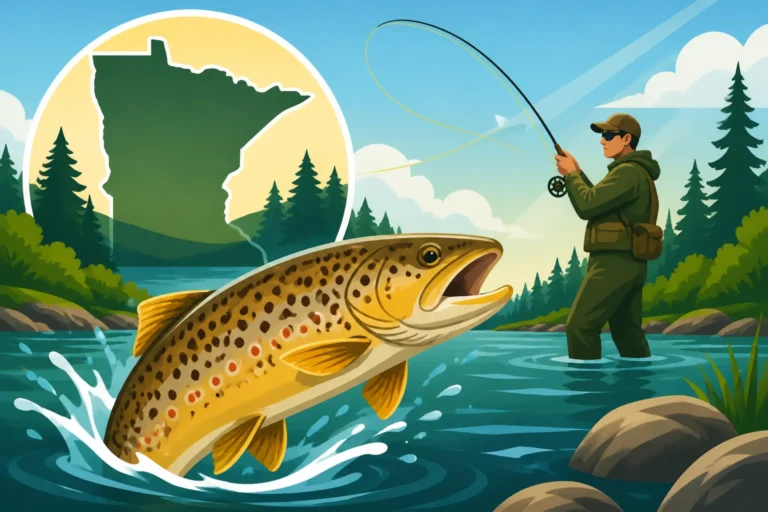
Brown Trout were introduced to Minnesota waters and have adapted well to many of our streams and some lakes. They are known for being wily and growing to impressive sizes. Brown trout are typically olive-brown to golden-brown on their backs and sides, with prominent dark spots that are often haloed with lighter rings. They also have reddish-orange spots, particularly on their sides, sometimes without halos. Their tail fin is usually square or slightly forked, and they lack the bright white leading edges on their lower fins that brook trout possess.
Rainbow Trout are another introduced species, widely stocked in streams and lakes across Minnesota due to their popularity with anglers and their hard-fighting nature. They get their name from the iridescent pink or reddish stripe that runs along their sides, especially prominent on spawning fish. Their bodies are typically silvery-green to blue-green on the back, fading to silver on the belly, and covered with numerous small black spots on the back, sides, and fins (including the tail fin). Their tail fin is typically slightly forked.
Lake Trout: Deepwater Giants
Lake trout are the largest of the char species and are true inhabitants of the deep, cold, oxygen-rich waters of northern Minnesota, primarily in Lake Superior and many lakes within the Boundary Waters Canoe Area Wilderness (BWCA) and Voyageurs National Park. Catching one is a significant achievement, often requiring specialized techniques like deep trolling or ice fishing. They are a species apart from their stream-dwelling cousins. Our guide on Lake Trout vs Brook Trout vs Brown Trout provides further insight.
Lake trout have a long, slender, almost torpedo-shaped body. Their coloration varies from pale gray to dark green or even brownish, with numerous light-colored, irregular spots on their sides, back, and dorsal fins. These spots are often larger and more distinct than those on rainbow trout. Their belly is typically white. A crucial identifier is their deeply forked tail fin, which is much more pronounced than other trout species. They also possess an adipose fin (a small fleshy fin between the dorsal and tail fins), a characteristic of all trout and salmon. Lake trout are slow-growing and long-lived, adapting perfectly to the frigid depths of their habitat.
North Shore Salmonids: Coho, Chinook, Steelhead
Lake Superior and its tributaries are home to a fascinating array of salmon and migratory trout, often referred to collectively as salmonids. These fish offer unique challenges and incredible rewards, especially during their spawning runs. Distinguishing between the various salmon species and migratory rainbow trout (steelhead) often comes down to fin ray counts, mouth characteristics, and spotting patterns.
Coho Salmon (Silver Salmon) in Lake Superior are characterized by their silvery sides and blue-green backs. They have small, widely scattered spots on their backs and on the upper lobe of their tail fin. The inside of their mouth is typically white with a black gum line at the base of the lower teeth. Their tail fin is moderately forked.
Chinook Salmon (King Salmon) are the largest of the Pacific salmon species found in Lake Superior. They are distinguished by their dark back, silvery sides, and a deeply forked tail that is heavily spotted on both lobes. The inside of their mouth is dark, almost black, with black gum lines. These powerful fish are a true test of an angler's tackle.
Steelhead are actually migratory rainbow trout that spend most of their lives in Lake Superior before returning to tributaries to spawn. They look like larger, more silvery versions of resident rainbow trout. They have a bright, chrome-like body with a pinkish stripe along their sides (which can be faint or vibrant depending on spawning stage) and numerous small black spots on their back, sides, and heavily spotted tail fin. The key differentiator from salmon is often the lack of a strong black gum line in the mouth for steelhead, and their broader, more trout-like head shape.
Unique and Underappreciated Species
Beyond the mainstream game fish, Minnesota's waters harbor a fascinating collection of unique and often underappreciated species. These fish add to the rich biodiversity of our aquatic ecosystems and offer alternative angling pursuits for those looking for something a little different. Many have unique characteristics that make them stand out from the crowd.
Lake Sturgeon: Ancient River Monsters
Imagine catching a fish that can live for over 100 years and grow to over 6 feet long! That's the lake sturgeon for you – a true living fossil. These magnificent creatures are the largest freshwater fish in Minnesota and are a testament to ancient evolutionary lines. Primarily found in the Rainy River, Lake of the Woods, and parts of the St. Croix and Red River systems, sturgeon fishing is a highly specialized, catch-and-release endeavor that attracts dedicated anglers. Our guide on Lake Sturgeon in Minnesota: Rainy River Giants will tell you all about them.
Lake sturgeon are unmistakable. They possess a primitive, shark-like appearance with a long, cylindrical body that is largely scaleless, instead covered with five rows of bony plates or "scutes" running along their body. Their coloration is typically olive-brown to gray on the back, fading to a white belly. They have a distinctive shovel-like snout with four sensitive barbels (whiskers) located on the underside, used for feeling along the bottom for food. Their mouth is protrusible and toothless, adapted for sucking up invertebrates. Their tail fin is heterocercal, meaning the upper lobe is longer than the lower, resembling a shark's tail. Anglers often comment on their incredible strength and prehistoric feel.
Catfish: Channel and Flathead
Minnesota's rivers, particularly the Mississippi, Minnesota, and St. Croix, are prime territory for catfish. These bottom-dwelling powerhouses offer fantastic fishing opportunities, especially for those who enjoy night fishing or strong, sustained fights. We have two main species: channel catfish and flathead catfish, each with distinct features and habits. Our Catfish in Minnesota: Channel & Flathead article covers these species in depth.
Channel Catfish are widely distributed and probably the most commonly caught catfish. They have a slender body, typically grayish-green to silvery-blue on the back, with scattered small black spots on their sides (though these spots can fade with age, especially in larger fish). Their tail fin is deeply forked, a key characteristic. They possess eight barbels around their mouth, used for sensing food in murky water. Their skin is smooth and scaleless. They feed on a variety of prey, from insects and crustaceans to small fish.
Flathead Catfish are the true giants of Minnesota's river systems, capable of growing to immense sizes (well over 50 pounds). They have a distinctive broad, flat head, hence their name. Their body is generally mottled yellow-brown to dark brown, often with a somewhat patchy or marbled appearance. Unlike channel cats, flatheads have a square or slightly notched tail fin, not deeply forked. They also have eight barbels, but their mouth is larger and they are almost exclusively piscivorous, meaning they prefer live fish as prey. Flatheads are more solitary and prefer deep holes and logjams in rivers. Telling these apart is crucial for regulations, as their populations are managed differently.
Burbot (Eelpout) and Bowfin (Dogfish)
While perhaps not as glamorous as walleye or muskie, burbot and bowfin are unique and fascinating fish that inhabit Minnesota's diverse waters. They offer interesting challenges and often surprise anglers with their fight and unusual appearances.
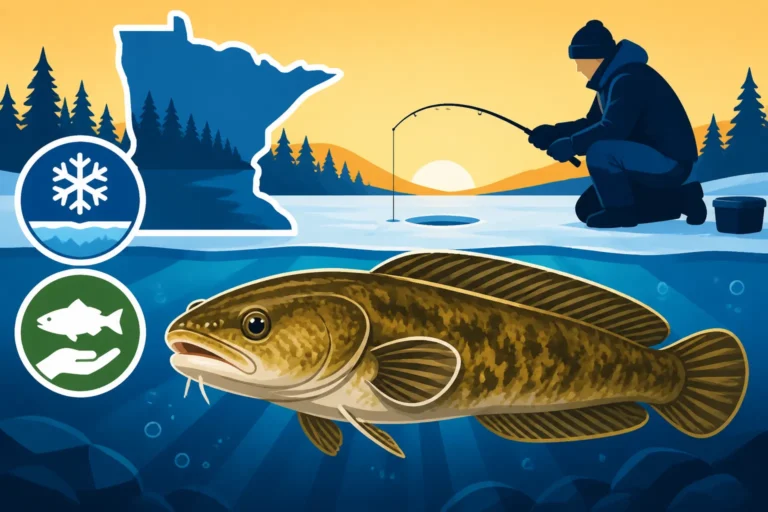
Burbot, affectionately (or not so affectionately) known as "eelpout," are the only freshwater member of the cod family found in North America. They are primarily a coldwater species, found in deep lakes and rivers, and are particularly targeted by ice anglers. They have a long, snake-like body, often mottled brown and olive, with a single barbel on their chin and a large mouth. Their skin is smooth, and they have two dorsal fins, the second one being very long, extending almost to the rounded tail fin. They are predatory and feed on other fish, often at night. Despite their less-than-charming appearance, burbot meat is surprisingly delicious, firm, and flaky.
Bowfin, also known as "dogfish," are another ancient species with a truly unique look. They are found in warmer, often weedy lakes and slow-moving rivers, particularly in central and southern Minnesota. They have a long, cylindrical body, typically olive-green to brown, with a distinctive long dorsal fin that runs almost the entire length of their back. Their head is covered in bony plates, and they have a large, toothy mouth. A key identifier is the large, dark spot (ocellus) with an orange or yellow halo at the base of their tail fin, especially prominent in males. They are incredibly hardy, capable of breathing air, and put up a ferocious fight when hooked. While often considered a "rough fish," they are a powerful and unique part of Minnesota's aquatic heritage.
Understanding Minnesota's Fish Diversity
Minnesota's waters are truly a treasure trove of aquatic life, offering a diverse array of fish species that cater to every type of angler. From the sought-after walleye to the prehistoric sturgeon, each species plays a vital role in our ecosystems and offers a unique angling experience. Learning to accurately identify your catch is more than just a matter of curiosity; it's essential for complying with fishing regulations, understanding fish behavior, and truly appreciating the natural world around us. So, the next time you feel that tug on your line, take a moment to observe your catch closely. You might just learn something new about the incredible fish that call Minnesota home.
Disclaimer
Please remember that fishing regulations, including size limits and possession limits, are subject to change. Always consult the most current Minnesota Department of Natural Resources (DNR) fishing regulations handbook or website before you head out on the water. This guide is for informational purposes and should not be considered a substitute for official DNR publications.