Muskie Fishing Techniques for Beginners
Let’s be honest: standing on a boat deck for eight hours, hurling a lure the size of a squirrel into the weeds without a single bite, can feel a little insane. Most beginners quit because they treat muskie fishing like bass fishing, but this is a completely different game of patience and precision. This guide solves that frustration by breaking down the essential techniques, gear, and mindsets you need to actually land the fish of 10,000 casts in Minnesota’s legendary waters.
Understanding the Beast Biology and Behavior
If you want to catch a muskie, you have to stop thinking like a fisherman and start thinking like an apex predator. Muskies are the lions of the Minnesota lake system; they aren't looking for a snack, they are looking for a meal that justifies the energy they spend to catch it. They are ambush predators, meaning they prefer to sit perfectly still, camouflaged in the weeds or near a rock, waiting for a high-calorie opportunity to swim by. Understanding this "sit and wait" mentality is the first step toward choosing the right spot to cast.
In many of our local lakes, muskies have a very specific home range. They aren't nomadic travelers like walleye can be. A big female might live on a specific 50-yard stretch of a weed line for the entire summer. This is why you’ll often hear veterans talk about "seeing a fish" in a certain spot. They aren't just guessing; they know that fish is a resident. When you are starting out, your goal isn't just to catch a fish, but to locate these residents. Once you know where one lives, you can return to it when the conditions are perfect.
Temperature is the primary driver of muskie behavior. In the early summer, they are often in the shallows where the water warms up first, soaking up the sun to help their metabolism. As the heat of July and August hits, they might slide deeper or bury themselves in the thickest "cabbage" weeds they can find to stay cool and oxygenated. If you aren't checking the water temperature constantly, you're fishing blind. I always tell beginners to pay attention to the Minnesota Muskie Season & Size Limit before they even head out, as the timing of the season dictates exactly where those fish are going to be hanging out.
Essential Gear for the Newbie Without Breaking the Bank
One of the biggest hurdles for beginners is the sticker shock of muskie tackle. You can easily spend a thousand dollars on a single rod and reel setup, but you don't have to. For your first rig, you need a "do-it-all" setup. Look for a rod that is at least 8 feet, 6 inches long. The length isn't just for casting distance; it’s for the figure-eight maneuver at the side of the boat. A heavy-power, fast-action rod will give you the backbone to set those massive hooks into a muskie's bony mouth without snapping your equipment.
When it comes to the reel, you need a high-quality baitcaster with a power handle. Muskies create incredible torque, and a cheap reel will literally fall apart after a few days of pulling heavy bucktails. You want a reel with a decent gear ratio—somewhere around 5.3:1 or 6.2:1—which allows you to move the bait quickly without wearing out your wrist. You can find several reliable entry-level muskie reels on Amazon that will get the job done for your first few seasons. Just make sure the drag is smooth; a jerky drag is the fastest way to lose a trophy at the side of the boat.
Line and leaders are the most underrated part of the setup. Don't even think about using monofilament. You need 80-pound test braided line. It sounds like overkill until you realize that a 50-inch muskie can put a literal snap-stress on the line that would break 30-pound braid instantly. On the end of that braid, you must use a high-quality leader. I prefer 100-pound to 130-pound fluorocarbon leaders because they are nearly invisible in the water but tough enough to withstand those razor-sharp teeth. If you're wondering about the specifics of what's legal and what’s not for your gear, it’s a good idea to check the Minnesota Fishing Regulations Changes for 2026 to stay compliant with any new tackle restrictions.
Mastering the Lure Selection
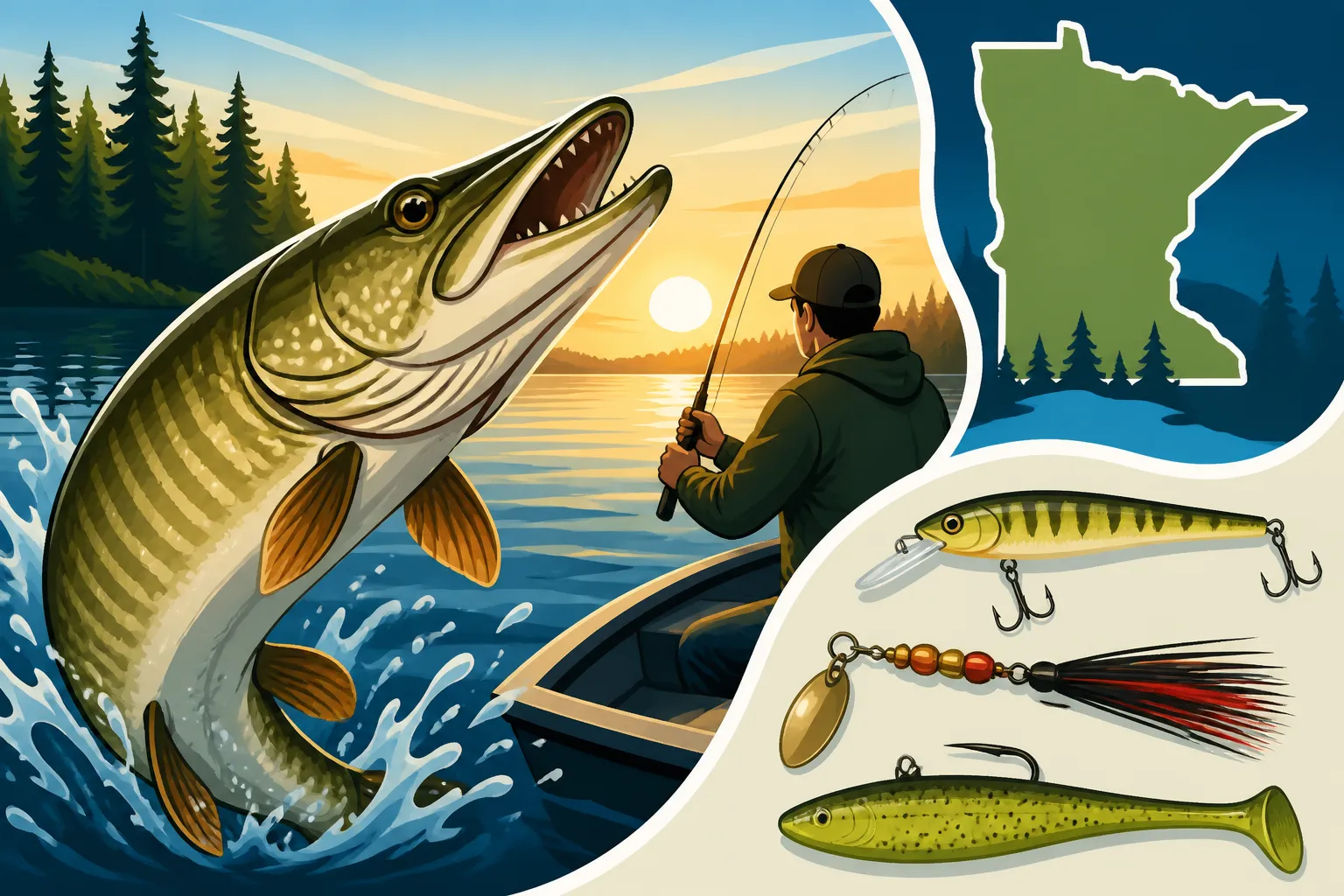
Walking into a tackle shop and looking at muskie lures is overwhelming. They are huge, expensive, and come in every color of the rainbow. For a beginner, I recommend sticking to the "Big Three": bucktails, topwaters, and jerkbaits. Bucktails are the bread and butter of the sport. They are simple to use—just cast and wind—and they catch more fish in Minnesota than probably all other lures combined. The vibration of the blades and the flow of the deer hair or tinsel are irresistible to a muskie's lateral line.
Topwater lures are where the real excitement happens. There is nothing in the world like a 20-pound fish exploding on a "Top Raider" or a "Whopper Plopper" at the surface. These are best used during low-light conditions, like dawn or dusk, or on those humid, overcast days when the water is like glass. Beginners often make the mistake of setting the hook the second they see the splash. You have to wait until you actually feel the weight of the fish on the rod, or you'll just pull the lure right out of its mouth. If you’re looking to stock up, Amazon often has bulk deals on these larger lures that can save you a few bucks compared to boutique shops.
Jerkbaits and gliders require a bit more "user input." These lures don't have an action of their own; you have to give it to them with rhythmic twitches of the rod tip. This mimics a dying or wounded sucker, which is a muskie's favorite snack. It takes practice to get that "walk the dog" action under the surface, but once you master it, you’ll have a tool that can trigger bites when the fish are being lazy. For more on how these different lures fit into a broader strategy, you might want to look into Best Muskie Fishing Tactics in Minnesota to see how the pros rotate their lure choices throughout the day.
| Lure Type | Best Condition | Retrieve Style | Difficulty |
|---|---|---|---|
| Bucktail | Sunny/Windy | Straight & Fast | Easy |
| Topwater | Calm/Low Light | Steady "Plopping" | Medium |
| Jerkbait | Cold Water/Cloudy | Twitch-Twitch-Pause | Hard |
| Crankbait | Deep Water/Rocks | Trolling or Casting | Easy |
| Soft Plastic | Deep Weeds | Slow Jigging | Medium |
Core Casting and Retrieval Techniques
The most important thing to learn about muskie fishing is that the retrieve doesn't end until the lure is out of the water. This is where the "Figure-8" comes in. About 30% to 50% of muskie strikes happen right at the side of the boat. Because muskies are curious, they will often follow a lure for fifty yards just to see what it is. If you just pull the lure out of the water to cast again, that fish will swim away. Instead, when your lure gets within a few feet of the rod tip, you plunge the rod into the water and lead the lure in a wide, sweeping "8" pattern.
Executing a proper figure-eight requires you to stay calm, which is hard when a five-foot fish is staring at your boots. You want to make your turns wide and keep the lure moving at a consistent speed—or even slightly faster—during the turns. Most fish will strike on the turn because that’s when the "prey" looks like it’s trying to escape. If a fish is following, don't stop! Stopping the lure is a signal to the muskie that the prey is "fake." Keep that lure moving until she either bites or sinks back into the depths. This is why Muskie Figure-8 Technique is often the first thing a guide will teach you.
Beyond the figure-eight, your casting technique needs to be efficient. You are going to be making hundreds, if not thousands, of casts in a weekend. If you are using your "all muscle," you’ll be exhausted by noon. Use the length of the rod to your advantage, letting the rod's "load" do the work for you. Aim for the edges of weed beds or the pockets inside the lily pads. Muskies love "edges"—the transition from shallow to deep, or from weeds to sand. If you can land your lure right on that transition line, you are much more likely to trigger a strike.
Finding Muskie in Minnesota Lakes
Minnesota is blessed with some of the best muskie water on the planet, but that doesn't mean they are everywhere. You need to target lakes that are managed for muskellunge. If you're in the Twin Cities, you have incredible options like Lake Minnetonka or White Bear Lake. If you're heading north, the heavy hitters are Mille Lacs, Leech Lake, and Lake Vermilion. Each of these lakes has a different "flavor" of fishing. For example, Mille Lacs Lake Fishing Guide: Walleye, Bass & More will show you that while it's famous for walleye, its muskie population is world-class.
Inside these lakes, you are looking for "green" weeds. Not all weeds are created equal. You want cabbage and coontail—large-leafed, sturdy plants that stay green well into the autumn. These plants provide the best cover for muskies and the best oxygen levels. If the weeds are brown and slimy, move on. The fish won't be there. Use your electronics to find the "crown" of a weed bed, where it comes closest to the surface, and cast all the way around it.
Don't overlook the rocks, especially as the season progresses into late summer and fall. Large boulders and reefs can hold a lot of heat, and they attract the smallmouth bass and perch that muskies love to eat. If you find a spot where a weed line meets a rock pile, you’ve found a "honey hole." For those who are just starting out and want to know exactly which lake to pick for their first trip, I highly recommend reading up on Best Muskie Lakes in Minnesota to find a body of water with a high "action" rating rather than just a "trophy" rating.
The Art of the Safe Release
This is the most critical section for any beginner. Muskies are a fragile resource. They take a long time to grow—a 50-inch fish could be 15 to 20 years old. If you catch one and handle it poorly, it will die, even if it swims away from the boat. You must have the right tools ready before you even make your first cast. This includes a massive, rubber-coated net, long-nose pliers, and high-quality hook cutters. You can find "release kits" on Amazon that bundle these tools together, and they are worth every penny.
The golden rule of muskie fishing is to keep the fish in the water as much as possible. Once the fish is in the net, keep the net in the lake. Do not haul the fish onto the carpet of the boat where it can thrash and damage its slime coat or internal organs. Use your pliers to pop the hooks out while the fish's head is still submerged. If a hook is buried in a bad spot, don't rip it out—use your bolt cutters to snip the hook. A ten-cent hook is not worth the life of a hundred-dollar fish.
When you're ready for a photo, have your camera or phone out and ready. Reach into the water, support the fish's weight with two hands (one under the "collar" or gill plate—being careful not to touch the red gills—and one under the belly), lift it for a quick five-second shot, and put it right back. When releasing, hold the fish by the tail in the water until it is strong enough to swim out of your hand. Never "pump" the fish back and forth; this actually forces water backward through the gills and can drown them. For more details on this, see Catch and Release Best Practices in Minnesota.
Planning Your First Muskie Trip
Success in muskie fishing is often about being in the right place at the right time. You can be the best caster in the world, but if the fish aren't "on," you won't catch them. Pay attention to the weather. A "falling barometer" or an approaching storm front is often the best time to fish. Muskies seem to sense the change in pressure and go on a feeding binge before the weather turns. Conversely, the day after a cold front—with bright blue "bird" skies—is usually the hardest time to get a bite.
If you are a total beginner, I often suggest hiring a guide for your first day. It seems expensive, but a guide will teach you more in eight hours than you’ll learn in three years on your own. They will show you the "milk run" of spots, help you perfect your figure-eight, and most importantly, they will have all the gear you need. If you're going solo, start with a smaller "action" lake where the fish population is higher, even if the average size is smaller. This will give you more "follows" and more chances to practice your moves.
Lastly, make sure you are legal. Minnesota takes its fishing laws seriously, and muskie regulations can be very specific depending on the lake. You’ll need a valid license, and in some cases, you need to be aware of the Minnesota Fishing Limits: Bag & Possession (2026) to ensure you aren't violating any specific lake ordinances. Always have your How to Get a Minnesota Fishing License Online information handy so you aren't caught off guard at the boat ramp.
Muskie Fishing vs. Other Species Comparison
| Feature | Muskie Fishing | Bass Fishing | Walleye Fishing |
|---|---|---|---|
| Typical Lure Size | 8 – 12 inches | 3 – 6 inches | 2 – 4 inches |
| Primary Goal | Quality over Quantity | Consistent Action | Food/Table Fare |
| Gear Strength | 80lb Braid | 10 – 20lb Line | 6 – 10lb Mono/Braid |
| Physical Demand | Very High | Medium | Low |
| Patience Required | Infinite | Moderate | Low to Moderate |
Troubleshooting Common Beginner Mistakes
The most common mistake I see beginners make is "lure-watching." You get so mesmerized by the action of your bucktail that you forget to look behind it. You should always be scanning the water three to five feet behind your lure. Many times, you won't see a "follow" because the fish is sitting deep under the lure, but you might see a "shadow" or a "push" of water. If you see that, it’s time to go into an immediate figure-eight.
Another mistake is fishing too slowly. Beginners often think they need to give the fish time to see the lure. In reality, muskies are trigger-based hunters. If a lure is moving fast and looks like it’s escaping, the fish has to make a split-second decision to strike. If the lure is crawling along, the fish has all day to realize it’s made of plastic and bucktail. Don't be afraid to burn that lure back to the boat. Speed kills in the muskie world.
Finally, don't give up. It’s called the fish of 10,000 casts for a reason. I have gone four straight days without seeing a single fish, only to have the fifth day result in three giants in the boat. It’s a game of mental toughness. If you can stay focused, keep your hooks sharp, and execute your figure-eights, the "Minnesota monster" will eventually show up. For those looking to branch out after they've mastered the muskie, exploring Northern Pike in Minnesota: Identification & Where to Catch can be a great way to stay busy during the "slow" muskie hours.
Minnesota Fishing Regulations and Safety
Always remember that Minnesota lakes can be dangerous, especially the big ones like Mille Lacs or Lake of the Woods. If you are out chasing muskies, you are often out in "big water" gear. Ensure your boat is equipped with all necessary safety equipment, and always wear your life jacket when the big motor is running. Muskie fishing often involves standing on elevated casting decks, and it only takes one unexpected wave from a passing cruiser to send you into the drink.
In addition to safety, be an advocate for the water. Aquatic Invasive Species (AIS) are a major threat to our muskie fisheries. Zebra mussels and Eurasian watermilfoil can change the entire ecology of a lake, making it harder for muskies to hunt and spawn. Always clean, drain, and dry your boat when moving between bodies of water. You can find more on this in the Aquatic Invasive Species (AIS) Rules for Boaters guide. Being a muskie angler means being a steward of the lake, ensuring that the next generation of Minnesotans gets to experience the heart-stopping thrill of a 50-inch fish following their lure to the boat.
Disclaimer
This guide is provided for informational purposes only. Fishing regulations in Minnesota are subject to change by the Department of Natural Resources (DNR) at any time. Always verify current seasons, size limits, and gear restrictions on the official Minnesota DNR website or in the current year’s printed regulation booklet before heading onto the water. Safe handling and release of muskellunge are essential for the sustainability of the fishery; please prioritize the health of the fish over a photo opportunity.