How to Catch Lake Trout: Jigging & Trolling
Trying to dial in those elusive, deep-dwelling lake trout in Minnesota can feel like searching for a needle in a haystack, especially when you’re new to their habits. These powerful, cold-water denizens demand a bit more strategy than your average panfish, often lurking in the frigid depths, far from the surface action. But don't let their mystique deter you! With the right approach, equipment, and a solid understanding of their movements, you can consistently put these magnificent fish in your boat. This guide will break down the most effective techniques—jigging and trolling—to help you unlock Minnesota's lake trout potential.
Unraveling the Mystery of Minnesota Lake Trout
Lake trout are a unique and thrilling challenge for any angler, known for their incredible fighting spirit and beautiful, spotted appearance. To catch them, you first need to understand their world: the deep, cold, oxygen-rich waters of Minnesota's most pristine lakes.
Identifying Lake Trout and Their Preferred Haunts
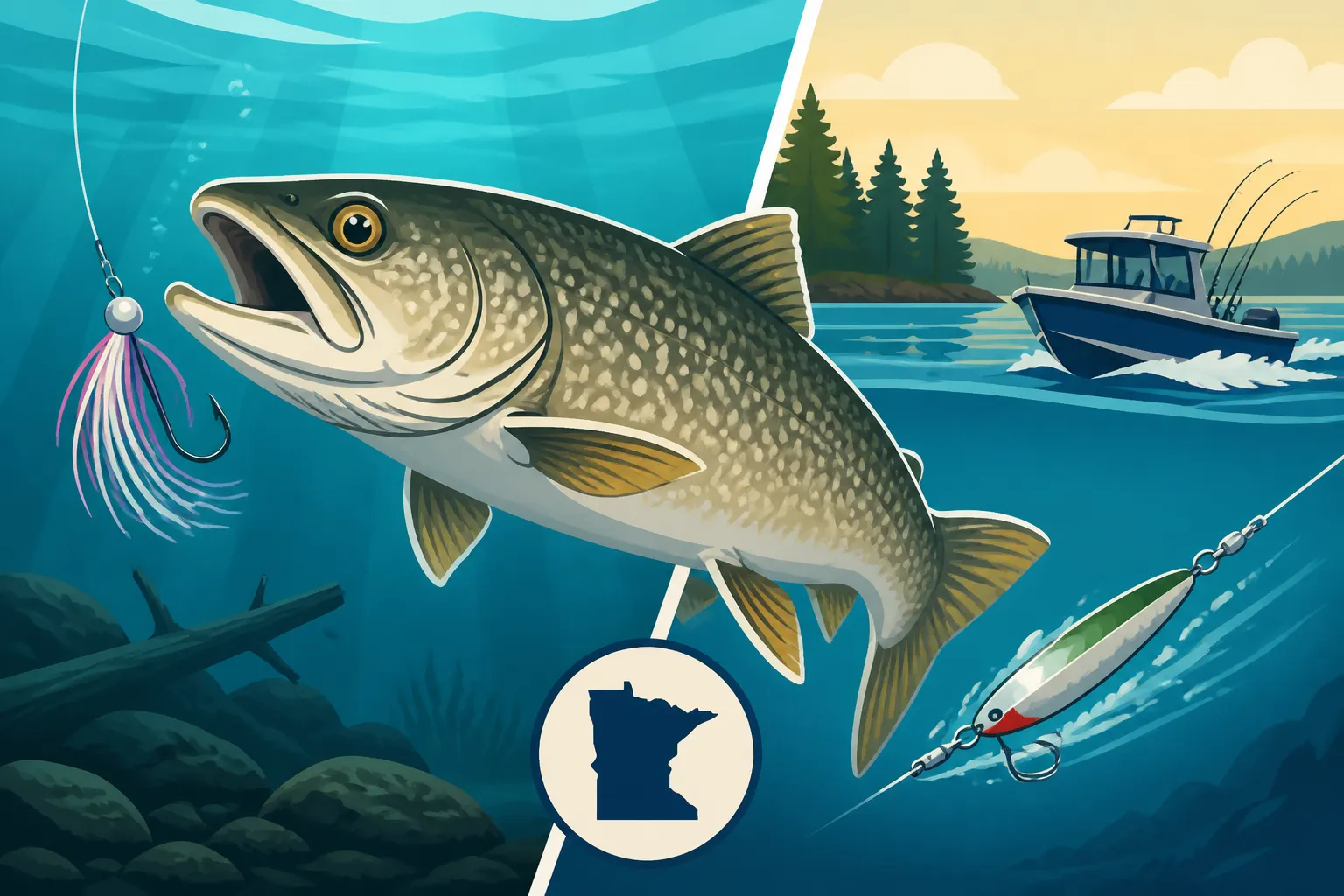
Lake trout, often simply called "lakers," are distinct from other trout species found in Minnesota. They typically have a deeply forked tail, a dark green to gray body with light spots, and a white leading edge on their lower fins, but without the black spot usually seen on brook or brown trout. They are true giants of the cold water, capable of reaching impressive sizes, sometimes exceeding 20 pounds in Minnesota's premier fisheries. For more on distinguishing between different trout species, check out our guide on Lake Trout vs Brook Trout vs Brown Trout.
These fish are creatures of habit when it comes to their environment. They thrive in water temperatures between 45 and 55 degrees Fahrenheit (7 to 13 degrees Celsius). This means that during the warm summer months, you'll almost exclusively find them in deep main-lake basins, often 50 feet or more, congregating around structure that offers both food and thermal refuge. Think about steep drop-offs, deep humps, underwater points, and the edges of vast, deep flats. These areas create current breaks and ambush points for their primary forage, which often includes ciscoes (tullibee), smelt, whitefish, and even smaller yellow perch.
Minnesota is blessed with several exceptional lake trout lakes. Arrowhead Region lakes like Lake Superior and many of the larger, deeper lakes within the Boundary Waters Canoe Area Wilderness (BWCA) are prime destinations. Think about lakes such as Lake Saganaga, Gunflint Lake, and Trout Lake. Further south, deep, clear lakes like Clearwater Lake near Grand Marais, or portions of Lake Vermilion, also hold strong populations. Knowing these deep-water havens is your first step to finding these magnificent fish.
Lake Trout Seasonal Migration and Behavior
Lake trout are not static residents; their behavior and location shift dramatically throughout the year, largely dictated by water temperature and spawning cycles. Understanding these seasonal patterns is crucial for successful angling. You can learn more about general fishing patterns in our article on Seasonal Fishing Patterns in Minnesota.
- Spring (Post-Ice Out): As soon as the ice leaves, usually late April to mid-May, lake trout can be found in relatively shallower waters, sometimes as shallow as 10-20 feet. The entire water column is cold and oxygenated, meaning they don't have to retreat to the extreme depths yet. They'll actively feed around points, shallow reefs, and shorelines that quickly drop into deeper water. This is an excellent time for both jigging and shallow trolling. They're often hungry after a long winter under the ice.
- Summer (Thermal Stratification): This is when lake trout go deep. As surface waters warm and the lake stratifies, creating distinct temperature layers, lake trout seek out the comfortable, cold water, typically below the thermocline. You'll find them concentrating around deep structure: submerged islands, deep rock piles, sharp breaklines, and the deepest sections of the main lake basin. Depths of 50 to 150 feet are common, sometimes even deeper. This period demands specialized deep-water techniques like downrigging or heavy jigging.
- Fall (Pre-Spawn and Spawning): As the water cools in late September and October, lake trout begin to move shallower again, preparing for their late-fall spawn. They will often congregate on rocky shoals, reefs, and specific rock rubble shorelines, typically in 10-40 feet of water, though the exact depth can vary. This can be another fantastic time for aggressive jigging or even casting large swimbaits, especially in areas with significant rock structure. Their spawning usually occurs in late October or November when water temperatures are consistently in the low 40s.
- Winter (Ice Fishing): Even under the ice, lake trout behave predictably. During early ice, they might be shallower, relating to structures similar to fall. As winter progresses, they often retreat to deeper basin areas, then return to suspended forage or deep structure. Jigging through the ice is a popular and highly effective method. For more information on fishing for them in the winter, check out our guide on How to Catch Lake Trout Through the Ice in Minnesota.
By adapting your tactics to these seasonal shifts, you'll significantly increase your chances of locating and catching Minnesota's impressive lake trout.
Mastering the Art of Jigging for Lake Trout
Jigging is a highly effective, active fishing technique for lake trout, particularly when they are concentrated in specific areas or relating tightly to structure. It allows for precise lure presentation and immediate feedback, making it an incredibly rewarding method.
The Right Gear for Vertical Jigging
When you're jigging for lake trout, you're not going for finesse. These fish are powerful, often striking hard and making strong runs, especially in deep water. Your gear needs to be robust and capable of handling heavy lures and deep-water fights.
-
Rods: Look for a medium-heavy to heavy power spinning or baitcasting rod, typically 6'6" to 7'6" in length. The rod should have a fast action tip for sensitivity and solid backbone to set the hook and muscle fish from the depths. A quality graphite blank will transmit subtle bites even at 100 feet down. Brands like St. Croix or Fenwick offer excellent options that can stand up to the challenge.
-
Reels: A sturdy spinning reel in the 3000-4000 series or a reliable baitcasting reel with a good drag system is essential. The reel should have a high retrieve rate to quickly bring lures back up for another drop or to gain line on a hard-fighting laker. Ensure it has a smooth, consistent drag that won't falter under pressure.
-
Line: This is where things get critical for deep-water jigging. Braided line is almost universally preferred due to its zero-stretch properties, which provide maximum sensitivity and hook-setting power at extreme depths. Spool up with 20-30 lb test braided line. To make your presentation more natural and less visible, always add a 6-10 foot leader of 15-20 lb test fluorocarbon line. The fluorocarbon is nearly invisible underwater and is more abrasion-resistant against rocks and the lake trout's sharp teeth. A strong knot, like a Double Uni or FG knot, is crucial for connecting your braid to fluoro.
-
Lures and Baits: Lake trout are opportunistic predators, and several lure types excel for jigging:
- Heavy Spoons: Brands like Acme Little Cleo, Dardevle, or Luhr-Jensen Krocodile in sizes from 1 oz to 3 oz are classic lake trout jigging lures. Silver, blue, white, or chartreuse colors are often effective, mimicking baitfish.
- Tube Jigs: Large tube jigs, 4-6 inches long, rigged with a heavy lead head (1/2 oz to 1 oz+) are fantastic, especially when tipped with a piece of cut bait or a scent like Berkley Gulp! Alive! Smelt. White, pearl, or glow-in-the-dark tubes are popular choices.
- Jigging Raps/Rapala Ice Jigs: While often associated with ice fishing, larger jigging raps (sizes 7, 9, 11) can be deadly in open water. Their erratic, darting action often triggers aggressive strikes.
- Large Grubs/Paddle Tails: Soft plastics in the 4-7 inch range rigged on heavy jig heads (3/4 oz to 2 oz) can imitate larger baitfish. White, pearl, smoke, or chartreuse are go-to colors.
- Blade Baits: Lures like the Heddon Sonar or Johnson ThinFisher, especially in silver or gold, produce a lot of vibration and flash, which can be irresistible to deep-dwelling lakers.
When buying specialized fishing gear, remember that retailers like Amazon often have a wide selection of these lures and tackle components.
Mastering Jigging Techniques
Successful lake trout jigging isn't just about dropping a lure; it's about presenting it with action and maintaining contact, often while watching your electronics.
- Vertical Presentation is Key: Unlike casting, you want your lure directly below your boat. Use your boat's trolling motor (like a Minn Kota Terrova or Ultrex) to stay directly over your target area and the fish. Drift fishing can also be effective if the wind and current allow you to cover structure at a good pace.
- The Lift-Fall Cadence: This is the bread and butter of lake trout jigging. Drop your lure to the desired depth (often just above where you see fish on your sonar). Then, with a strong, sharp lift of your rod tip (anywhere from 1-5 feet), propel the lure upwards, followed by a controlled fall. The strike often happens on the fall, as the lure is fluttering or spiraling down. Pay close attention to any "ticking" or sudden slack in your line.
- Experiment with Action: Don't be afraid to vary your jigging retrieve. Sometimes a slow, subtle twitch is all it takes. Other times, an aggressive rip followed by a long pause is what they want. Watch your sonar: if fish are present but not reacting, change your cadence. Incorporate pauses of varying lengths – sometimes a 5-10 second pause after a big lift is what seals the deal.
- Deadsticking/Soaking: While active jigging is common, sometimes a more passive approach can work, especially if fish are lethargic. Drop a heavy spoon or tube jig to the bottom, give it a few jigs, then let it sit motionless or just gently drift with the boat's movement. Tipping your jig with a piece of cut herring or sucker meat can make it even more enticing.
When and Where to Employ Jigging Tactics
Jigging truly shines in specific scenarios, making it a highly targeted and efficient method when conditions are right.
- Concentrated Fish: If your sonar is showing schools of lake trout or individual marks tightly grouped around a specific deep hump, rock pile, or cliff face, jigging is the way to go. You can drop your lure directly into the strike zone.
- Steep Structure: Jigging excels along sharp drop-offs and vertical structures where trolling might be difficult due to snags. You can work the contours precisely, enticing fish holding tight to these features.
- Spot-on-the-Spot: When you've identified a "spot-on-the-spot"—a specific small area within a larger structure that holds fish consistently—jigging allows you to meticulously pick it apart. Use your GPS to mark these precise locations.
- Calm Days: On calm days, when boat control is easier, jigging becomes much more effective. Wind and waves can make it challenging to keep your lure vertical and maintain bottom contact in deep water.
- Open Water Suspenders: Sometimes lake trout suspend in open water, chasing schools of baitfish. When your electronics show arcs suspended high off the bottom in the middle of a basin, dropping a heavy jigging lure directly to their depth can be incredibly effective.
By understanding these techniques and matching them to the conditions, you’ll be well on your way to consistent lake trout success.
Trolling Strategies for Covering Lake Trout Territory
While jigging is excellent for concentrated fish, trolling is the ultimate technique for covering vast expanses of water and locating scattered lake trout, especially in large lakes. It allows you to present lures at various depths and speeds, mimicking baitfish moving through their environment.
Essential Trolling Setups and Lure Choices
Effective lake trout trolling requires specialized gear to reach deep depths and handle strong strikes.
- Rods: You'll want medium to medium-heavy action trolling rods, typically 7-9 feet long, with a moderate or moderate-fast taper. This action helps absorb the shock of a strike and keeps fish pinned during long fights. Fiberglass or composite rods are popular for their durability and forgiving action.
- Reels: Levelwind baitcasting reels are standard for trolling. Look for reels with a line counter feature, which is absolutely critical for knowing how much line you have out and replicating successful depths. Reels like the Daiwa Accudepth or the Shimano Tekota are workhorses for this application. Spool up with 15-25 lb monofilament or fluorocarbon main line, or consider using lead core or copper line for depth.
- Depth Control Devices: This is where trolling gets scientific.
- Downriggers: These are mechanical devices that use a heavy ball weight (often 8-12 lbs) to carry your fishing line and lure down to a precise, desired depth. Your fishing line is temporarily clipped to the downrigger wire, and when a fish strikes, the line pops free, allowing you to fight the fish directly. For very deep lake trout, downriggers are indispensable.
- Dipsy Divers/Planer Boards: Dipsy Divers are dive weights that plane out to the side while taking your lure down. They're great for presenting lures away from the boat's wake and can reach depths of 30-80 feet depending on size and speed. Planer boards (like Offshore Tackle's side planers) pull lines out wide, allowing you to run multiple lines without tangles, especially useful for shallower trolling passes or when combining with lead core.
- Lead Core Line: This specialized line has a lead core inside a braided sheath, causing it to sink. Each "color" (section, usually 10 yards) of lead core sinks a certain amount at a given speed. For example, at 2 mph, each color might get you 5 feet of depth. By letting out multiple colors, you can achieve substantial depths without heavy weights directly on your line.
- Snap Weights: These are clip-on weights that allow you to add weight to your regular fishing line at specific distances from your lure, helping it dive deeper.
- Lures:
- Spoons: Thin metal spoons like Luhr-Jensen Kwikfish, Eppinger Daredevil, or Northern King spoons are classic lake trout trollers. Silver, blue, green, and orange are popular colors. Sizes from 3-6 inches are common.
- Crankbaits/Stickbaits: Long, slender crankbaits that imitate baitfish, such as Rapala Original Floaters, Husky Jerks, or Storm ThunderSticks, are effective, especially in varying depths. Look for diving lip designs that get them down.
- Flasher/Dodger Combos: Sometimes lake trout respond better to the added attraction of a flasher or dodger ahead of a short leader with a spoon or tube jig. These large, wobbling plates create significant flash and vibration, drawing fish in.
- Plugs: Large, diving plugs like the J-Plug or Lyman lures are extremely popular for big lake trout, especially in places like Lake Superior. Their wide, wobbly action drives lakers wild.
Locating Fish and Adjusting Trolling Depths
Trolling is a game of continuous adjustment and observation. Finding the fish is only half the battle; presenting your lure at their exact depth is the other.
- Utilizing Sonar: Your fish finder (see our guide on Best Fish Finders & Electronics for Minnesota Fishing) is your best friend. Watch for baitfish schools, individual lake trout arches, and the thermocline (the distinct temperature boundary where water changes rapidly). Lake trout will almost always be in or just below the coldest, oxygenated water, which often coincides with the thermocline in summer. Mark any fish you see.
- Dialing in Depth: This is critical. If you see fish at 70 feet, you want your lure at 70 feet, or slightly above them. Downriggers make this precise, while lead core requires experience to estimate depth based on colors out and boat speed. Experiment with depths in 5-10 foot increments until you start getting bites. Keep a log of successful depths, boat speeds, and lures used.
- Trolling Speed: Lake trout typically prefer slower trolling speeds, often between 1.5 to 3.0 mph, but this can vary. Faster speeds can elicit reaction strikes, while slower speeds allow them to track and commit. Adjust your speed to make your lures work optimally; some spoons have better action at higher speeds, while plugs might prefer slower pulls.
- "S" Turns and Turns: Don't just troll in a straight line. Make wide, sweeping "S" turns or gentle turns. When your boat turns, the lures on the inside of the turn will slow down and drop, while the lures on the outside will speed up and rise. These changes in speed and depth often trigger strikes from following fish. A lot of strikes happen right as the boat is coming out of a turn.
- Targeting Structure: While trolling open water is common, also focus on trolling along the edges of deep structure, like main-lake points, submerged reefs, or the deep side of humps. Lake trout will often cruise these edges looking for prey.
Advanced Trolling Tactics for Finicky Biters
Sometimes, even with the right depth and speed, lake trout can be finicky. Here's how to entice those tougher bites:
- Color Changes: Don't be afraid to cycle through different lure colors. What works one day might not the next. Carry a variety of silver, gold, blue, green, orange, and even glow-in-the-dark patterns. Water clarity and light conditions can heavily influence color preference.
- Scent Applications: Adding scent to your lures can make a significant difference. Products like Smelly Jelly, Pro-Cure, or even simply rubbing cut bait on your spoons can add an extra layer of attraction, especially for less aggressive fish.
- Long-Lining vs. Short-Lining: Vary the distance your lure is behind the boat. Sometimes fish are spooked by the boat and prefer a lure 200 feet back on a planer board. Other times, they might hit a lure just 50 feet back off a downrigger. Experimentation is key.
- Combining Techniques: Don't limit yourself to just one method. You can run downriggers deep while simultaneously deploying lead core lines at mid-depths or Dipsy Divers to the side. This multi-line approach helps you quickly pinpoint where the fish are holding and what they're hitting. Remember to follow Minnesota Fishing Limits: Bag & Possession (2026) regarding how many lines you can legally fish.
- Wind and Current: Pay attention to how wind and current affect your boat and lure presentation. Trolling with the wind can be easier, but sometimes going against it provides a more natural presentation for your lures. Adjust your boat speed (ground speed, not just engine RPM) to maintain optimal lure action.
Key Considerations for Consistent Lake Trout Success
Catching lake trout consistently isn't just about the immediate technique; it's about preparation, interpretation, and responsible practices that ensure future fishing opportunities.
Interpreting Your Electronics and Lake Maps
Modern electronics and mapping are invaluable tools for lake trout anglers, especially when dealing with deep, complex underwater terrain.
- High-Resolution Sonar: A good fish finder with high-resolution 2D sonar and possibly side imaging or down imaging is a game-changer. Look for clear fish arches, baitfish schools, and changes in bottom composition. Pay attention to the "clutter" on your screen, which can indicate baitfish, zooplankton, or even schools of young lake trout. Many anglers swear by brands like Garmin, Humminbird, or Lowrance for their advanced capabilities.
- Understanding the Thermocline: On your fish finder, the thermocline often appears as a fuzzy or cloudy horizontal line. This is a critical depth to identify because lake trout will typically be just below it or actively moving through it. Adjust your lures to run at this depth or deeper.
- GPS and Lake Mapping: Integrated GPS with detailed lake maps (like Navionics or LakeMaster chips) is essential. These maps reveal contours, humps, drop-offs, and rock piles that are lake trout magnets. Mark successful waypoints—where you catch fish, where you see bait, or where you identify promising structure. Don't be afraid to use fishing apps to aid your navigation and exploration. Our guide on Best Fishing Apps for Minnesota (Fishbrain, Navionics) can give you a head start.
- Waypoint Management: When you catch a lake trout, immediately mark a waypoint. Over time, these waypoints will reveal patterns, showing you preferred depths, structures, and even specific areas where active fish tend to congregate. A collection of well-managed waypoints is your personal treasure map.
- Side Imaging/Down Imaging: These technologies offer incredibly detailed views of the bottom structure and suspended fish away from directly under your boat. Use side imaging to scan wide areas for humps, boulders, or even schools of baitfish that traditional 2D sonar might miss. Then, you can motor over the spot for a more precise jigging or trolling pass.
Responsible Catch and Release Practices
Lake trout are slow-growing fish, and large, mature fish are crucial for maintaining healthy populations. Practicing responsible catch and release, especially for larger specimens or when targeting specific limits, is vital for the future of Minnesota's lake trout fisheries. Always check current regulations regarding Lake Trout Season & Limit in Minnesota and Minnesota Trout Stamp & Trout Regulations before heading out.
- Minimize Fight Time: Use appropriate tackle that can bring the fish in relatively quickly. Prolonged fights exhaust fish and reduce their chances of survival.
- Proper Handling: Avoid touching the fish's gills or eyes. Support its body horizontally, especially larger fish, to prevent internal organ damage. If possible, keep the fish in the water while unhooking it.
- Barbless Hooks: Crimp down the barbs on your hooks. This makes unhooking much faster and causes less damage to the fish's mouth.
- Deep Water Concerns (Barotrauma): Fish caught from very deep water (usually 30 feet or more) can suffer from barotrauma, where rapid changes in pressure cause their swim bladder to expand. Signs include a bloated belly, bulging eyes, or stomach protruding from the mouth.
- Venting Tools: If a fish shows severe signs of barotrauma and you intend to release it, a venting tool (a hypodermic needle) can be used to carefully deflate the swim bladder. This requires knowledge and precision; improper venting can harm the fish more than it helps. Learn how to do this correctly before you need to.
- Descender Devices: These tools attach to the fish's lip and rapidly send it back down to depth, allowing its swim bladder to recompress. This is often the safest method for deep-caught fish that are to be released.
- Quick Release: Have your camera ready (if you want a photo), get your measurement quickly, and release the fish as fast as possible. Gently hold the fish upright in the water until it regains its strength and swims away on its own. Our guide on Catch and Release Best Practices in Minnesota offers more detailed tips.
Optimal Conditions and Timing for Lake Trout Fishing
While lake trout are generally deep-water residents, specific conditions can influence their activity and make them more vulnerable.
- Weather Patterns: Stable weather patterns are generally best. Extreme cold fronts can often put fish down, making them less active. Overcast days or low-light conditions (dawn, dusk) often see lake trout moving slightly shallower to feed.
- Time of Day: During summer, the lowest light hours—early morning and late evening—are often the most productive. The lake trout might venture a bit higher in the water column or become more aggressive feeders during these times. Mid-day summer fishing means going very deep. In spring and fall, when the entire water column is cooler, midday can be productive.
- Water Temperature: As mentioned, their preferred temperature range is critical. Use a thermometer to find where these ideal temperatures are located in the water column, usually in relation to the thermocline.
- Forage Location: Ultimately, lake trout will be where their food is. If you're marking schools of baitfish on your electronics, you can bet the lake trout won't be far behind. Sometimes the baitfish are suspended, sometimes they're near structure. Adapt your presentation to target the depth of the primary forage.
By combining your understanding of lake trout behavior with effective jigging and trolling techniques, supported by modern electronics and responsible angling practices, you’ll be well-equipped to tackle Minnesota’s magnificent lake trout. Don't forget to explore some of the Best Fishing Lakes in Minnesota known for lake trout to start your adventure!
| Technique | Primary Depth Range | Recommended Lures | Key Advantages | When to Use |
|---|---|---|---|---|
| Jigging | 30-150+ feet | Heavy Spoons, Tube Jigs, Jigging Raps, Blade Baits | Precision, targets concentrated fish, active presentation | Fish concentrated on structure, steep drop-offs, calm days |
| Trolling | 20-150+ feet | Spoons, Crankbaits, Plugs, Flasher/Dodger Combos | Covers large areas, finds scattered fish, consistent depth control with downriggers | Locating fish, covering open basins, targeting suspended fish, windy days |
Disclaimer
Always consult the most current Minnesota Department of Natural Resources (DNR) fishing regulations before heading out on the water. Regulations can change frequently, and it is every angler's responsibility to know and follow the rules.