Flathead vs Channel Catfish Identification
You are drifting along a muddy bend on the Minnesota River as dusk turns to ink, your heavy catfish rod suddenly folds double in the rod holder, and after ten minutes of intense straining against heavy current, a wide, slimy forehead breaks the surface. In the dim glow of a headlamp, every big cat can look like a monster, leaving many anglers scratching their heads over whether they just landed a massive flathead or a huge channel catfish. This guide breaks down the exact physical characteristics, behavior traits, habitat preferences, and handling methods so you can identify your catch with total confidence every single time.
Tail Head and Fins Key Anatomical Differences
Sorting out these two species becomes simple once you know which anatomical features to examine first. While color can shift based on water clarity, structural features like head shape, lower jaw alignment, and fin geometry remain reliable indicators regardless of where you pull the fish from.
Lower Jaw Projection and Head Shape
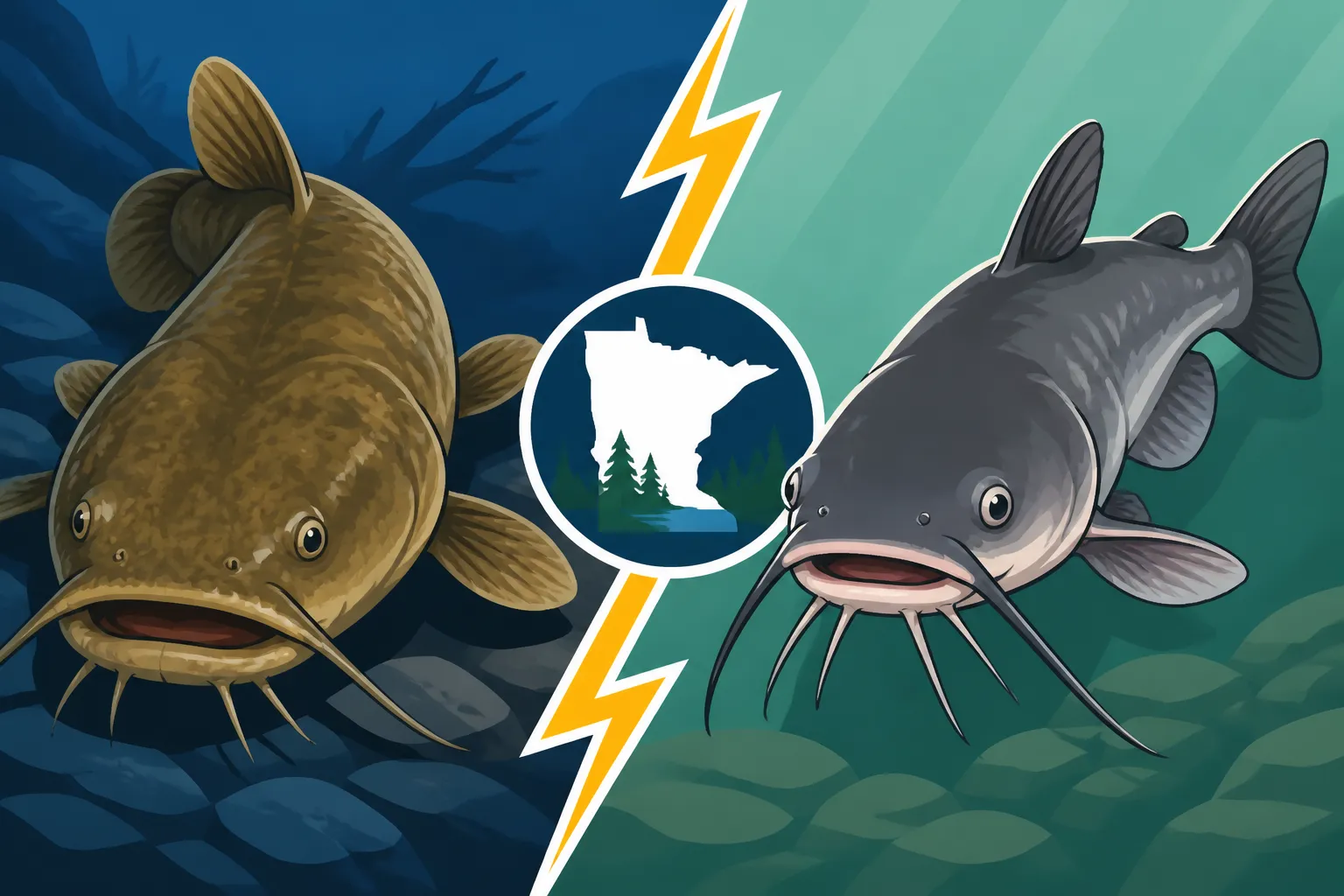
The head structure provides the quickest visual clue when looking into the landing net. A flathead catfish earns its name honestly with an extremely wide, flattened head that looks almost scooped out between the eyes. If you look at the mouth profile, the flathead possesses an underbite where the lower jaw projects distinctly past the upper jaw. This pronounced lower lip acts like a scoop and is an adaptation designed for engulfing living fish swimming directly above it on the riverbed.
In contrast, a channel catfish has a much narrower, rounded head profile that tapers smoothly toward the snout. The upper jaw on a channel catfish naturally overlaps the lower jaw, creating an overbite or flush lip arrangement. When you slide your gloved thumb into the mouth to hoist the fish, this bite orientation is immediately obvious. The channel cat’s mouth is positioned lower on the head to easily pick cut bait, dead organisms, or macroinvertebrates off the river bottom, while the flathead’s mouth faces slightly upward to ambush live prey.
Understanding this head geometry is crucial when fish reach intermediate sizes around ten to fifteen pounds. Young flatheads may not look as massive across the skull as fifty-pound river monsters, but that lower jaw projection remains a constant identifier from the time they are fingerlings until they reach trophy proportions.
Tail Fin Shape – Rounded vs Forked
If the head is obscured by mud or night gear, look directly at the tail fin. The tail configuration offers an undeniable blueprint for identification that never changes over the lifespan of the fish. A channel catfish features a deeply forked tail fin with sharply pointed upper and lower lobes. This aerodynamic, high-aspect-tail allows channel cats to swim efficiently in open water and forage across broad distances in lakes, reservoirs, and river channels.
A flathead catfish sports a tail that is broadly rounded, square, or at most slightly notched along the back margin. It completely lacks the deep V-cut found on the channel catfish. This broad paddle tail is engineered for explosive bursts of power over short distances rather than endless open-water cruising. When a flathead launches itself out of a hollow log jam to strike an unsuspecting bluegill, that wide tail provides the raw thrust necessary to haul a massive body through snag-heavy cover.
Anglers sometimes confuse a flathead tail with a bullhead tail, but comparing the overall size and jaw structure quickly settles that debate. If you see a deep, distinct fork split down the middle of the caudal fin, you are without question holding a channel catfish or its rarer southern relative, the blue catfish.
Anal Fin Structure and Ray Count
For precise biological identification, examining the anal fin along the underside of the belly provides absolute certainty. The anal fin of a channel catfish is relatively long and rounded, exhibiting a smooth, convex curve similar to the outline of a gentle hill. When biologists count the soft support rays embedded within the fin structure, a channel catfish typically displays between twenty-four and thirty individual fin rays.
The anal fin of a flathead catfish is noticeably shorter, blockier, and more square in appearance. It contains far fewer rays, usually ranging from fourteen to seventeen rays total. The trailing edge of the flathead anal fin connects to the body at a sharper angle, giving it a compact, rigid look compared to the flowing, curtain-like fin of the channel cat.
Counting fin rays might sound tedious when you are trying to unhook a dark, wet fish at night, but feeling the length of the fin base gives you a quick shorthand. A fin that covers a large percentage of the lower belly tail section belongs to a channel catfish, while a compact, squarish fin sits under a flathead.
| Physical Characteristic | Channel Catfish | Flathead Catfish |
|---|---|---|
| Head Profile | Rounded, narrow taper, overbite | Extremely flattened, underbite |
| Tail Fin Shape | Deeply forked V-shape | Rounded, square, or slightly notched |
| Anal Fin Profile | Long, curved, convex outline | Short, compact, squarish edge |
| Anal Fin Ray Count | 24 to 30 fin rays | 14 to 17 fin rays |
| Body Markings | Spots on juveniles, smooth slate | Mottled brown, yellow, green cam |
| Mouth Orientation | Terminal or slightly sub-terminal | Superior, projecting lower jaw |
Body Coloration and Markings Across Life Stages
Relying entirely on color can trick even seasoned anglers because water chemistry, mud clarity, and bottom sediment drastically influence skin pigmentation. However, understanding how pigmentation shifts as these fish mature helps you recognize patterns in the field. To deepen your overall knowledge of native species across state waters, check out the comprehensive Minnesota Fish Species: Identification Guide.
Juvenile Channel Catfish Spots and Olive Tones
Young channel catfish are among the most distinctly marked fish in freshwater environments. Up until they reach roughly four to six pounds, channel cats feature silvery-olive to light blue flanks peppered with small, irregular dark spots. These small dark dots look almost as if someone sprinkled black pepper along the sides of the fish. Their bellies remain crisp white, and their fins often have a translucent, dusky hue.
As channel catfish mature past the ten-pound mark, these characteristic spots gradually fade away. Trophy channel cats often take on a uniform slate-grey, dark olive, or almost navy-blue appearance along their back and sides. Anglers catching large, spotless channel cats sometimes mistake them for blue catfish or odd flatheads, but checking the forked tail and overbite immediately clears up the identity.
In turbid, muddy river water like the lower Minnesota River, juvenile channel cats may appear paler or washed out to blend with suspended silt. Conversely, in clear, sand-bottom lakes, their silver sheen can be brilliant, catching moonlight as they break the surface.
Mottled Camouflage of Flathead Catfish
Flathead catfish are built for concealment and ambush, and their skin patterns reflect that lifestyle perfectly. Instead of silver tones or clean olive hues, a flathead exhibits a chaotic, mottled pattern composed of dark brown, olive drab, yellowish-buff, and black splotches. This earthy, marbled color scheme breaks up the outline of the fish, allowing it to vanish into submerged timber, granite crevices, and murky leaf litter.
Young flatheads, often called yellow cats or mud cats by local anglers, display striking contrast in their mottling. They often sport a bright cream-colored or yellowish belly paired with chocolate-brown bands across their backs. A key detail on young flatheads is the top lobe of the tail fin, which frequently features a distinct white or light-colored patch at the tip.
As flatheads grow into forty-plus pound giants, their coloration can darken into an overall bronzed or dark brown tone, but close inspection always reveals lingering marbled patterns. They never develop the clean, unpatterned metallic slate-blue hue seen on adult channel catfish.
Identifying Spawning Males and Color Shift Confusion
During the early summer spawning window, hormones cause dramatic visual changes in both species, often creating confusion for fishermen. Male channel catfish undergo substantial physical transformations when preparing and guarding nesting crevices. Their heads swell laterally, developing fleshy pads behind the eyes, and their skin darkens into an intense, dark blue-black tone.
These swollen, dark male channel cats are frequently misidentified as blue catfish or strange flathead hybrids. The broadened head profile on a spawning male channel cat can temporarily mimic the wide skull of a flathead, but examining the lower jaw overbite and the deeply forked tail fin easily prevents a false ID.
Male flatheads also undergo minor color shifts during the spawn, often taking on a pale, washed-out yellow hue as they spend weeks fanning eggs inside dark hollow logs or undercut banks. Understanding these seasonal transformations ensures you do not rely on head width or skin darkness alone when making a field call.
Feeding Habits Bait Preferences and Fishing Techniques
The physical differences between these two fish directly dictate how they hunt, what they eat, and how you should rig your tackle to catch them. For a deeper breakdown on targeted tactics for both species, review our dedicated guide on Best Catfish Fishing Tactics in Minnesota.
Live Bait Tactics for Predatory Flatheads
Flathead catfish are apex predators that rarely scavenge once they grow beyond juvenile sizes. Unlike channel catfish, flatheads are strictly designed to hunt live prey, using their massive mouth and sensory barbels to detect the vibrations of struggling fish in zero-visibility water. If you want to consistently target flatheads, presentation choice is non-negotiable: live, high-action bait is king.
Local anglers targeting big flatheads rely heavily on sturdy live bait species like wild-caught bullheads, green sunfish, sucker minnows, and large creek chubs. The bait must be hooked carefully—often through the tail or just behind the dorsal fin—to allow maximum natural movement on the bottom without pulling free from heavy circle hooks.
Flathead Live-Bait Rigging:
- Main Line: 65-80lb Braid
- No-Sinker Slide + Sinker
- Rubber Bead
- Heavy Barrel Swivel
- Leader: 60-80lb Mono (18-24 inches)
- 8/0 – 10/0 Circle Hook -> Hooked through tail/back of Live Bullhead or Sucker
Because flatheads setup camp inside dense logjams and snag-infested root wads, gear strength is critical. Heavy-power casting rods, high-capacity reels loaded with sixty-to-eighty-pound braided mainlines, and thick monofilament leaders are essential to turn a powerful fish before it wraps your rig around submerged timber.
Cut Bait and Stink Bait Strategies for Opportunistic Channel Cats
Channel catfish possess an extraordinary sense of taste and smell distributed across their entire body, barbels, and lateral line. While they are fully capable of catching live minnows, channel cats are primarily opportunistic feeders that rely on scent trails floating downriver to locate food. This olfactory hunting style makes them highly susceptible to cut bait, prepared baits, and smelly offerings.
Freshly cut baitfish—such as sliced white sucker, gizzard shad, threadfin, or river herring—release rich oils into the water column, creating an irresistible scent highway for hunting channel cats. Dip baits, sour doughs, chicken liver, and nightcrawlers are also incredibly effective, especially in warm lake environments or slow-moving pool sections.
Unlike the specialized heavy gear needed for flatheads, channel catfish can be targeted using medium to medium-heavy spinning or baitcasting tackle. A standard slip-sinker rig paired with a size 2/0 to 5/0 hook allows a channel cat to pick up the bait and run without feeling resistance from the lead weight.
Seasonal Feeding Patterns in Minnesota Rivers
Understanding seasonal transitions helps you predict where and how these species feed throughout the year. In early spring following ice-out, channel catfish are the first to wake up, feeding aggressively in shallow, sun-warmed backwaters on winterkill fish. They remain active across a wider temperature range than flatheads.
Flatheads are warm-water lovers that remain dormant in deep winter quarters long after ice thaws. They begin active feeding only when water temperatures climb significantly into the late spring range. Once warm weather sets in, flatheads embark on intense night-feeding raids, moving out of deep wood cover into shallow gravel bars and riffle edges to corner baitfish.
As autumn arrives and water temperatures begin to drop, channel cats continue to feed heavily on cut bait to pack on winter energy reserves. Flatheads, however, quickly slow their metabolism, staging near deep wintering holes where they eventually drop into a semi-dormant state until the following spring. If you want to learn more about navigating these river flows successfully, dive into our article on How to Catch Catfish in Minnesota Rivers.
Habitat Selection in Minnesota Waters
While flatheads and channel catfish coexist in many of the same river systems, their micro-habitat preferences within those waterways are distinct. Knowing where to set your anchors or throw your bank lines saves hours of fishing empty water.
Deep Holes and Logjams – The Flathead Stronghold
Flatheads are solitary, territory-oriented fish that spend their daylight hours hidden deep inside heavy structural cover. They crave structure that breaks heavy river currents while offering total overhead concealment. If a river section lacks wood or heavy rock, flathead populations will be sparse.
Ideal flathead habitat includes:
* Massive cottonwood logjams anchored in deep river bends.
* Scour holes located immediately downstream of bridge pilings or wing dams.
* Undercut granite banks and submerged rock ledges with high water depth.
* Tangled root balls situated right along steep drop-offs.
During the daytime, a flathead will lodge itself so tightly inside a log tangle that you must drop a bait directly against the wood to provoke a reaction bite. At night, these fish venture out, but they rarely stray far from their primary wood shelter, patrolling nearby shallow sand flats or rock riffles before returning to their timber sanctuary before sunrise.
Runs, Eddies, and Lakes – Channel Catfish Adaptability
Channel catfish are far more versatile and gregarious than flatheads. They comfortably inhabit broad river channels, murky agricultural ditches, expansive natural lakes, urban ponds, and deep impoundments. Rather than hiding inside dense wood tangles, channel cats often roam in loose schools across open flats, mud basins, and moderate river currents.
Key channel catfish habitats include:
* Current seams where fast water meets slow eddy water behind gravel bars.
* Deep mud basins in natural lakes during summer heat and winter freezes.
* Tailwaters below dams where chopped baitfish wash down from upstream.
* Shallow, vegetated bays in early spring where water warms rapidly.
Because channel catfish wander actively in search of scent trails, you do not need to drop your bait into tight cover. Positioning your rig in an open run downstream of a bend or gravel point allows the scent of cut bait to pull foraging fish directly to your hook. To explore species distribution in famous waterways, review our complete guide on Catfish in Minnesota: Channel & Flathead.
Key Minnesota River Systems for Catfishing
Minnesota offers world-class waters for both species, particularly throughout its southern and central river drainages. The Minnesota River is arguably the premier flathead factory in the Upper Midwest, offering miles of snags, deep scour holes, and abundant forage species like suckers and bullheads.
Key Minnesota Catfish River Systems:
| Minnesota River | Premier Flathead haven (Mankato to Shakopee) |
| Mississippi River | Dual Fishery (Pool 2 Trophy Area, Pool 4 & 9) |
| St. Croix River | Deep clear water, excellent Channel & Flathead mix |
| Red River of the North | World-Class Trophy Channel Catfish destination |
The Mississippi River provides exceptional fishing for both species. Pool 2—stretching between St. Paul and Hastings—is renowned for producing massive flatheads and channel cats due to special catch-and-release ethics and rich forage. Further downstream, Pool 4 near Red Wing offers expansive channel cat flats alongside deep flathead wood cover.
The St. Croix River boasts incredible water depth and clear conditions, supporting healthy populations of both species near Stillwater and Hudson. Meanwhile, if trophy channel catfish are your sole focus, the Red River of the North along the northwestern border is legendary, producing massive, slate-grey channel cats in fast, cool water, though flatheads are virtually absent from that northern drainage. For a broader look at exploring these famous flows, check out Minnesota River Fishing: Mississippi, Minnesota & St. Croix.
Regulations Handling and Conservation in Minnesota
Properly handling these fish protects both the angler from injury and the fishery from over-exploitation. Big catfish are slow-growing apex organisms that require years to reach trophy sizes in cold northern waters.
Safe Handling Techniques to Avoid Pectoral Spines
Handling catfish requires respect, particularly when dealing with smaller fish. Juvenile channel catfish and flatheads possess needle-sharp, serrated spines on their dorsal fin and pectoral fins. These spines are coated in a mild protein-based venom that causes severe burning, swelling, and throbbing pain if it punctures human skin.
How to Hold Small to Medium Catfish safely:
- Approach from behind the dorsal fin.
- Place your palm firmly over the back of the fish behind the dorsal spine.
- Slide your index finger behind one pectoral spine.
- Slide your middle/ring finger behind the opposite pectoral spine.
- Lock your grip so the spines extend safely between your fingers.
For giant catfish weighing twenty to fifty pounds, pectoral spines dull down and become less of a puncture hazard, but the sheer weight of the fish presents new challenges. Never lift a trophy catfish by its gills, eye sockets, or by a single jaw line without supporting its abdomen. Hold big fish horizontally with one gloved hand gripping the lower jaw and your other arm cradling the heavy belly to prevent internal organ damage.
Catch and Release for Trophy Whiskers
A flathead catfish takes over twelve to fifteen years of growth in Minnesota waters to reach forty pounds, surviving fierce winter freezes and heavy angling pressure. Because of this slow growth rate, practicing catch-and-release on large cats is vital to maintaining high-quality fisheries.
When landing giant fish, use heavy rubberized landing nets or soft cradles to preserve their protective slime coat. Keep the fish out of the water for as short a time as possible, especially during hot summer nights when surface oxygen levels are low. If you want to snap photos, have the camera ready before lifting the fish from the water, hold your breath while the fish is out, and lower it back down as soon as you need to breathe again.
Releasing a large flathead requires patience. Hold the fish by the tail and lower jaw in calm water, keeping it upright facing into the gentle current until it regains muscle tension and kicks away under its own power. To learn more about proper fish preservation practices, read our guide on Catch and Release Best Practices in Minnesota.
Harvest Restrictions and Rules Overview
While selective harvest of smaller channel catfish makes for fantastic fish fries, state regulations are designed to protect larger breeding stock from overharvest. Daily bag limits and length restrictions vary between inland waters, border waters like the Mississippi and St. Croix rivers, and special regulation zones.
General state rules often impose strict possession limits on flatheads, along with maximum size thresholds allowing only one fish over a certain length to be kept per day. Because flathead populations rely heavily on mature, older adults to sustain natural reproduction, many catfishermen voluntarily practice full catch-and-release for all flatheads regardless of length.
Always consult current Minnesota Department of Natural Resources regulation booklets before heading to the river, as border waters shared with Wisconsin or the Dakotas may carry different possession boundaries and seasonal openers.
Common Misidentifications and Hybrid Myths
Docks, tackle shops, and online forums are filled with fish tales regarding rare cat hybrids and mysterious species. Sorting fact from fiction helps keep your field records accurate.
Blue Catfish Rumors vs Minnesota Reality
One of the most persistent myths among upper Midwest catfishermen is catching a wild blue catfish in central or northern Minnesota waters. Blue catfish (Ictalurus furcatus) are heavy-bodied, deeply forked-tail catfish native to massive southern river basins. While they do exist in limited numbers in the southern reaches of the Mississippi River near the Iowa border, confirmed catches in upper Minnesota pools are exceptionally rare.
Almost every reported “blue cat” caught in the Minnesota River or Twin Cities metro pools turns out to be a dark, slate-grey adult male channel catfish in its spawning dress. To definitively distinguish a true blue catfish from a channel catfish, look at the bottom anal fin:
* Blue Catfish: Anal fin edge is straight like a razor blade, containing 30 to 35 fin rays.
* Channel Catfish: Anal fin edge is rounded and convex, containing 24 to 30 fin rays.
If your fish has a rounded anal fin and twenty-six rays, it is an oversized channel catfish, no matter how bright silver or deep blue its skin appears under your headlamp.
Bullheads vs Young Catfish Confusion
Inexperienced anglers frequently confuse small channel catfish or juvenile flatheads with bullheads (black, yellow, or brown bullhead species). Bullheads belong to the same family but remain much smaller, rarely exceeding two to three pounds in most waters.
To quickly separate bullheads from catfish:
* Check the tail: Bullheads have squarish or rounded tails without a deep V-fork, separating them instantly from channel catfish.
* Check the jaw: Bullheads have flush or overbiting jaws, separating them from flatheads which have a projecting lower jaw underbite.
* Check the chin barbels: Black bullheads feature dark black chin barbels beneath the mouth, whereas channel cats have pale or white chin barbels.
If you catch a six-inch whiskerfish with a deeply forked tail and pale chin whiskers, you are holding a young channel catfish, not a bullhead.
Field Check Checklist Before Preserving Your Catch
When you are tired, dark conditions set in, and a mud-covered whiskerfish is squirming on the riverbank, follow this step-by-step checklist to confirm your catch identity within ten seconds:
- Look at the tail fin split: Is it deeply forked into two points?
- Yes -> It is a Channel Catfish.
- No (Square/Rounded) -> Move to step 2.
- Examine the lower jaw: Does the lower lip project outward past the upper lip in a distinct underbite?
- Yes -> It is a Flathead Catfish.
- No (Overbite/Flush) -> It is likely a Bullhead species.
- Inspect body pattern: Is the skin covered in dark brown and olive camouflage splotches, or is it smooth slate-grey/silver with black dots?
- Splotched marbled camouflage -> Flathead Catfish.
- Smooth slate or small pepper spots -> Channel Catfish.
By applying this quick mental checklist on the water, you will never second-guess your catch again, whether you are filling a stringer with eater channel cats or snapping a quick trophy photo with a massive river flathead. If you want to hone your skills for targeting channel catfish on iconic river stretches, explore our specific location guides like Where to Catch Channel Catfish in Minnesota and Mississippi River Catfish in Minnesota. For targeting giant mottled predators in heavy wood, be sure to check Where to Catch Flathead Catfish in Minnesota.
Disclaimer
This article is for general informational purposes only and does not constitute professional advice. Laws, prices and regulations vary by location and change over time. Consult a qualified professional for guidance on your specific situation.