Muskie Figure-8 Technique
There is a specific kind of heartbreak that only a Minnesota muskie angler truly understands. You’ve spent six hours casting a double-bladed bucktail into the cabbage weeds of Lake Vermilion, your shoulders are aching, and your focus is starting to drift toward the sandwich in your cooler. Then, out of nowhere, a shadow the size of a fence post appears behind your lure. It’s a trophy-class fish, and it’s following your bait right to the gunwale. If you pull that lure out of the water now, the hunt is over. This guide is designed to teach you the most critical skill in muskie fishing: the figure-8 technique, which transforms those agonizing follows into heart-stopping strikes.
The Heart of the Chase: Why the Figure-8 is Non-Negotiable
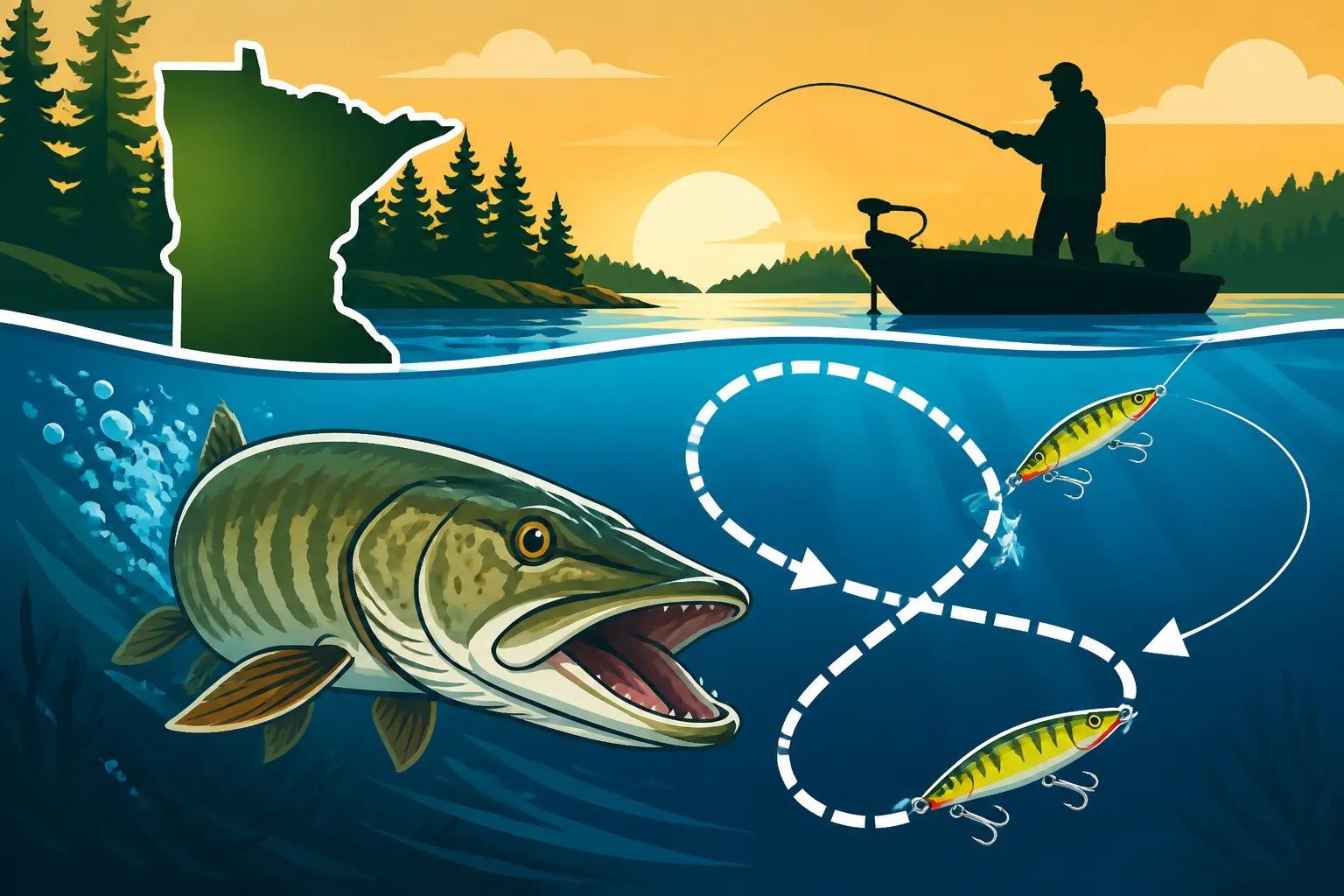
If you talk to any veteran guide on Leech Lake or Mille Lacs, they will tell you the same thing: more muskies are caught within ten feet of the boat than anywhere else in the lake. Muskies are apex predators, but they are also incredibly curious and cautious. They will often track a lure for fifty feet just to see what it does when it "runs out of room." In the wild, a baitfish trapped against a shoreline or a fallen log has to make a sudden, desperate move to escape. The figure-8 mimics that "last stand" behavior, triggering a primal predatory response that overrides the fish's natural caution.
Overcoming the Follower Frustration
The psychological toll of seeing a "follower" can be devastating for a beginner. You see that massive head and those flared gills, and your first instinct is to freeze or, worse, pull the lure out of the water in excitement. This is the moment where Muskie Fishing in Minnesota: The Fish of 10,000 Casts becomes a reality. You have done the hard work of finding the fish and convincing it to follow; the figure-8 is simply the closing argument of your presentation.
Validation is key here—everyone misses their first few boatside strikes. The adrenaline dump is so massive that your hands might shake, causing you to ruin the cadence of the lure. Recognizing that a follow is a victory in itself helps calm the nerves. Instead of thinking, "Oh no, there's a giant fish," try to think, "Great, the fish is here, now let’s dance." This shift in mindset is what separates the weekend warriors from the pros who consistently put Biggest Muskie Ever Caught in Minnesota contenders in the net.
The Biology of a Muskie's Strike Trigger
Understanding why a muskie strikes at the boat requires a bit of fish psychology. Muskies have a highly developed lateral line system that detects vibrations and pressure changes. When your lure is moving in a straight line during the retrieve, the fish is in "tracking mode." As soon as that lure makes a sharp, accelerating turn—like the first corner of a figure-8—the pressure waves change.
To the muskie, this change signals that the prey has realized it is being hunted and is trying to bolt. This often causes the muskie to accelerate and flare its gills, a behavior known as "inhaling" the bait. If you haven't mastered Muskie Fishing Techniques for Beginners, you might not realize that the fish isn't always "biting" the lure; it’s creating a vacuum to pull the lure into its mouth. The figure-8 keeps the lure moving in that critical strike zone, giving the fish the time and the "escape" signal it needs to commit.
Executing the Perfect Figure-8: Step-by-Step Mechanics
The mechanics of a proper figure-8 are more about fluid motion than raw power. It’s a dance between the angler, the rod, and the water. You aren't just moving the lure in a circle; you are creating a path of travel that maximizes the lure’s action while keeping it away from the boat’s hull where a fish might spook.
Transitioning from the Cast to the Turn
The most common mistake happens in the last five feet of the retrieve. Many anglers retrieve the lure all the way to the rod tip and then realize a fish is there. By then, it’s too late. You need to leave about a foot and a half to two feet of line out from your rod tip as the lure approaches the boat. As the lure gets within reach, you should transition from reeling to a wide, sweeping motion.
Think of it as an "L" shaped transition. You are reeling, reeling, and then you sweep the rod tip deep into the water while the lure is still moving. Never stop the lure. If a muskie sees a lure stop, it almost always turns away. The transition should be seamless. You can find specialized Best Muskie Lures (Bucktails, Jerkbaits, Topwater) that are designed to maintain their action even during these low-speed, high-torque turns.
Lead with the Rod Tip, Not the Reel
Once you are in the figure-8 motion, your reel is effectively useless. You should have your thumb on the spool (if using a casting reel) and your other hand firmly on the foregrip of the rod. You use the length of the rod to "drive" the lure through the water. Imagine you are painting a giant, underwater number eight.
The rod tip should be submerged at least a foot or two into the water. This does two things: it keeps the lure from "blowing out" or breaking the surface, and it gets the lure closer to the fish's eye level. If you are using a bucktail, the blades should be humming. If you are using a glide bait, the side-to-side "walk" should continue through the curves. I’ve often found that keeping a few extra sets of high-quality split ring pliers, which you can easily grab on Amazon, makes these frantic boatside moments much more manageable when you finally do hook up and need to perform a quick release.
Speed and Depth Variations
A static, slow figure-8 is rarely as effective as one with varying speeds. As you go into the turns (the "rounds" of the eight), you should actually accelerate. This mimics a baitfish trying to "corner" away from a predator. On the straightaways of the eight, you can maintain a steady pace.
Depth is another variable to play with. If the muskie is following deep, push your rod tip further down. If it’s right on the surface, keep the lure in the top two feet of the water column. You want to lead the fish. Don't put the lure right in its face; pull it away from the fish. Muskies want to chase; they don't want to be fed. If you’re looking for specific storage bins to keep these massive lures organized, Amazon usually has a good selection of weather-resistant boxes that can handle the weight of muskie-sized tackle.
| Lure Type | Figure-8 Speed | Turn Radius | Depth Strategy |
|---|---|---|---|
| Bucktails | Fast / Consistent | Wide | Just below surface |
| Glide Baits | Rhythmic / Slow | Sharp | Mid-depth (3-4 feet) |
| Topwater | Slow / Churning | Extra Wide | Surface only |
| Rubber (Bull Dawgs) | Erratic / Heavy | Deep | Bottom of the figure-8 |
Essential Gear for Successful Boatside Maneuvers
You cannot perform an effective figure-8 with a short, flimsy rod. Muskie fishing in Minnesota has seen a massive shift toward longer rods over the last decade, and the figure-8 is the primary reason why. When you're standing on the casting deck of a boat on Lake Vermilion Walleye & Muskie waters, that extra rod length is your best friend.
Choosing the Right Rod Length and Power
A rod in the 8’6” to 9’6” range is now considered the standard for serious muskie hunters. The extra length allows you to make much wider turns in your figure-8. A wide turn is crucial because it gives a 50-inch fish enough room to actually turn its body and follow the lure. A short rod forces you into tight circles that a large muskie simply cannot navigate, leading to "head-side" follows where the fish just hovers and then leaves.
The power of the rod also matters. You need a "Heavy" or "Extra-Heavy" action rod to handle the weight of the lures and the violent strike of a fish at the boat. When a muskie hits during a figure-8, you have almost no line stretch because the fish is only a few feet away. The rod has to absorb all that initial shock. Many anglers start by looking at basic gear on Amazon to get a feel for the hobby before investing in high-end custom rods, and you can certainly find heavy-duty options there to get started. Don't forget to check the Minnesota Muskie Season & Size Limit before heading out, as regulations can change depending on which lake you’re targeting.
Leader Material and Terminal Tackle
Your leader is the only thing standing between you and a mouth full of razor-sharp teeth. For figure-8 maneuvers, a high-quality fluorocarbon leader (100lb to 130lb test) is often preferred over wire. Fluorocarbon is nearly invisible and has a slight bit of "give" that helps during a short-line strike.
However, the most important part of the terminal tackle for the figure-8 is the snap. It must be a heavy-duty "stay-lok" or "ball bearing" swivel. The torque put on a lure during repeated tight turns can cause inferior snaps to open or wire to fatigue. You are often dealing with the Leech Lake Muskie Strain Explained in many northern Minnesota lakes, which are known for their explosive power. Ensure your gear can handle the "boatside thrash" that occurs the second the hooks find home.
Advanced Tactics: Reading the Fish’s Body Language
Not every follow is the same. To be successful, you need to become a student of fish behavior. By watching how the muskie reacts to your movements, you can adjust your figure-8 in real-time to trigger the bite. You should always wear high-quality polarized sunglasses; you can often find polarized sunglasses on Amazon that help cut through the glare of a Minnesota sunset.
The Hot Follow vs. The Lazy Cruiser
A "hot" follow is easy to spot. The fish is tight on the bait, its fins are flared, and it might even be nipping at the blades. In this scenario, don't overthink it. Execute a fast, wide figure-8 and be ready for an immediate strike. The fish is already "lit up," and it just needs the lure to stay in the water long enough to commit.
A "lazy" cruiser is much harder. This fish is trailing by three or four feet, moving slowly, and looks almost bored. For these fish, you need to change the game. Try a "low and slow" figure-8, or conversely, a massive burst of speed on the straightaway to see if you can startle it into an emotional response. Sometimes, a lazy fish can be turned into a hot fish if you can get it to make a sharp turn. If you can’t tell the difference between a big pike and a muskie, check out our guide on Muskie vs Northern Pike: How to Tell the Difference.
Adjusting the Size of Your Loops
The size of your figure-8 should correspond to the size of the fish. If you see a monster—something in the 50-plus-inch range—you need to make your loops as large as humanly possible. These fish have a massive turning radius. If your loop is too small, the fish will have to "cut the corner," which often results in it bumping the lure with its nose or getting spooked by the rod tip.
Conversely, if a smaller "male" muskie is following, you can get away with tighter, faster movements. These smaller fish are often more aggressive and more agile. Regardless of the size, always finish your eight. Even if you think the fish has left, perform at least two or three full rotations. Muskies are masters of camouflage and will often sink five feet down and just watch. A second or third "eight" can bring them back up from the depths for a surprise strike. This is often how a Biggest Muskie Ever Caught in Minnesota record-breaker is fooled.
Common Mistakes That Spook Trophy Muskies
Even seasoned pros make mistakes when the pressure is on. The key is to minimize these errors so that when the "fish of a lifetime" finally appears, you are a well-oiled machine. Being aware of Best Gear for Muskie Fishing in Minnesota will help, but technique is what closes the deal.
Short-Circuiting the Figure-8
The most common mistake is stopping the figure-8 too soon. An angler sees the fish turn away and assumes the chase is over. They pull the lure out of the water, and—splash—the fish was actually just circling back for a second look. I have seen countless muskies strike the moment an angler starts to lift the lure for the next cast.
Always, always, always complete your figure-8. Even if you don't see a fish, get into the habit of doing a "safety" turn at the end of every single cast. It builds muscle memory and ensures that you never pull a lure away from a stealthy follower. If you do hook up, make sure you have the Best Landing Net for Muskie & Pike ready to go, as a fish caught at the boat is usually full of energy and ready to fight.
Making Eye Contact and Excessive Movement
Muskies have excellent vision. If you are leaning over the gunwale, staring directly into the fish's eyes, and waving your arms around, the fish is going to notice. It’s hard not to stare, but try to keep your head back and your movements confined to your arms and the rod.
Avoid hitting the side of the boat with your rod or your boots. Sound travels incredibly well underwater, and a "thump" against an aluminum hull is like a gunshot to a muskie. Stay calm, stay quiet, and let the lure do the talking. If you are fishing in a high-pressure area like the Best Muskie Lakes in Minnesota, the fish are already wary of boat noise. Stealth is your greatest ally.
Putting It All Together: Practice and Patience
The figure-8 is not something you master in a day. It takes hours of repetitive motion until it becomes second nature. But once it does, your confidence on the water will skyrocket. You’ll stop fearing the follow and start welcoming it.
Developing Muscle Memory During the Long Hours
Muskie fishing involves a lot of "dead time"—hours of casting with no action. Use this time to practice your figure-8. Don't just go through the motions; visualize a fish following every single cast. Practice your transitions, practice your deep turns, and practice your speed changes.
When that fish finally does show up, you want your body to go into "auto-pilot." You shouldn't have to think about where your hands are or how deep the rod tip is. It should be a fluid, instinctive reaction. This dedication is what eventually leads to a successful trip on one of the Best Muskie Lakes in Minnesota.
The Importance of Consistency
Consistency is the hallmark of a great muskie angler. Whether you are on the first cast of the morning or the last cast of a three-day weekend, your figure-8 should look the same. The one time you get lazy and skip the "safety" turn is exactly when the 54-incher will be lurking in the prop wash.
Keep your hooks sharp, your leaders fresh, and your mind focused. Minnesota offers some of the best muskie fishing in the world, from the metro lakes of the Twin Cities to the wilderness of the Boundary Waters. By mastering the figure-8, you are giving yourself the best possible chance to turn a "near miss" into a legendary story.
Minnesota Fishing Regulations Disclaimer
Fishing regulations in Minnesota are subject to change annually and can vary significantly by lake and region. Always consult the official Minnesota Department of Natural Resources (DNR) fishing regulations handbook before heading out on the water. Ensure you possess a valid Minnesota fishing license and are aware of the specific season dates, size limits, and possession limits for muskellunge on the specific body of water you are fishing. Practice proper catch-and-release techniques to preserve our world-class muskie fishery for future generations.