What’s the Difference Between a Muskie and a Pike?
It's an age-old question that has stumped countless anglers on Minnesota's waters: Is that a muskie or a northern pike? You're not alone if you've ever stared down a long, toothy fish, wondering exactly what you've just hooked. The confusion is completely understandable; these two predatory fish share a striking resemblance, often leading to misidentification and, sometimes, even legal trouble if regulations aren't followed. This comprehensive guide is here to untangle the mystery once and for all, helping you confidently distinguish between a muskie and a northern pike, ensuring a better understanding of Minnesota's incredible fishing opportunities.
Telling Them Apart: Key Identification Features
When you've got a big, aggressive esocid on the line, the excitement can make it tough to focus on the details. But knowing exactly what to look for can make all the difference, especially with strict regulations surrounding these species in Minnesota. The most reliable ways to differentiate muskies and northern pike come down to specific markings on their heads and bodies.
Jaw and Cheek Markings: The Definitive ID
This is truly your golden ticket for identification, the absolute first thing you should check when you're trying to figure out if you've got a muskie or a northern pike. Look closely at the underside of the fish's lower jaw and its operculum, which is that hard, bony flap covering the gills, often called the cheek. These areas have distinct patterns of scales that are unique to each species.
Northern pike, for instance, have fully scaled cheeks and typically have scales covering the entire upper and lower halves of their gill covers. If you run your finger along the entire length of the cheek and it feels rough with scales, that's a strong indicator. Their lower jaw usually has pores, which are small sensory dots, along its length, but the area is often smooth, not scaled underneath.
Muskies, on the other hand, are the opposite. They have scales only on the upper half of their operculum, or gill cover. The lower half of the cheek will be completely bare, feeling smooth to the touch. Similarly, their lower jaw will often show pores, but the distinct lack of scales on the bottom portion of the gill cover is the most reliable visual cue. This subtle but crucial difference means you won't see scales extending all the way down their cheek like you would on a pike. Many experienced anglers in Minnesota swear by this "scale check" as the quickest and most accurate method.
| Feature | Northern Pike | Muskie |
|---|---|---|
| Cheek (Operculum) | Fully scaled (both upper and lower halves) | Scales only on the upper half; lower half is bare/smooth |
| Lower Jaw | Pores, often smooth underneath (though some variations exist) | Pores, bare/smooth underneath the jaw, not scaled |
| Body Markings | Light spots or beans on a dark background | Dark spots, bars, or blotches on a lighter background |
| Tail Fin | More rounded, less deeply forked, sometimes with a reddish tint | More deeply forked, pointed lobes, often darker/dusky |
| Typical Size (MN) | Up to 30-40 inches common; rarely over 15 lbs | Often 30-50+ inches; 20-50+ lbs for trophy fish |
| Snout Shape | Shorter, broader, "duck-billed" | Longer, more pointed, streamlined |
| Spots/Bars | Light spots on a dark background | Dark spots, bars, or blotches on a light background |
Body Shape and Fin Characteristics
While the jaw and cheek are the most foolproof methods, there are other visual cues that can help distinguish these fish, especially once you get more accustomed to seeing them. These differences often become more pronounced as the fish grow larger.
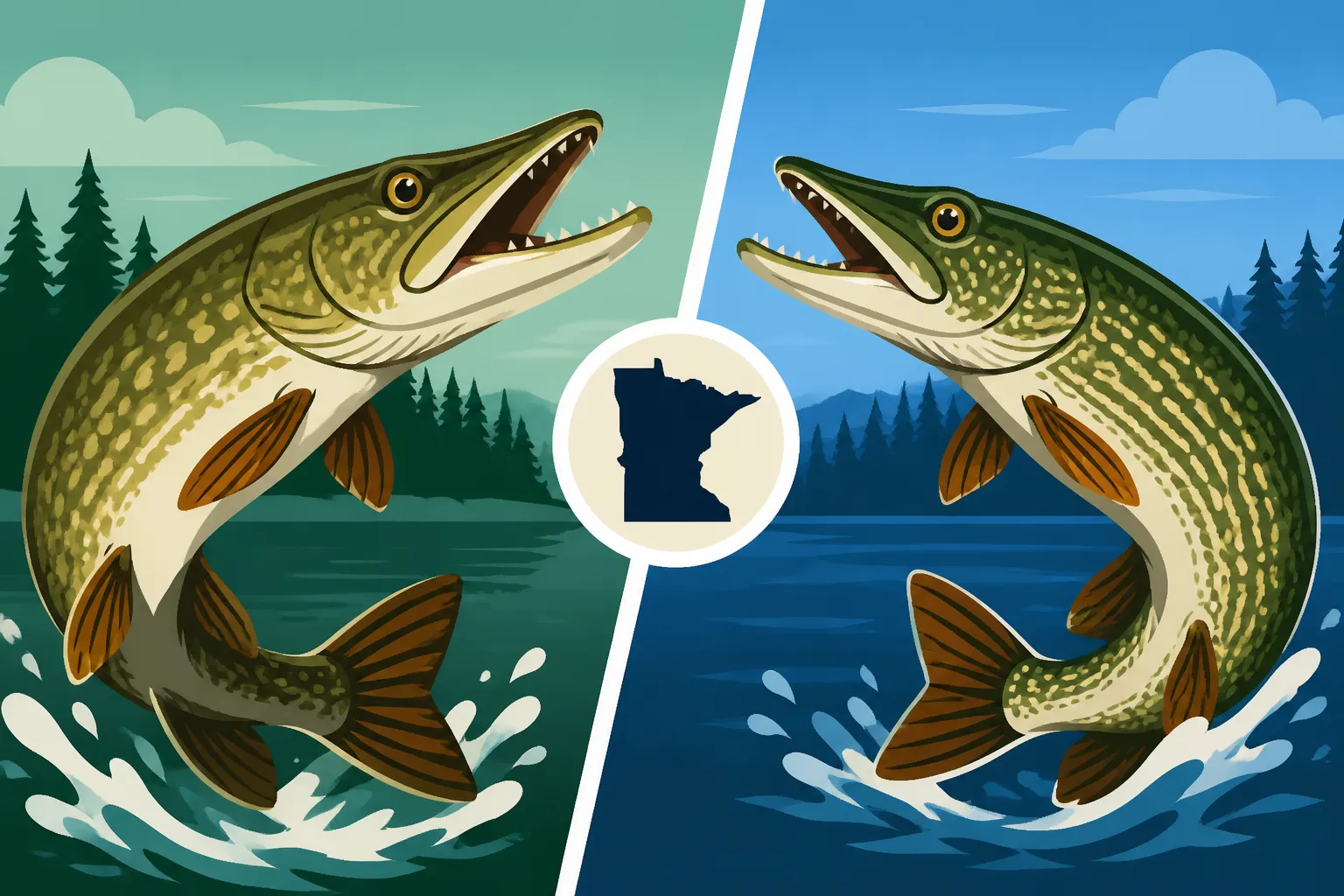
Northern pike tend to have a slightly shorter, broader snout, sometimes described as "duck-billed." Their body coloration is usually a dark green or olive green with light-colored, bean-shaped spots or streaks running along their sides. Think of it as light markings on a dark background. Their tail fin is typically more rounded at the tips and less deeply forked than a muskie's, and in some cases, it might even have a reddish hue, particularly on younger fish.
Muskies, often called the "fish of 10,000 casts," usually have a longer, more pointed, and streamlined snout. Their body pattern is typically the reverse of a pike: dark spots, bars, or blotches on a lighter, often greenish or yellowish-gray background. Imagine dark markings on a light background. Their tail fin is generally more deeply forked with sharper, more pointed lobes. As they grow into true trophy fish, their overall appearance is often more robust and muscled, reflecting their apex predator status. You'll rarely see a small muskie that doesn't scream "predator."
Behavior and Habitat: More Than Just Looks
Beyond their physical appearance, muskies and northern pike exhibit different behaviors and prefer slightly varied habitats, even when they coexist in the same body of water. Understanding these distinctions can not only help with identification but also improve your chances of targeting one species over the other.
Aggression and Feeding Habits
Both pike and muskie are formidable predators, known for their ambush tactics and voracious appetites. However, there are some subtle differences in their aggression and preferred feeding habits that anglers have observed over time. Northern pike are generally considered more aggressive and opportunistic eaters. They'll often strike at almost anything that moves, from smaller fish to frogs, mice, and even ducklings. They're quicker to commit to a strike and often found in weed beds, ready to ambush unsuspecting prey. This makes them a bit easier to catch, especially for less experienced anglers.
Muskies, while equally predatory, often exhibit a more deliberate and sometimes frustrating feeding behavior. They are known for "following" lures right up to the boat, inspecting them with intense curiosity before deciding whether or not to strike. This is where the famous "figure-8" technique comes into play, a desperate last-dditch effort to trigger a strike when the fish is boat-side. They can be incredibly picky, often requiring multiple casts with different presentations or a lot of persistence. A muskie might follow a bait for a hundred yards, only to turn away at the last second, while a pike would have likely already committed. This makes Muskie Fishing in Minnesota: The Fish of 10,000 Casts a truly apt title.
Preferred Waters and Structure
In Minnesota, you'll find both pike and muskie in a vast array of lakes and rivers, but their specific preferences within those bodies of water can differ. Northern pike are incredibly adaptable and are found in almost every lake and river system across the state. They thrive in shallow, weedy bays, around submerged timber, and along the edges of weed lines where they can easily hide and ambush prey. Lakes like Lake of the Woods, Leech Lake, and numerous smaller northern Minnesota waters are prime pike territory. They are often found in relatively shallower water than their muskie cousins.
Muskies, while also using weed edges and structure, often prefer deeper, clearer lakes with abundant forage like ciscoes (tullibees) and whitefish. They frequently relate to main lake points, rocky reefs, submerged islands, and deeper weed beds, especially on larger, clear water lakes. Iconic muskie fisheries in Minnesota include Mille Lacs Lake, Lake Vermilion, Leech Lake (home to the unique Leech Lake Muskie Strain Explained), and some of the larger lakes in the Brainerd Lakes Area. While they will utilize shallow cover, especially during certain times of the year, trophy muskies are often associated with deeper, more expansive structures.
Fishing for Muskie vs. Pike in Minnesota
The choice of tackle and even the general approach to fishing can vary significantly depending on whether you're explicitly targeting muskies or northern pike. While there's overlap, optimizing your setup can lead to more success and, importantly, safer handling of these powerful fish.
Tackle and Lure Considerations
When it comes to tackle, a good rule of thumb is that muskie gear is usually beefier than what you'd use for northern pike. For pike, a medium-heavy to heavy action spinning or baitcasting rod, spooled with 20-30 pound braided line and a strong wire or fluorocarbon leader, is usually sufficient. Pike aren't shy about biting through mono or fluoro directly, so a leader is non-negotiable. Popular pike lures include spinnerbaits, spoons like the classic Daredevl, smaller bucktails, and crankbaits. You might find some excellent insights on Best Northern Pike Fishing Tactics in Minnesota for a more in-depth look.
Muskie fishing, on the other hand, demands specialized heavy-duty gear. This means long (8-10 foot), extra-heavy action baitcasting rods, reels capable of handling heavy braided line (65-100 pound test), and rugged leaders (often 12-18 inches of heavy fluorocarbon or titanium wire). The lures are also massive, ranging from foot-long bucktails and jerkbaits to huge rubber baits and topwater lures that look like small birds. Handling these gargantuan baits requires a specific casting technique and a lot of stamina. For more detailed recommendations, check out Best Muskie Lures Bucktails, Jerkbaits, Topwater and Muskie Fishing Tips for Minnesota Anglers.
Regulations and Conservation
Understanding the distinct regulations for muskie and northern pike in Minnesota is absolutely critical. Misidentification can lead to serious legal consequences, including hefty fines and loss of fishing privileges. Minnesota's Department of Natural Resources (DNR) manages these species with specific size and possession limits designed to sustain healthy populations.
Northern pike regulations vary by zone in Minnesota, often featuring different bag limits and sometimes protected slot limits. For instance, the "Northern Pike Limits by Zone" rules mean that what you can keep in the Northeast zone might be different from the North-Central or Southern zones. It's crucial to consult the current Minnesota fishing regulations guide every year, as these rules can change. Generally, pike have a more generous daily bag limit compared to muskie.
Muskie regulations are typically much stricter due to their slow growth rate and their status as a trophy fish. Many lakes in Minnesota have a one-fish possession limit for muskies, and the minimum size can be quite large, often 50 or 54 inches. This means most muskies caught are released. Catch and release is a cornerstone of muskie fishing culture, aimed at preserving these incredible fish for future generations. Knowing the difference between the species is paramount, because keeping a small muskie when you thought it was a pike could land you in significant trouble. Always be sure to check the specific regulations for the lake you are fishing, especially regarding Northern Pike Season & Limit in Minnesota and Muskie Season & Limit in Minnesota.
Why Does It Matter?
Beyond satisfying your curiosity, correctly identifying a muskie versus a northern pike has tangible impacts on your fishing experience and the overall health of Minnesota's fisheries.
Avoiding Legal Trouble
The most immediate and practical reason to know the difference is to stay within the law. As discussed, Minnesota has very different regulations for pike and muskie. Imagine you catch a 35-inch fish, thinking it's a nice keeper northern pike for dinner, when in fact, it's a muskie, and the minimum size for muskie on that lake is 50 inches with a one-fish limit. That's a significant violation that could result in fines, confiscation of your catch, and potentially your equipment.
Conservation officers are very diligent, and ignorance of the law is no excuse. By being able to quickly and accurately identify your catch, you protect yourself from penalties and contribute to responsible angling. Always carry a current Minnesota fishing regulations PDF or booklet, or use a fishing app, to double-check the rules for the specific body of water you're on, especially as Minnesota Fishing Regulations Changes for 2026 can occur.
Targeting Success and Species Management
From an angler's perspective, knowing the difference allows you to tailor your techniques and gear for specific targets. If you're out for pike, you might focus on weedy bays with smaller, flashier baits. If you're chasing the elusive muskie, you'll be throwing larger baits over deeper structure, working tirelessly for that one monumental strike. This specialized approach increases your chances of success for your chosen species.
From a broader ecological standpoint, accurate identification is crucial for species management. The DNR relies on angler reports and creel surveys to monitor fish populations. When anglers can accurately report what they're catching and keeping (or releasing), it provides better data for biologists to make informed decisions about stocking, regulations, and habitat protection. This helps ensure that both pike and muskie populations remain healthy and abundant for generations of Minnesota anglers to enjoy. Proper identification also ties into broader concepts of Minnesota Fishing Limits: Bag & Possession (2026), which are designed to maintain ecological balance.
Disclaimer
Please note that fishing regulations in Minnesota can change annually. Always consult the most current Minnesota Department of Natural Resources (DNR) fishing regulations handbook or website before heading out on the water. This guide is for informational purposes only and should not be considered a substitute for official DNR regulations.