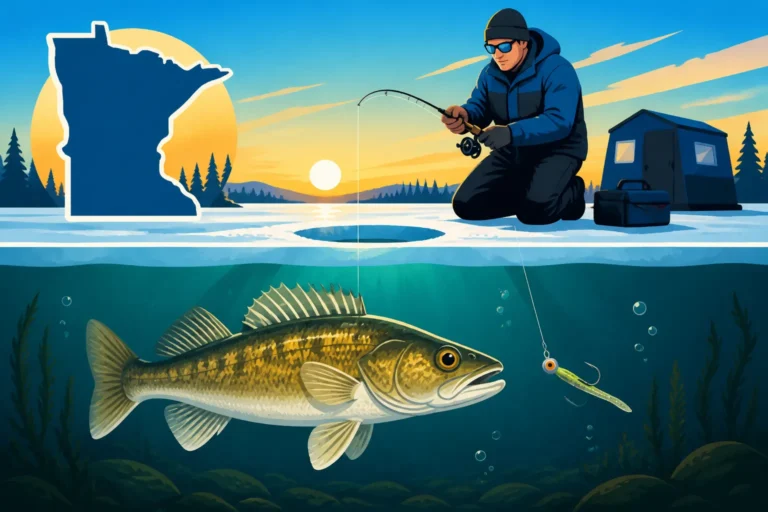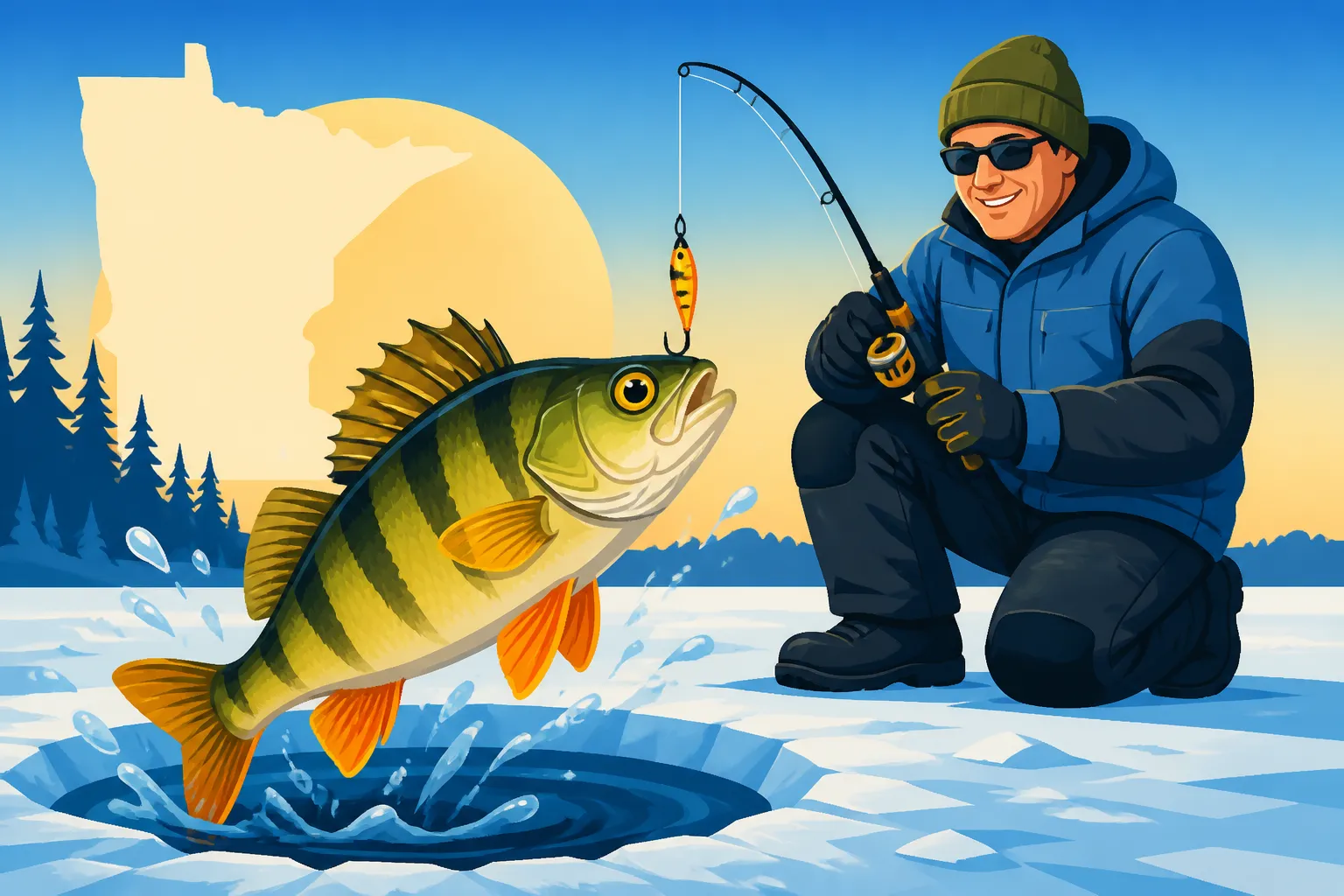
Ice Fishing for Perch in Minnesota
Many anglers spend their winter weekends drilling hundreds of holes only to pull up three-inch "dinks" or stare at a silent flasher screen while the wind howls across the lake. This guide breaks down the science and strategy of finding jumbo perch in Minnesota, ensuring you spend more time catching "pounds" than "ounces" by targeting the right structure and mastering specific jigging cadences.
Finding the Jumbos: Minnesota's Top Perch Destinations
If you want to fill a bucket with jumbos—those legendary perch that push past the 12-inch mark—you have to go where the genetics and forage allow them to thrive. In Minnesota, we are blessed with several world-class fisheries, but each requires a slightly different mindset. Lake Winnibigoshish, or "Winnie," is arguably the capital of Minnesota perch fishing. On Winnie, the fish tend to move in massive schools across the expansive mud flats and sandy points. When you find them, the action is fast and furious, but the challenge is the sheer volume of water you have to cover. You aren't just looking for one fish; you’re looking for the "roving pack" that is shadowing schools of minnows or digging for insect larvae in the marl.
Mille Lacs Lake offers a different but equally rewarding experience. While many people focus on the world-class walleye, the perch here are gargantuan. They often inhabit the deep mud flats during the mid-winter months, specifically targeting the transitions where the mud meets the gravel. Because Mille Lacs Lake Fishing Rules & Limits can be strict for other species, many locals have turned their attention to these yellow-bellied giants as a primary winter target. When fishing Mille Lacs, you have to be prepared for "ghost" marks on your electronics—fish that hover a few inches off the bottom and require a very subtle touch to trigger.
Don't overlook the smaller, "sleeper" lakes in the Otter Tail County area or the Brainerd Lakes region. While they might not have the name recognition of the big three, many of these lakes have lower fishing pressure, allowing perch to reach impressive sizes. In these smaller bodies of water, look for the deep weed edges that still hold green vegetation. Perch are highly visual predators, and they will use the remaining stalks of pondweed or coontail as an ambush point for small invertebrates. If you are struggling on the big water, moving to a 500-acre lake with a deep basin can often be the ticket to a successful afternoon.
Understanding Perch Behavior and the Search for Structure
Yellow perch are notorious "roamers." Unlike a walleye that might hold tight to a specific rock pile for hours, a school of perch is constantly on the move, searching for their next meal. This means your Best Seasonal Pattern for Yellow Perch in Minnesota usually involves a lot of "hole hopping." During the early ice period, you will find them in relatively shallow water, often between 8 and 12 feet, near the last remaining green weeds. As the oxygen levels drop in the shallows and the water turns colder, they migrate toward the deeper basins. By mid-January, it is common to find the biggest schools in 25 to 35 feet of water.
The "transition zone" is the most important concept to master when ice fishing for perch. This is the area where the lake bottom changes from one material to another—usually from hard sand or rock to soft mud. Perch love these areas because the mud is home to bloodworms and other larvae, while the harder bottom provides better visibility for hunting minnows. If you can find a spot on a lake map where a steep drop-off flattens out into a basin, that’s your starting point. You want to drill a line of holes from the edge of the drop-off out into the flat until you start seeing life on your flasher.
Another key behavior to watch for is "climbing." When a school of perch is aggressive, they will actually move up in the water column to meet your bait. If you see a mark on your electronics rise 5 feet off the bottom to investigate your jig, you’ve found an active school. However, if the marks stay glued to the bottom and won't budge, they are likely in a neutral or negative feeding mood, often caused by a recent cold front. In these scenarios, you have to slow everything down and perhaps switch to a more delicate presentation, which we will cover in the gear section.
Essential Gear: Rods, Reels, and Sensitive Tips
When you are chasing jumbos, your standard walleye rod is usually too stiff. You need a rod with a "fast" or "extra-fast" action but a very light tip. This is because perch are notorious for "up-biting." They will swim under the jig, inhale it, and move upward, which actually removes the weight from your line. If your rod is too heavy, you won’t see the tip slightly rise, and the fish will spit the hook before you even know they were there. Many veteran anglers prefer a 28-inch light power rod with a high-visibility tip. You can find excellent options for these setups on Amazon, where brands like 13 Fishing or Shimano offer dedicated panfish series that won't break the bank.
The reel is less about the drag and more about the line management. Since perch are often found in deep water, you want a reel with a high retrieve ratio so you can get your bait back down to the school quickly after a catch. I recommend using 3-lb or 4-lb test fluorocarbon line. Fluorocarbon is nearly invisible under the water and sinks faster than monofilament, which is crucial when you are trying to reach a school 30 feet down. If you're fishing in a heated shack, you can go as light as 2-lb test, but for hole hopping outside, 4-lb gives you a bit more durability against the ice edges.
Don't forget the importance of a high-quality tackle box. Your Best Tackle for Yellow Perch in Minnesota should include a variety of tungsten jigs. Tungsten is much denser than lead, meaning a tiny jig can still get down to the bottom quickly in deep water. This is a game-changer when you need to get back to a school before they move on. I often pick up bulk packs of tungsten jigs on Amazon to ensure I have a variety of colors, especially "glow" patterns for the low-light periods and natural "perch" or "crawfish" patterns for clear water days.
| Gear Category | Recommended Specification | Why It Matters |
|---|---|---|
| Rod | 28" Light Power, Fast Action | Detects subtle up-bites and prevents hook pulls. |
| Line | 3-4 lb Fluorocarbon | Invisible to fish and sinks quickly in deep water. |
| Lure Type | Tungsten Jigs (3mm – 5mm) | Reaches deep water faster than lead and provides better "feel." |
| Bait | Wax Worms or Eurolarvae | Provides the scent and wiggle needed to seal the deal. |
| Electronics | Flasher or Live Sonar | Essential for locating moving schools and timing the hook set. |
Mastering the Cadence: How to Trigger a Bite
The biggest mistake I see people make when Ice Fishing for Perch in Minnesota is jigging too aggressively. While a big, flashy spoon can call fish in from a distance, it often scares them away if you keep "ripping" it once they are on the screen. The most effective technique for perch is what we call "bottom pounding." This involves dropping your jig all the way to the lake floor and letting it hit the mud repeatedly. This creates a small cloud of silt and mimics a minnow or insect digging in the bottom. After 5 or 6 "pounds," lift the jig about 6 inches off the bottom and hold it perfectly still. Most of your bites will come during this pause.
If the fish are being finicky, try the "quiver." This isn't a big up-and-down movement; it's more like a nervous shake. You want the jig to vibrate in place without moving more than half an inch. This mimics a dying minnow or an insect trying to swim. If you see a fish approach your jig on the flasher but it won't commit, slowly start to "raise" the jig away from the fish. This triggers a competitive instinct—the fish thinks the meal is escaping and will often rush forward to grab it. This "chase" is one of the most exciting parts of perch fishing.
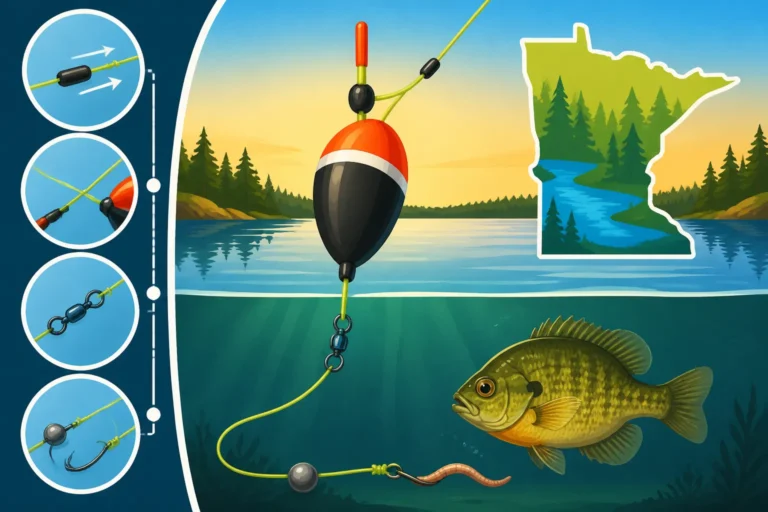
Deadsticking is another underutilized tactic for perch. This involves having a second line—where legal—with a plain hook and a small minnow or a cluster of wax worms. You simply set this rod in a holder and let the bait do the work. Often, the "active" jigging in one hole will draw the fish in, but they will choose to eat the "easy meal" on the stationary line. To make this effective, use a How to Set Up a Slip Bobber Rig Step by Step guide to ensure your bait is suspended exactly 6 to 12 inches off the bottom.
Technology on the Ice: Flashers vs. Live Sonar
In the modern era of ice fishing, going out without electronics is like hunting in the dark. At a minimum, you need a basic flasher. Understanding How to Read a Flasher (Vexilar/Humminbird) is the difference between guessing and knowing. A flasher tells you three things: how deep the water is, where your bait is, and if there are fish below you. With perch, you are looking for "flickering" lines near the bottom. Because perch school so tightly, the bottom signal on your flasher will often look "thick" or "jagged" when a school is present.
For those who want to take it to the next level, forward-facing sonar like Garmin LiveScope has changed the game. Instead of just seeing what is directly under your hole, you can see 50 to 100 feet in every direction. This allows you to "hunt" for schools of perch. If you see a school 40 feet to your left, you can drill a hole exactly over them instead of guessing. While expensive, you can often find deals on Amazon for the necessary batteries and mounting hardware to build your own "shuttle" system. Even if you don't use LiveScope, a good GPS map like Navionics is essential for finding those deep-water transitions and mud flats.
However, don't let the technology distract you from the basics. Sometimes, the "noise" from multiple electronics in a small area can actually spook fish in shallow water. If you are in less than 10 feet of water, consider turning down the gain on your unit or even turning it off if the fish seem "skittish." Perch have a very sensitive lateral line and can feel the pulses from high-powered transducers in certain conditions. In deep water, this is rarely an issue, but in the shallows, stealth is your best friend.
Safety, Timing, and the Late Season Push
The best time of day to catch perch in Minnesota is typically the "mid-day" window. Unlike walleye, which are most active at dawn and dusk, perch are visual predators that need light to hunt. I’ve often found that the best action starts around 10:00 AM and lasts until 3:00 PM. This makes perch fishing a great family activity, as you don't have to be on the ice in the pitch black of early morning. However, on very clear lakes, there can be a secondary "bite" right at sunset as the fish move from their deep-water haunts back toward the weed edges for the night.
As the season progresses into late February and March, perch begin to congregate in massive numbers for the upcoming spawn. This is often the best time of year for Ice Fishing for Perch in Minnesota because the fish are hungry and highly concentrated. Look for "staging areas"—these are usually the flats immediately adjacent to the shallow bays where they will eventually spawn. During this time, the fish are often aggressive and will hit larger lures, like a 1/8 oz spoon tipped with a minnow head.
Safety is paramount during this late-season push. While the perch fishing is heating up, the ice is often beginning to degrade near the shorelines and around pressure ridges. Always check the ice thickness as you go, and never venture onto a new part of the lake without a set of ice picks around your neck. If you are new to the sport, reading through a Minnesota Ice Fishing & Shelter Rules guide will help you stay legal and safe while you're out chasing those yellow-bellied jumbos.
Choosing the Right Bait and Lure Combinations
While tungsten jigs are the gold standard, the "tipping" or bait you choose is what ultimately triggers the strike. For most of the winter, "euro-larvae" (maggots) are the most effective bait. I like to thread three or four of them onto a single hook to create a "medusa" effect. The constant wiggling is irresistible to perch. If you are specifically targeting trophy-sized fish, switching to a small fathead minnow or a "crappie minnow" can help filter out the smaller four-inchers. Hook the minnow through the back so it stays horizontal and struggles against the weight of the jig.
Color matters more than most people think. In the tea-colored waters of Northern Minnesota, like Lake of the Woods or Red Lake, "gold" and "orange" are the dominant colors. The dark water absorbs most of the light spectrum, but these metallic and high-vis colors still pop. In the crystal-clear waters of the Brainerd area, natural greens, blues, and silver are more effective. If the bite dies down, don't be afraid to change colors frequently. Sometimes, just switching from a "glow red" to a "glow blue" is enough to restart a feeding frenzy.
Lastly, consider the "dropper" rig. This involves a small spoon with the hook removed, replaced by a 2-to-3-inch piece of fluorocarbon line and a tiny plain hook or fly. The spoon acts as the "attractor," flashing and thumping to call fish in, while the tiny hook below it mimics a small organism that has been stirred up. This is a classic "old school" Minnesota tactic that still works today, especially on pressured lakes where the fish have seen every commercial lure on the market. You can easily find the components for these rigs on Amazon, allowing you to custom-build your droppers to match the forage of your specific lake.
Minnesota Fishing Regulations and Ethics
As an angler, it is your responsibility to know the rules. Perch limits are generally generous in Minnesota, but there are specific lakes with special regulations designed to protect the "jumbo" status of the fishery. Before you head out, make sure you have a current Minnesota Fishing License: Cost, Types & How to Buy (2026) and that you’ve checked the specific "special regulations" section of the DNR handbook for the lake you are fishing. Over-harvesting large females can lead to a "stunted" population where the lake is full of fish but none of them ever reach a keepable size.
Ethical angling also means practicing good "selective harvest." While it's tempting to keep a bucket full of 12-inchers, consider releasing some of the truly giant 14-plus inch "jumbos" and keeping the more common 10-to-11-inch fish for the frying pan. These larger fish are often the most successful spawners and have the best genetics for growth. By being a steward of the resource, you ensure that the next generation of Minnesota anglers can enjoy the same thrill of pulling a "football" through an eight-inch hole in the ice.
Finally, always remember to "Leave No Trace." The ice is a fragile environment, and anything you leave behind—trash, cigarette butts, or extra bait—ends up in the water when the ice melts in the spring. Keep your fishing spot clean, respect the space of other anglers, and enjoy the quiet beauty of a Minnesota winter. Whether you're on a remote lake in the BWCA or a metro pond, the goal is the same: a day of fresh air, a bit of challenge, and hopefully, a few jumbos for a Sunday fish fry.
Disclaimer
This guide is intended for informational purposes only. Fishing regulations and ice conditions can change rapidly. Always consult the official Minnesota Department of Natural Resources (DNR) website for the most current laws, limits, and safety warnings. Ice fishing involves inherent risks, including the danger of falling through thin ice or exposure to extreme cold. Always prioritize safety, carry proper rescue gear, and tell someone your location before heading out on the ice.