Bottom Bouncer & Crawler Harness for Walleye
If you have ever spent a grueling afternoon on a Minnesota lake watching walleyes on your electronics refuse every jig you drop, you know the deep frustration of a "selective" bite. This guide solves that problem by detailing the bottom bouncer and crawler harness system, a technique designed to cover water and trigger aggressive strikes from fish that ignore stationary presentations.
The Mechanics of the Bottom Bouncer System
The bottom bouncer is arguably the most efficient tool in a Minnesota angler’s arsenal for maintaining contact with the lake floor without constantly snagging. At its core, the bottom bouncer is an L-shaped wire with a weight molded onto the long arm. This design is purposeful; it allows the weight to tick along the bottom while the shorter arm keeps your trailing crawler harness slightly elevated and away from debris. It is the ultimate "search and destroy" tool for finding active fish across large expanses of structure.
Understanding the L-Shaped Wire
The L-shaped wire is the secret sauce of this entire operation. When you are trolling over the sprawling flats of a lake like Mille Lacs, the lake bed isn't always a smooth sandy beach. You often encounter "sticky" bottom, small rock clusters, or patches of low-lying vegetation. The long "leg" of the bottom bouncer acts as a feeler. As it moves forward, the wire strikes an obstruction and tips the entire rig upward and over the snag. This prevents the weight itself from wedging into cracks between rocks, which is the primary reason why traditional sinkers fail in these environments.
The short arm of the wire is where your leader attaches. Because this arm sits several inches above the bottom, your crawler harness remains in the "strike zone"—that critical 6 to 12 inches above the lake bed where walleyes typically cruise. Without this separation, your spinner would constantly be fouled by zebra mussels or slime, rendering your presentation useless. Many anglers find that picking up a bulk pack of these weights on Amazon is the most cost-effective way to stay stocked for a long season of reef fishing.
Choosing the Right Weight for Depth
One of the most common mistakes beginners make is using a bottom bouncer that is too light for the depth they are fishing. If your weight is too light, you have to let out an excessive amount of line to reach the bottom, which creates a massive "bow" in your line. This bow kills your sensitivity and makes it nearly impossible to tell if you’ve picked up a piece of weed or if a walleye is trailing the bait. A good rule of thumb for Minnesota waters is to use one ounce of weight for every 10 feet of depth.
For example, if you are working the 20-foot edges of a mid-lake hump on Lake Winnibigoshish, a 2-ounce bouncer is your best friend. If you move deeper, say into 30 feet of water on a clear lake like Ten Mile, you should bump up to a 3-ounce bouncer. Having the extra weight allows you to keep your line at a much steeper angle, which provides a more direct connection to the fish. When you feel that "thump," you want to be as close to the fish as possible, not 150 feet behind the boat with a giant curve in your fluorocarbon.
Maintaining the 45-Degree Angle
The 45-degree angle is the "golden rule" of bottom bouncing. If your line is trailing out the back of the boat at a shallow 20-degree angle, you are essentially dragging the bouncer on its side, which leads to snagging. Conversely, if it’s at a 90-degree angle directly under the boat, you lose the ability to cover a wide path and the bait may surge too much with every wave. To achieve that perfect 45-degree angle, you need to balance your boat speed with the weight of the bouncer.
Imagine you are trolling a transition line on Gull Lake. You see the depth change from 18 to 22 feet. As you navigate this, you should be constantly letting out or reeling in a small amount of line to keep that wire ticking the bottom. You don't want the weight to "plow" the mud; you want it to "dance" across it. Every time the wire ticks a rock, the spinner blade behind it flares and vibrates, which often triggers a reactionary strike from a nearby walleye. This is why Walleye Fishing Techniques: Complete Minnesota Guide often emphasizes boat control as much as the lure itself.
Rigging the Perfect Crawler Harness
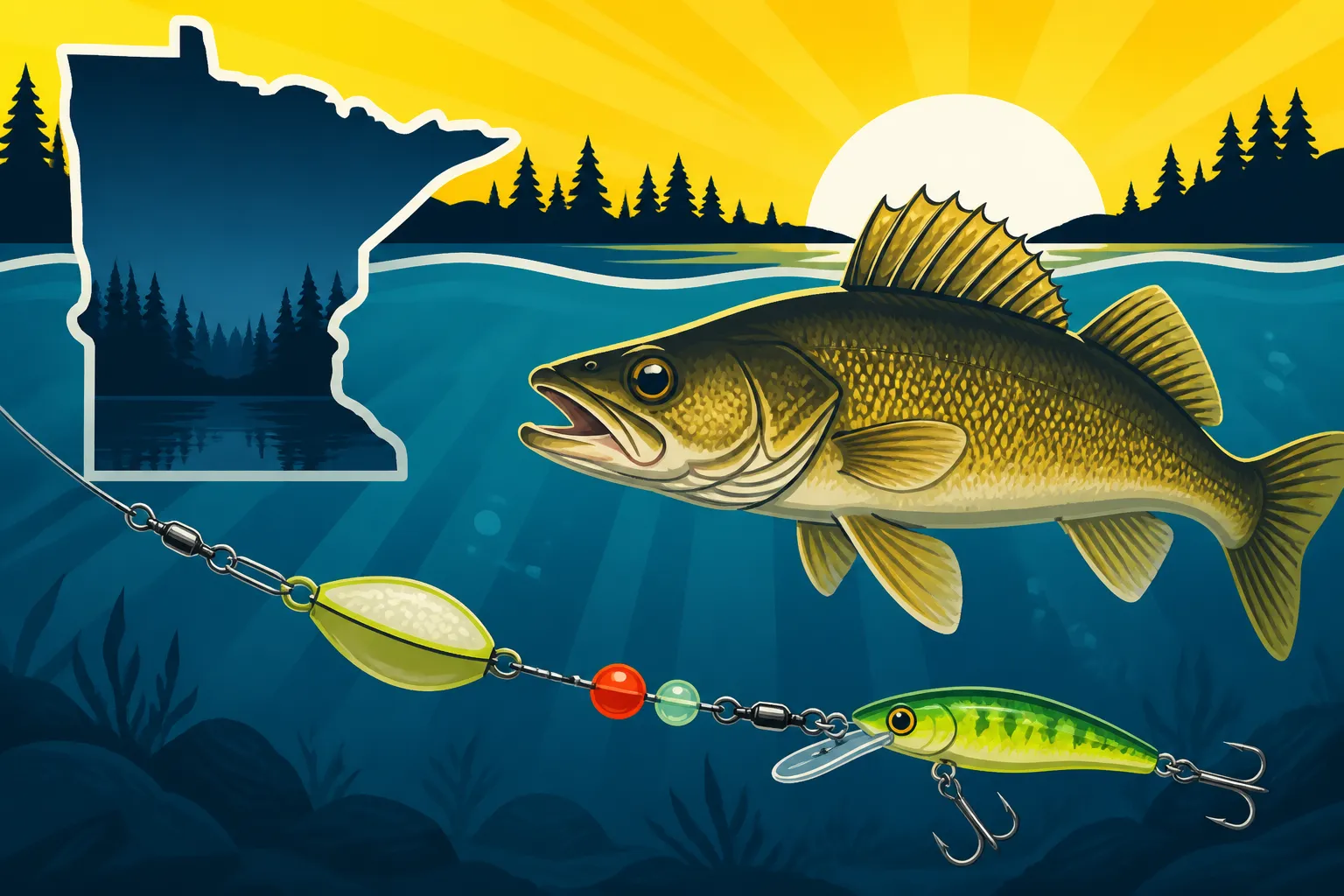
Once you have your bottom bouncer selected, the crawler harness—often called a "spinner rig"—is what actually catches the fish. A standard harness consists of a length of line, a series of beads, a plastic clevis that holds a spinning blade, and usually two hooks in tandem to hold a large nightcrawler. In Minnesota, where water clarity can range from the "coffee-stained" rivers to the gin-clear depths of the north, the specifics of your harness can make or break your day.
Blade Sizes and Colors for Minnesota Waters
The blade is the engine of the crawler harness. It provides the flash and vibration that draws fish in from a distance. In the stained waters of Lake of the Woods, large #5 or #6 Colorado blades in "gold" or "firetiger" patterns are legendary. The Colorado blade is rounder and creates more "thump" in the water, which helps walleyes locate the bait using their lateral lines in low-visibility conditions. Because these blades are prone to getting lost or bent, many veteran trollers buy their components on Amazon to tie their own custom rigs during the winter months.
In clearer lakes, such as those in the Alexandria area, you might downsize to a #3 Indiana or Willow Leaf blade. These blades are narrower and spin faster with less vibration, providing a more subtle "flicker" that mimics small minnows or perch. Silver, blue, and purple are often the go-to colors in clear water, especially on sunny days. Best Walleye Lures: Jigs, Cranks & Spinners provides a deeper look into how these color choices shift based on the forage base of a specific lake.
Leader Length and Line Selection
The length of the leader between your bottom bouncer and the spinner is a point of much debate. The "standard" is usually about 36 to 48 inches. A shorter leader (30 inches) is great for dirty water or when you are fishing tight to heavy cover like submerged timber or steep drop-offs, as it keeps the bait closer to the bouncer's path. However, in the ultra-clear waters of the Boundary Waters or deep-water mines, a longer leader of 60 inches or more may be necessary to prevent the fish from being spooked by the heavy wire bouncer.
Line selection for the harness itself is critical. Most commercial rigs use 10lb to 14lb monofilament, but many pros prefer 12lb fluorocarbon. Fluorocarbon is nearly invisible underwater and has better abrasion resistance against the teeth of a walleye or the occasional northern pike. If you are tying your own, ensure your knots are seated perfectly, as the constant rotation of the blade can put a lot of stress on the line over an eight-hour fishing day.
Bead Patterns and Vibration Factors
Beads aren't just for decoration; they serve as spacers to keep the spinning blade from fouling on the hooks. However, the color and size of the beads also contribute to the overall profile of the rig. A "hot" bead pattern—such as alternating chartreuse and orange—can be a game-changer during the Spring Crappie Fishing in Minnesota transition when walleyes are moving toward summer humps.
Some anglers also incorporate "floats" into their bead sequence. These are small, buoyant foam beads that lift the harness slightly higher. This is particularly effective if you are trolling over a "carpet" of low-lying moss or algae. By adding a float, you ensure the hooks stay above the gunk, keeping your nightcrawler clean and appetizing. Experimenting with different bead counts can also change the vibration frequency of the blade, which is something you should adjust until you find what the fish are "asking" for that day.
Best Minnesota Lakes for Bottom Bouncing
While you can use a bottom bouncer on almost any body of water, some Minnesota lakes are practically tailor-made for this technique. These are usually large lakes with expansive flats, long tapering points, or massive reef complexes where fish are spread out rather than concentrated in one tiny "honey hole."
Working the Mud Flats of Mille Lacs
Mille Lacs is perhaps the most famous "flat" lake in the world. Its massive mud flats rise out of 30-plus feet of water and are home to huge populations of walleyes throughout the summer. Bottom bouncing is the gold standard here. Because the flats are so large, you need a technique that allows you to cover miles of water to find where the schools are holding.
On Mille Lacs, you’ll often find fish on the "edges" of the flats in the morning and moving onto the "top" of the flats as the sun gets higher. Using a 2-ounce bouncer with a hammered gold Colorado blade is a classic Mille Lacs presentation. If you're planning a trip there, be sure to check the latest Mille Lacs Walleye Regulations (2026) to ensure you're within the legal limits for the season.
Navigating the Reefs of Lake of the Woods
Lake of the Woods is a different beast entirely. It’s a massive, island-filled inland sea with complex rock reefs and mud basins. In the summer, walleyes here often migrate to the deep mud (30-34 feet) between the reefs. This is where the bottom bouncer shines because it allows you to troll through these deep basins effectively.
The water in Lake of the Woods is quite stained, often appearing like dark tea. Because of this, vibration is king. Many anglers use oversized blades and brightly colored beads to help the fish find the bait. It’s not uncommon to catch your Minnesota Walleye Limit & Size Rules quota in just a couple of hours when you find a school of "active" fish in the mud. Just remember that Lake of the Woods also has a healthy population of sturgeon, so don't be surprised if your bottom bouncer suddenly feels like it's hooked to a freight train.
Targeting Transition Zones on Leech Lake
Leech Lake offers a mix of everything: shallow weeds, deep rocks, and massive flats like Walker Bay. Bottom bouncing is incredibly effective on the transition zones where the sand meets the rock or where the weeds give way to mud. During the When Is the Minnesota Walleye Opener 2026? period, many fish are still in the shallower bays, but as June progresses, they move toward the main lake reefs.
On Leech, a "slow death" rig—which is a variation of the crawler harness using a specially bent hook that makes the worm spin—is often paired with a bottom bouncer. This provides a different vibration than a traditional blade and can be lethal on pressured fish. If the bite is tough, try slowing your troll down to 0.8 mph and using a smaller bouncer to make the presentation as stealthy as possible.
| Feature | Colorado Blade | Indiana Blade | Willow Leaf Blade |
|---|---|---|---|
| Shape | Round/Wide | Teardrop | Long/Narrow |
| Vibration | High "Thump" | Medium | Low/Subtle |
| Ideal Speed | 0.8 – 1.2 mph | 1.0 – 1.5 mph | 1.2 – 2.0 mph |
| Best Water | Stained/Murky | All-Purpose | Clear/High Sun |
| Primary Goal | Attraction via Lateral Line | General Mimicry | Visual Flash/Speed |
Step-by-Step Technique and Boat Control
Mastering the bottom bouncer isn't just about throwing it overboard and driving the boat. It requires a nuanced understanding of how your boat’s movement affects the bait’s action below. Precision is what separates a "lucky" angler from a consistent producer.
Trolling Speeds and GPS Management
Your speed is the most critical variable. For a standard crawler harness, the "sweet spot" is usually between 1.0 and 1.2 mph. If you go too slow (below 0.7 mph), the blade won't spin, and the harness will just drag lifelessly through the mud. If you go too fast (above 1.5 mph), the harness may "helicopter" and twist your line, or the blade will create so much lift that your bouncer loses contact with the bottom.
Using a GPS or a high-quality fish finder is essential for maintaining this speed. Even a 0.1 mph difference can be the trigger that starts the fish biting. In Minnesota, wind is almost always a factor. If you are trolling with the wind, you may need to use your bow-mount electric motor to "brake" the boat and keep your speed down. If you are trolling against the wind, you’ll need to bump up the thrust. Consistency is key; walleyes often follow a bait for a long distance before committing, and a sudden surge or stall in speed can cause them to turn away.
Detecting the Subtle Walleye Bite
One of the biggest hurdles for people transitioning from jigging to bottom bouncing is learning how a bite feels. It is rarely a "slamming" strike. Usually, it feels like you’ve suddenly picked up a small piece of wet cardboard. Your rod tip will load up slightly, or you’ll feel a dull heaviness. This is the walleye inhaling the nightcrawler and swimming along with the boat.
When you feel this heaviness, do not immediately set the hook. This is the hardest part for most anglers. If you jerk the rod right away, you will likely pull the bait right out of the fish's mouth before they’ve reached the hooks. Instead, "feed" the fish by slowly lowering your rod tip toward the water for two or three seconds. This gives the fish time to fully engulf the crawler and the tandem hook set.
Hook Setting with a Long Lead
After you have "fed" the fish for a few seconds, the hook set should be a long, sweeping motion rather than a sharp snap. Because you have a heavy weight and often a lot of line out, a sharp snap doesn't translate well to the business end of the rig. A firm, steady sweep to the side or upward will engage the hooks.
Once the fish is hooked, keep a steady bend in the rod. Do not pump the rod like you’re fishing for saltwater tuna. The weight of the bottom bouncer creates a lot of leverage, and if you give the fish any slack, they can use the weight of the bouncer to shake the hooks loose. This is especially true with bigger walleyes that like to "head shake" on the way up. Consistent tension is your best friend until that fish is in the net.
Selecting the Right Gear for the Job
You can't just use any old rod for bottom bouncing. Because you are dragging a 2-ounce or 3-ounce weight all day, a flimsy panfish rod will be doubled over just from the weight of the rig, leaving you with no "backbone" to set the hook.
Rod Action and Sensitivity
The ideal rod for bottom bouncing is a 7’0” to 8’6” medium-heavy power rod with a "moderate" or "fast" action. A moderate action is often preferred because it has a softer tip that allows the walleye to "load up" on the bait without feeling too much resistance. This softer tip acts as a buffer, giving the fish that extra second to commit to the crawler.
Telescoping rods are popular among Minnesota anglers who travel between lakes, as they can be collapsed for easy storage in boat lockers. Many of these specialty rods are available on Amazon and are designed specifically for the "load and sweep" style of trolling. Look for a rod with a long handle, as you’ll likely be propping it against your leg or placing it in a rod holder for hours at a time.
Reel Selection and Line Counters
While a standard baitcasting reel works, a line-counter reel is a massive advantage. Knowing exactly how many feet of line you have out allows you to replicate success. If you catch a fish with 45 feet of line out in 20 feet of water, you can put your bait right back into that exact same spot every time. This precision is what allows you to "target" specific depths on a breakline.
If you don't have a line counter, you can count the "passes" of the level-wind guide on your baitcaster, but it’s far less accurate. Low-profile line counters have become very popular recently because they are lighter and more comfortable to hold than the bulky "round" reels of the past. If you’re just starting out, checking out Best Fishing Gear for Beginners in Minnesota (By Budget) can help you decide if the investment in a dedicated trolling reel is right for you.
Terminal Tackle and Storage
Bottom bouncing requires a lot of "stuff." You’ll need a variety of bouncer weights, different blade sizes, hooks, beads, and clevises. Keeping this organized is a challenge. Many anglers use "pool noodles" or specialized foam "tackle tamers" to wrap their pre-tied crawler harnesses around. This prevents the 4-foot leaders from turning into a giant bird's nest in your tackle box.
Don't forget the bait itself. Large, healthy nightcrawlers are the lifeblood of this technique. Keep them in a "worm bedding" rather than just dirt, and keep them cold. A "sun-cooked" crawler turns mushy and loses its scent, and a walleye can definitely tell the difference. Investing in a small, insulated bait cooler is one of the best "pro tips" for anyone serious about summer trolling in the Midwest.
Troubleshooting Common Issues
Even the best techniques have their pitfalls. Whether it's dealing with "trash fish" or navigating treacherous rock piles, being prepared for the hiccups will keep you on the water longer.
Dealing with Snags and Rock Piles
If you are fishing a lake with "craggy" rocks, like the reefs on Lake Vermilion, you are going to get snagged eventually. When the bouncer wedges, don't just pull as hard as you can from the front of the boat. This usually just seats the weight deeper. Instead, circle the boat back around to the opposite direction of your troll. Often, pulling the rig "backward" will pop the wire free.
To minimize snags, try to "hand-hold" your rod rather than leaving it in a rod holder when you are over rocks. By holding the rod, you can "lift" the bouncer over a particularly high rock or drop it into a hole manually. This "active" bouncing is much more effective in snag-prone areas than "passive" trolling.
Managing Nuisance Fish and Small Perch
One of the downsides of using live nightcrawlers is that everything likes to eat them. On many Minnesota lakes, you’ll find yourself plagued by "bait thieves"—small yellow perch, sunfish, or even "shiners" that peck at the tail of your crawler. If you feel a "machine gun" vibration on your rod, that’s usually a small fish trying to rip the tail off.
If this happens constantly, you have two choices: move or adapt. Moving to deeper water often gets you away from the smaller "nursery" fish. Alternatively, you can switch to a "gulp" or artificial crawler. While not always as effective as the real thing, artificial baits are much tougher and can survive the pecking of a dozen small perch, staying on the hook until a big walleye finally shows up. You can find a wide variety of these "scented" plastics on Amazon in colors that match the local forage perfectly.
Disclaimer
This guide is intended for informational purposes only. Fishing regulations in Minnesota are subject to change, and it is the responsibility of the angler to ensure they are in compliance with all state and local laws, including those regarding invasive species and limit requirements. Always check the current Minnesota DNR regulations before heading out on the water.