Best Ice Shelters: Clam vs Otter (Flip vs Hub)
Navigating Minnesota’s ice fishing scene without a proper shelter can feel like an arctic survival challenge. The biting winds, relentless snow, and bone-chilling temperatures don't just make fishing uncomfortable; they can cut your day short and even pose real safety risks. This comprehensive guide will walk you through everything you need to know about choosing the best ice shelter, specifically diving deep into the popular Clam and Otter brands, and comparing the distinct advantages of flip-over versus hub styles, ensuring your next winter excursion is warm, safe, and productive.
Why a Good Ice Shelter is Non-Negotiable for Minnesota Winters
Let's be honest, standing out on the open ice, even on a "mild" Minnesota winter day, is an endurance test. The wind cuts through layers, your hands go numb, and keeping bait from freezing solid becomes a full-time job. A quality ice shelter isn't a luxury; it's a fundamental piece of gear that transforms a potentially miserable experience into an enjoyable one, allowing you to focus on the fish, not the frostbite.
The Brutal Reality of Open-Ice Fishing
Picture this: you've driven hours to your favorite lake, like Upper Red Lake or Lake of the Woods, with high hopes of catching some jumbo perch or walleye. You drill your holes, set up your gear, and within 30 minutes, a squall rolls in. Suddenly, you're hunched over, shivering, trying to shield your hole from drifting snow, and your lines are freezing in the guides. Your tackle box becomes an icy slab. This isn't just unpleasant; it's a quick way to get hypothermia and, frankly, ruins the entire point of a relaxing day on the ice. Without protection, your hands will be too stiff to tie knots, your electronics will struggle in the extreme cold, and your patience will wear thin long before the fish even think about biting.
Many of us have started our ice fishing journeys with just a bucket and a jig, enduring the elements directly. While it builds character, it significantly limits your time on the ice and how much you can truly enjoy the experience. The reality of Minnesota winters means temperatures can drop well below zero, and wind chills can make it feel even colder. A shelter provides a crucial barrier against these harsh conditions, extending your fishing day and making it far more tolerable.
Comfort and Safety Beyond the Catch
Beyond just staying warm, an ice shelter offers a level of comfort and safety that's truly invaluable. Imagine being able to take off your bulky gloves to re-tie a knot, or having a portable heater roaring away, keeping your hands pliable and your feet from turning into blocks of ice. A shelter allows you to set up your fish finder, maybe a Best Ice Fishing Flashers: Vexilar vs Humminbird vs Garmin, without worrying about snow accumulation on the screen or the battery dying prematurely due to extreme cold. It's a refuge where you can enjoy a hot cup of coffee or a sandwich without battling the wind.
For families or groups, a shelter becomes a social hub, a place to share stories, keep snacks and drinks from freezing, and simply enjoy each other's company out of the elements. From a safety perspective, a shelter can provide immediate protection during sudden whiteouts or severe weather changes, offering a controlled environment where you can warm up, re-group, and assess conditions before making your next move. It keeps young anglers and those new to ice fishing much safer and more comfortable, making them more likely to fall in love with the sport.
Flip-Over Shelters: The Mobile Angler's Dream
Flip-over shelters, often affectionately called "flip-shacks," are the go-to choice for anglers who prioritize mobility and quick setups. They're designed for the "run-and-gun" style of fishing, where you're constantly moving from hole to hole, searching for active fish. These shelters are characterized by their sled base, which also serves as storage and a foundation, and a collapsible frame that "flips over" to create the shelter.
Advantages of the Flip-Over Design
The biggest draw of a flip-over shelter is its unparalleled portability and speed of deployment. When you're scouting for fish, maybe following a school of crappie on Lake Waconia or searching for active walleye on Mille Lacs, every minute counts. With a flip-over, you can literally pull up to a spot, unstrap the cover, flip the top over, and be fishing in under a minute. Your rods, tackle, and even a small heater are often already stored in the sled, ready to go. This efficiency is a game-changer when fish are moving or when you're trying to cover a lot of ice.
Another significant advantage is the integrated sled, which acts as a built-in transport system for all your gear. You can pile in your Best Ice Augers for Minnesota: Electric vs Gas, your rods, Best Ice Fishing Rods for Walleye & Panfish, bait, and even a portable power station, then pull it all across the ice by hand, with an ATV, or snowmobile. Brands like Clam and Otter have refined their sled designs over the years, making them incredibly durable and easy to tow, even through deep snow. Plus, many flip-overs come with comfortable seating already integrated, often swiveling seats or bench-style seating, providing an immediate fishing station once deployed.
Disadvantages and Trade-offs
While flip-overs are fantastic for mobile anglers, they do come with a few trade-offs. Firstly, their footprint can be somewhat limited compared to hub shelters, especially for multiple anglers. While models exist for two or three people, they can feel a bit cramped with all your gear, especially when jigging actively or trying to land a larger fish. The sled base, while convenient for transport, can sometimes make it harder to position directly over your holes, and you're often fishing outside the main sled area.
Another consideration is weight. While designed for portability, the larger flip-overs, especially those with thermal insulation, can be quite heavy. Hauling a fully loaded two-person flip-over across slushy ice or through heavy snow can be a real workout, even with a tow bar. Storage at home can also be an issue; they are long and somewhat bulky due to the integrated sled. Finally, set-up on extremely uneven ice can be a little challenging as the sled needs a relatively flat surface to sit properly.
Top Contenders: Clam vs. Otter Flip-Overs
When it comes to flip-over shelters, the debate almost always boils down to Clam versus Otter. Both brands offer an impressive lineup, each with its own loyal following and design philosophies.
Clam, known for its innovation, offers a wide range of flip-overs from single-person units like the Clam Scout to spacious three-person models like the Clam X-300 Pro Thermal. Their shelters often feature clever design elements like light bar attachments, rod holders, and quick-release pole systems. Many of their higher-end models, like the Clam X-Series or Clam Legend Thermal, boast full thermal fabric, which is crucial for retaining heat in frigid conditions. Clam also introduced the "fish trap" concept which revolutionized the flip-over market.
Otter, on the other hand, is renowned for its rugged durability and premium construction. Their Otter XT Pro X-Over series, for example, is famous for its thick, rotomolded sleds that can take a serious beating season after season. Otter also emphasizes thermal insulation heavily, using high-quality thermal fabrics that are exceptionally warm. Anglers often rave about the robust framework and comfortable seating in Otter shelters, feeling like they are built to last a lifetime. Models like the Otter Cabin or Otter Lodge offer ample space and comfort for multiple anglers. When you buy an Otter, you're investing in a piece of equipment known for its sheer toughness and longevity, often found at retailers like Bass Pro Shops.
Hub Shelters: Space and Stability for the Crew
Hub shelters represent the other primary category of ice shelters, offering a distinct set of advantages, particularly when it comes to interior space and accommodating larger groups. These shelters expand from a compact bag into a cube-like structure, supported by a system of flexible poles that "hub" out from central connection points.
Advantages of the Hub Design
The standout feature of a hub shelter is the sheer amount of usable space it provides. Because they don't have an integrated sled and expand outward, a hub shelter offers a much larger floor plan compared to a flip-over of similar packed size. This makes them ideal for groups, families, or anglers who simply prefer more room to spread out their gear, run multiple lines, and move around comfortably. If you’re thinking about fishing with friends on a big lake like Lake Vermilion or Leech Lake, a hub shelter can easily fit three, four, or even six anglers, along with all their chairs, heaters, and electronics.
Hub shelters are also incredibly lightweight and compact when packed down. They fold up into a relatively small, cylindrical bag that's easy to transport in the trunk of a car, on a small sled, or even strapped to a backpack. This makes them a great option for situations where you don't have an ATV or snowmobile to pull a heavier flip-over. Their relatively simple design also means they tend to be more affordable than comparable flip-over models, making them a popular choice for budget-conscious anglers or those just getting into the sport who still want protection from the elements.
Disadvantages and Logistical Challenges
While spacious and portable, hub shelters do have their downsides. The primary one is the setup time. Unlike the quick flip of a flip-over, a hub shelter requires you to unpack it, extend all the hubs, and then anchor it securely to the ice. This process can take several minutes, especially in windy conditions, and requires more effort. You'll also need to carry separate chairs, a portable sled for your gear, and a heater, as these are not integrated into the shelter itself.
Another potential drawback is stability in high winds. While modern hub shelters come with sturdy anchor systems, a strong gust can still try to pick them up and send them tumbling if not properly secured with ice anchors and guy lines. This is a critical consideration in wide-open expanses of Minnesota lakes. Finally, the floor is open to the ice, meaning you don't have the insulated barrier of a sled base, which can sometimes lead to colder feet unless you bring insulated mats or carpeting.
Leading Brands: Clam vs. Otter Hubs
Just like with flip-overs, Clam and Otter dominate the hub shelter market, offering a range of sizes and features to suit various needs.
Clam's hub shelters are well-regarded for their innovative features and thoughtful designs. Models like the Clam Yukon, Clam Big Mouth, and the various Clam X-Series Hubs are popular choices. Clam often incorporates features like oversized doors for easy entry, internal mesh pockets for organization, and ample windows. Their thermal models, utilizing their proprietary "Full Thermal Trap Technology," are excellent at keeping the heat in, which is especially important in larger, more open hub designs. The Quick-Set design makes them relatively easy to deploy once you get the hang of it.
Otter hub shelters, such as the Otter Vortex Lodge or Otter Vortex Resort, carry the brand's reputation for rugged construction into the hub category. They are known for using incredibly durable fabrics and robust pole systems, designed to withstand the harshest winter conditions. Otter's thermal models, in particular, are highly praised for their superior insulation and ability to hold heat, making them incredibly comfortable even on the coldest days. If you're looking for a hub shelter that feels like a tank and is built to withstand years of abuse, an Otter hub shelter is a fantastic choice, often found online through retailers like Amazon.
Clam Ice Shelters: Innovation and Angler Focus
Clam Corporation has been a pioneering force in ice fishing, consistently pushing the envelope with innovative designs and angler-centric features. They were instrumental in popularizing the flip-over style shelter, making mobile ice fishing accessible to the masses. Their product line is vast, catering to every type of ice angler, from the solo explorer to large groups.
Flagship Flip-Over Models
Clam's flip-over shelters are often synonymous with convenience and smart engineering. The Clam X-Series represents their premium thermal line, with models like the X-100, X-200, X-300, and X-400 Pro Thermal. These shelters feature heavy-duty thermal fabric that significantly reduces condensation and retains heat, making them incredibly comfortable. They often include features like light bars, accessory pockets, and comfortable seating options. For instance, the X-200 Pro Thermal is a popular two-person choice, offering a balanced blend of space, warmth, and mobility.
Then there's the Clam Legend Thermal, a top-tier offering known for its spacious interior and robust construction, often seen as a flagship for those who want the best of Clam's flip-over technology. Even their more entry-level models, like the Clam Kenai Pro, offer excellent value for single anglers looking for a compact, quick-deploy solution. Many of these utilize the "Instant Set" design, which truly lives up to its name for rapid deployment.
Popular Hub Models
Clam's hub shelters bring the same focus on innovation and angler experience to a more communal fishing environment. The Clam Yukon X Thermal is a wildly popular hub, offering substantial space for up to four anglers. It’s a great example of their thermal hub technology, ensuring a warm and dry interior. The Clam Big Mouth Series lives up to its name, featuring oversized doors that make it incredibly easy to move gear in and out, or to quickly respond to a biting fish.
For larger groups, Clam offers options like the Clam X-600 Thermal, a true powerhouse that can accommodate 5-6 people comfortably. These hubs are designed with durable materials and robust hub systems to withstand strong winds and heavy snow loads. Clam also includes thoughtful details such as ceiling vents for proper airflow (especially when using a heater), clear windows for visibility, and reinforced corners for longevity. For those looking for a versatile shelter, Ice Fishing in Minnesota: Complete Beginner-to-Pro Guide often recommends a good hub shelter like those from Clam.
Key Technologies and Features
Clam distinguishes itself through several key technologies:
- Full Thermal Trap Technology: This proprietary fabric blends insulation directly into the shell, creating a highly efficient barrier against the cold and drastically reducing condensation build-up. This means a warmer, drier interior, even on the coldest days.
- Rapid Poles & Instant Set Design: Clam has focused on making deployment as quick and effortless as possible. Their pole systems are designed for smooth extension and retraction, enabling anglers to get fishing faster.
- Integrated Lighting and Accessories: Many Clam shelters come with pre-installed or easily attachable LED light bars, rod holders, and various storage pouches, enhancing the overall fishing experience without needing aftermarket add-ons. You can find many of these accessories for sale at Bass Pro Shops.
- Roto-Molded Sled Bases (Flip-Overs): Clam's sleds are designed to be durable and slide easily over snow and ice, offering secure storage for all your gear.
Otter Ice Shelters: Durability and Premium Performance
Otter Outdoors has carved out a reputation for building some of the most robust and highest-quality ice fishing shelters on the market. Their philosophy centers around extreme durability, superior thermal performance, and premium comfort, making them a favorite among serious anglers who demand the best and expect their gear to last for many seasons.
Flagship Flip-Over Models
Otter's flip-over shelters are built like tanks, starting with their legendary rotomolded sleds. The Otter XT Pro X-Over Series is their flagship line, boasting not only incredibly tough sleds but also heavy-duty thermal fabrics and a unique "X-Over" design that allows the front wall to articulate, creating more fishable space and easier entry. Models like the Otter XT Pro Cabin (2-person) and Otter XT Pro Lodge (2-3 person) are incredibly popular, offering spacious layouts and rock-solid stability.
The Otter Resort and Otter Vortex flip-overs also exemplify Otter's commitment to quality, featuring extra-thick thermal fabrics that excel at trapping heat. Anglers often highlight the quality of the poles, hinges, and overall construction, noting that these shelters feel incredibly secure even in the fiercest winds. When you're fishing a wide-open expanse like Lake of the Woods, that kind of confidence in your shelter is priceless.
Popular Hub Models
Otter applies the same rigorous standards to its hub shelters. The Otter Vortex Lodge Thermal and Otter Vortex Resort Thermal are prime examples of their commitment to durability and warmth in a hub design. These shelters feature the same heavy-duty thermal fabric found in their flip-overs, ensuring excellent heat retention and minimal condensation. The robust pole systems and oversized hubs are designed for extreme conditions, providing superior stability compared to many competitors.
Otter hubs also stand out with their attention to detail, such as reinforced stress points, large zippered doors, and plenty of interior storage pockets to keep your gear organized. If you're planning a trip with a larger group and need maximum space and comfort, perhaps on a weekend expedition, an Otter hub shelter like the Vortex Resort offers ample room for several anglers, a heater, and all your creature comforts. Their reputation for quality means you'll find them readily available at specialized outdoor stores and often with good reviews on platforms like Amazon.
Key Technologies and Construction
Otter's commitment to premium performance is evident in its core technologies:
- Rotomolded Sleds: This is perhaps Otter's most famous feature. Their sleds are rotationally molded from high-density polyethylene, making them incredibly tough, resistant to cracking in cold weather, and able to slide smoothly over rough ice and snow. They are virtually indestructible.
- ThermalTec™ 600-Denier Fabric: Otter uses a heavy-duty, layered thermal fabric that not only provides superior insulation but is also highly durable and resistant to tears and abrasions. This material is key to their shelters' ability to stay warm and reduce condensation.
- MAXimum Duty Sled and Frame Systems: Otter invests heavily in strong aluminum frames and pole systems that are designed to withstand years of heavy use and abuse, minimizing flex and maximizing stability.
- Quick-Switch Modular Seating: Many Otter flip-overs feature versatile seating systems that can be easily moved, removed, or swapped out to customize the interior layout to your fishing style and preferences.
Choosing Your Perfect Shelter: Flip-Over vs. Hub Considerations
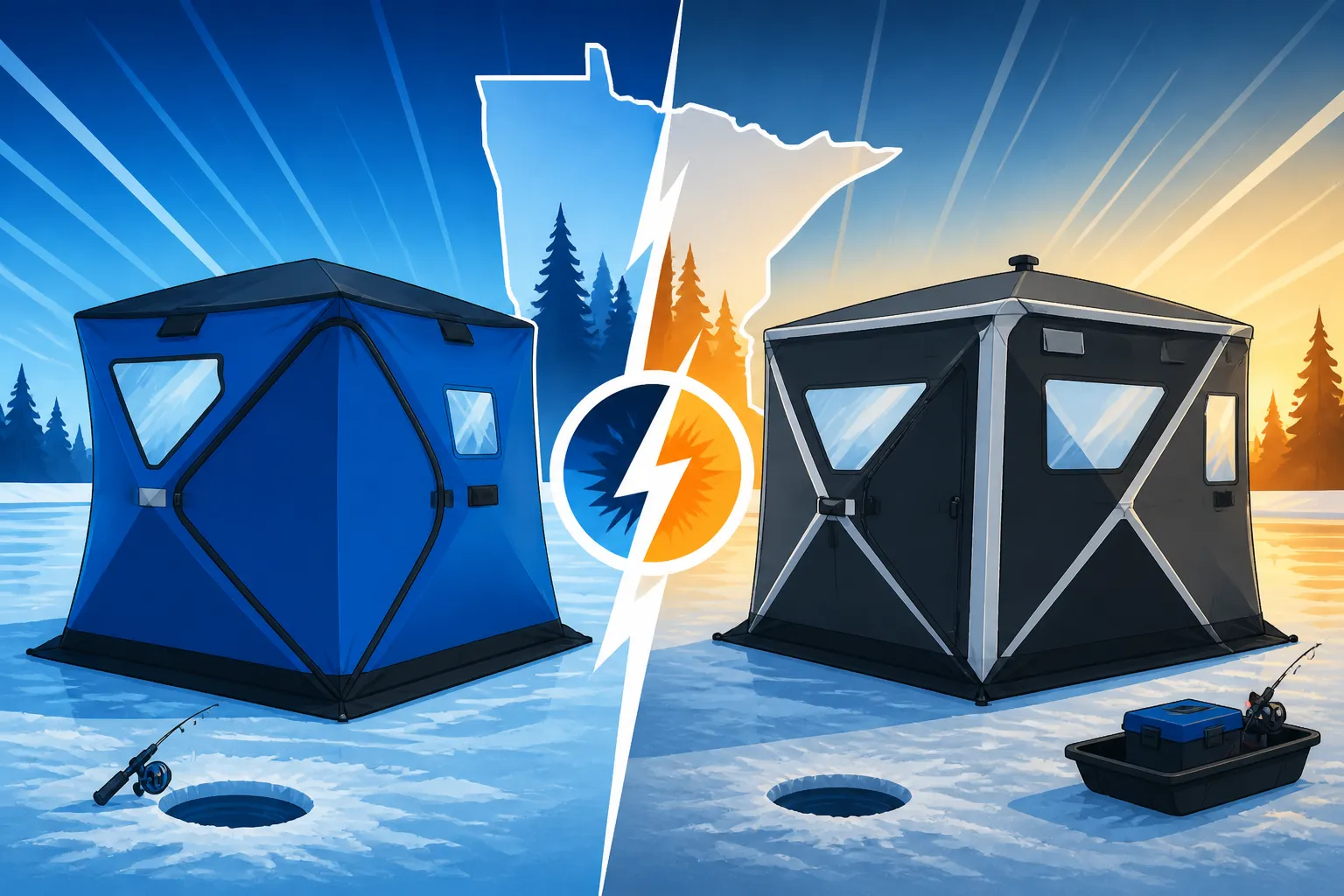
Deciding between a flip-over and a hub shelter isn't about one being inherently "better" than the other; it's about matching the shelter to your specific fishing style, group size, and personal preferences. Each has distinct advantages that make it ideal for different scenarios on the ice.
Angler Count and Group Size
This is often the most critical factor. If you're primarily a solo angler or fish with just one partner, a flip-over shelter often makes the most sense. A one or two-person flip-over provides enough space for you and your gear, allows for quick moves, and keeps you warm. You can set up your Best Ice Fishing Electronics for Beginners and jig away in comfort.
However, if you frequently fish with three or more people, or if you like to bring the whole family, a hub shelter is usually the superior choice. The open floor plan and expansive interior of a 4-6 person hub shelter provide ample room for everyone, their gear, multiple holes, and a heater, preventing that cramped feeling. Imagine a day ice fishing on Winnie with friends, where a large hub allows everyone to spread out and enjoy the experience without constantly bumping elbows.
| Feature | Flip-Over Shelter | Hub Shelter |
|---|---|---|
| Primary Benefit | Mobility, Quick Setup | Space, Portability (when packed) |
| Best For | Solo/Duo, Run-and-gun, Frequent moving | Groups/Families, Stationary fishing, Large space |
| Transport | Integrated sled (towed by hand/ATV/snowmobile) | Bag (carried by hand, in sled, car trunk) |
| Setup Time | Very Fast (seconds) | Moderate (minutes), requires anchoring |
| Packed Size | Long, bulky (due to sled) | Compact, cylindrical (easy to store) |
| Interior Space | More restricted, often narrower | Spacious, open, cube-like |
| Seating | Often integrated, comfortable | Requires separate chairs |
| Wind Stability | Good (low profile, heavy sled) | Good (when anchored well), can catch wind |
| Price Point | Generally higher (due to integrated features) | Generally lower |
| Thermal | Excellent (sled acts as barrier) | Excellent (if thermal fabric), open floor |
Portability and Transport Needs
How you plan to get your shelter onto the ice significantly impacts your choice. If you own an ATV, snowmobile, or even a robust utility sled that you pull by hand, a flip-over shelter is a fantastic option. The integrated sled makes it incredibly easy to load all your gear and simply tow it to your desired fishing spot. The weight isn't as much of a factor when you have motorized assistance.
Conversely, if you're limited to walking out onto the ice, or if you primarily travel by car and need something that fits easily in a trunk, a hub shelter shines. Its lightweight and compact packed size make it much more manageable for manual transport or fitting into smaller vehicles. You'll need a separate small sled for your other gear, but the total weight will likely be less than a fully loaded flip-over. Think about how you'll get your gear onto the ice for Shore & Bank Fishing in Minnesota (No Boat) scenarios versus driving out onto a plowed lake access.
Thermal Efficiency and Winter Conditions
Both flip-over and hub shelters are available in thermal versions, which are highly recommended for Minnesota's brutal winters. Thermal fabric significantly improves heat retention and reduces condensation, making a huge difference in comfort.
However, there's a subtle difference. A flip-over shelter, with its insulated sled base, often creates a more fully enclosed and warmer environment, especially around your feet. The sled acts as a barrier against the cold ice, minimizing drafts and heat loss from below. This can be a huge comfort when the thermometer dips into the single digits or below.
Hub shelters, while offering thermal fabric walls, have an open floor. This means you're directly on the ice, which can feel colder underfoot. Many hub anglers mitigate this by bringing insulated floor mats, carpet scraps, or even plywood panels to cover their fishing area. Ultimately, a good heater, like a Mr. Heater Portable Buddy, is essential for both types of shelters to maintain warmth, but the overall thermal envelope can be slightly better in a well-sealed flip-over. You might also consider Best Ice Fishing Heater for a Shelter to maximize your comfort regardless of shelter type.
Comparing Clam and Otter: A Head-to-Head Analysis
When it comes down to Clam versus Otter, you're looking at two titans of the ice fishing world, both offering exceptional products. The choice often comes down to nuanced differences in design philosophy, material choice, and ultimately, what you value most in an ice shelter.
Material Quality and Craftsmanship
Otter has built its reputation on extreme durability and premium materials. Their rotomolded sleds are legendary for their toughness, able to withstand impacts and abrasive surfaces without cracking. The fabric on Otter shelters, particularly their ThermalTec, feels incredibly robust and heavy-duty, often boasting higher denier counts which indicate stronger, more tear-resistant material. Their frame systems are typically made from thicker-gauge aluminum, contributing to a feeling of unyielding stability. If you're rough on your gear, or fish in extremely challenging conditions year after year, Otter's construction often gives it an edge in raw durability.
Clam, while also using high-quality materials, often balances durability with innovative features and weight considerations. Their thermal fabrics are excellent, and their sleds are designed for smooth towing. Clam's craftsmanship is top-notch, with attention to detail in stitching, zippers, and pole systems. While an Otter might feel like it's built to survive an apocalypse, a Clam shelter often feels incredibly refined and thoughtfully designed for the angler's daily needs. Neither brand is "cheaply made," but Otter leans into the "overbuilt" category more distinctly.
Price Point and Value Proposition
Generally speaking, Otter shelters tend to sit at a slightly higher price point than comparable Clam models. This premium reflects their commitment to top-tier materials, heavy-duty construction, and often, more refined thermal technology. For many anglers, the investment in an Otter is seen as buying a shelter that will truly last a lifetime, holding its value well over time. The longevity and resilience often justify the initial cost for dedicated ice enthusiasts.
Clam offers a wider range of price points, making them very accessible to anglers across different budgets. You can find excellent entry-level Clam shelters that provide fantastic protection and features without breaking the bank, all the way up to their high-end thermal models that compete directly with Otter. Clam's value proposition often lies in its innovative features, smart design, and excellent performance for the price. If you're looking for a feature-rich shelter at a competitive price, Clam often delivers. You can often find great deals on both brands at major outdoor retailers like Bass Pro Shops or online marketplaces such as Amazon.
Feature Set and Angler-Specific Innovations
Clam is arguably the more innovative of the two brands, constantly introducing new features and design elements. They are often the first to integrate things like overhead mesh storage, clear windows for ambient light, sophisticated light bar systems, and convenient accessory attachments. Their focus is often on optimizing the fishing experience from a user-friendly perspective. For example, the instant-set features on many Clam shelters are a direct result of their commitment to quick deployment.
Otter, while still innovative, tends to focus on refining core performance: maximizing warmth, durability, and stability. Their innovations often center on improving existing components, such as their X-Over frame system for increased space or their refined seating systems. While they might not have as many "gadgets" as some Clam models, every feature on an Otter is typically optimized for rugged reliability and superior function in harsh conditions. For serious anglers who value pure performance and endurance, an Otter often checks all the boxes. For instance, if you're focused on Ice Fishing for Walleye: Tactics & Setups, you might appreciate the robust foundation of an Otter.
Essential Accessories and Setup Tips for Your Shelter
Having the best ice shelter is only half the battle. To truly maximize your comfort, safety, and fishing success, you need the right accessories and know-how to set up your portable fortress properly. Ignoring these details can quickly turn a great day into a frosty ordeal.
Anchoring and Stability in High Winds
This is perhaps the most critical aspect of setting up any ice shelter, especially a hub style. High winds on open lakes are a common occurrence in Minnesota, and an improperly anchored shelter can quickly become a dangerous kite.
- Ice Anchors: Always use the ice anchors that come with your shelter, or upgrade to better ones. Screw-in anchors are generally more secure than spike-style anchors. Most shelters require at least four anchors, one for each corner, but in high winds, use all available tie-down points, including guy ropes for hub shelters.
- Anchor Tools: A drill adapter for your ice auger (or a dedicated anchor tool) can save your hands and make screwing anchors into hard ice much faster and easier.
- Snow Skirts: For hub shelters, piling snow around the base or "snow skirting" is essential. This not only seals off drafts but also adds weight and stability to the shelter, preventing it from lifting in gusts.
- Positioning: Try to orient your shelter with the narrowest side facing into the wind to reduce the surface area exposed to gusts. If possible, set up near a natural windbreak like a treeline or an island. Remember to check Ice Shelter Removal Deadlines in Minnesota to ensure you don't leave any gear behind.
Heating Solutions for Maximum Comfort
A reliable heating source is what truly transforms an ice shelter into a cozy retreat. Without heat, even the best thermal shelter will eventually succumb to the Minnesota cold.
- Propane Heaters: Portable propane heaters like the Mr. Heater Portable Buddy or Big Buddy are the gold standard for ice shelters. They are safe, efficient, and provide ample warmth. Always ensure proper ventilation by leaving a small window or vent open to prevent carbon monoxide buildup.
- Carbon Monoxide Detector: This is a non-negotiable safety item. Always bring a battery-operated carbon monoxide detector into your shelter when running a propane heater. Your life literally depends on it.
- Fuel Management: Bring enough propane! A 1-lb cylinder might last a few hours, but a 20-lb tank with a hose adapter is often more economical and reliable for longer trips or larger shelters. Keep spare cylinders in an accessible, warm place to prevent them from freezing.
Lighting, Seating, and Storage Solutions
Small details can make a big difference in comfort and organization.
- Lighting: Many shelters come with LED light bars, but extra headlamps or battery-powered lanterns are always a good idea, especially for night fishing. Good lighting makes tying knots, rebaiting, and seeing your bite much easier.
- Seating: Flip-overs often have integrated seating. For hub shelters, comfortable folding chairs or even bucket seats are essential. Consider padded seats or cushions for longer days on the ice.
- Storage: Keep your shelter tidy and organized. Internal mesh pockets (many Clam and Otter shelters have these) are great for small items like lures, phones, and snacks. Magnetic tool holders or hangable caddies can keep pliers, scissors, and other essentials within easy reach.
- Floor Mats: For hub shelters, insulated foam mats or even old carpet squares can make a huge difference in keeping your feet warm and comfortable. They also provide a clean surface for your gear.
- Rod Holders: Integrated rod holders or clamp-on versions are invaluable for keeping your rods organized and off the floor, especially when you're running multiple lines, adhering to How Many Lines Can You Fish in Minnesota? rules.
Disclaimer
The information provided in this guide is for general informational purposes only and does not constitute professional advice. Ice fishing involves inherent risks, including but not limited to falling through the ice, frostbite, hypothermia, and carbon monoxide poisoning. Always prioritize safety, check ice conditions before venturing out, follow all local regulations, and use appropriate safety equipment. The author and publisher are not responsible for any accidents, injuries, or damages that may occur as a result of using this information. Stay safe and enjoy the ice!