How to Catch Sauger in Minnesota (Step by Step)
It's incredibly frustrating when you're out on the water, targeting a specific fish, and you're not entirely sure if what you've caught is even the right species, or if you're using the best techniques to find them. Sauger in Minnesota can be a bit of a mystery for many anglers, often overshadowed by their more famous cousin, the walleye. This comprehensive guide is here to unravel that mystery, providing you with a step-by-step approach to identifying, locating, and successfully catching sauger in our beautiful Minnesota waters.
Understanding Sauger in Minnesota
Sauger are a fantastic sport fish, offering a different challenge and often found in different areas than the more common walleye. Getting to know their habits, preferred environments, and how to tell them apart is the first crucial step to filling your livewell with these tasty fish.
Sauger Identification and Distinguishing from Walleye
One of the biggest head-scratchers for many anglers is telling the difference between a sauger and a walleye. They look remarkably similar at first glance, and they're often found in similar habitats, especially in river systems. But there are distinct features that, once you know them, make identification a breeze.
The most reliable way to tell a sauger from a walleye is by looking at their dorsal fin. Sauger will have distinct, dark spots arranged in rows on their spiny dorsal fin. Walleye, on the other hand, usually have a more uniformly colored dorsal fin, sometimes with a dark blotch at the base of the last few spines, but without those clear rows of spots. Another key difference is the caudal (tail) fin. Walleye almost always have a prominent white tip on the lower lobe of their tail fin. Sauger, however, typically lack this white tip; their tail fin will be mottled or clear. If you're still unsure, feel their bodies. Sauger scales tend to feel rougher to the touch than walleye, especially near the head. Understanding these differences is vital, as Minnesota Walleye Limit & Size Rules and sauger limits can sometimes differ, and you don't want to accidentally keep an over-limit fish. For a deeper dive into distinguishing these two, check out our guide on How to Identify a Walleye vs Sauger.
Here's a quick comparison table to help you out on the water:
| Feature | Sauger | Walleye |
|---|---|---|
| Dorsal Fin | Distinct dark spots in rows | Clear or mottled, sometimes a dark blotch |
| Caudal Fin | No white tip on lower lobe | Distinct white tip on lower lobe |
| Body Scales | Rougher feel, especially near head | Smoother feel |
| Body Shape | Often more slender, cigar-shaped | Typically stockier |
| Coloration | More mottled, camouflaged, darker | More golden, olive, or brown |
| Cheek Scales | Usually entirely scaled | Lower part of gill plate usually scale-less |
Preferred Habitat and Behavior
Sauger are true bottom dwellers, often preferring deeper, murkier water than walleye. While walleye often hang out on rocky reefs, weed lines, and structural breaks in clear lakes, sauger thrive in environments with current, like major river systems such as the Mississippi, Minnesota, and St. Croix Rivers. They are less light-sensitive than walleye, meaning they'll often bite throughout the day in their preferred deep, turbid haunts, rather than just at dawn or dusk. You'll find them hugging the bottom in current seams, deep holes, behind wing dams, and around bridge pilings where the current is broken, but they can still ambush prey.
Their preference for current-laden, deeper, and often darker water means your approach needs to be tailored to get your bait right in front of them. Unlike walleye, who might suspend or patrol slightly higher in the water column, sauger are almost always right down there, often tightly schooled. This behavior is key to understanding why certain presentations are so effective for them. They're not going to chase a lure from afar; you need to present it almost directly to them, often patiently.
Sauger Fishing Seasons and Regulations
Generally, sauger fishing seasons often run concurrently with walleye seasons in Minnesota, opening around mid-May and extending into winter for ice fishing. However, it's absolutely crucial to remember that regulations can vary by lake and river system, and sometimes even by specific body of water or management zone within a larger system. For instance, some sections of the Mississippi River, which is a prime sauger fishery, might have different rules than a specific inland lake.
Always, and I mean always, consult the most current Minnesota Department of Natural Resources (DNR) fishing regulations booklet before you head out. This isn't just a suggestion; it’s a legal requirement. These regulations cover everything from seasons to possession limits and size restrictions, ensuring sustainable fishing for everyone. You can usually find the official PDF online, or grab a physical copy at bait shops and DNR offices. Staying informed about the latest Minnesota Fishing Regulations Changes for 2026 is critical for a legal and enjoyable trip.
Essential Gear for Targeting Sauger
Just like any specialized fishing, having the right tools makes all the difference when you're after sauger. While there's a lot of overlap with walleye gear, a few specific choices can really boost your success rate for these subtle biters.
Rods, Reels, and Line
For sauger, sensitivity is the name of the game. Their bite can be incredibly light, especially in current, feeling like nothing more than a slight tick or just added weight. You want a setup that lets you feel everything.
- Rods: A medium-light to medium power spinning rod, typically 6'6" to 7' in length, is ideal. Look for a rod with a fast or extra-fast action tip. This means the tip bends easily, allowing you to detect those subtle bites, while the backbone of the rod remains stiff enough for a solid hookset. Graphite rods are fantastic for this due to their light weight and excellent sensitivity. Brands like St. Croix, Fenwick, and Shimano offer excellent options that provide the feel you need without breaking the bank. You can find a wide range of these sensitive rods available on Amazon, often with customer reviews that can guide your choice.
- Reels: A quality spinning reel in the 1000 to 2500 size range will balance well with your chosen rod. Smooth drag and reliable operation are more important than sheer cranking power. Look for a reel that feels comfortable in your hand and has a good retrieve ratio.
- Line: This is where you can really gain an advantage.
- Braided Line: A 6-10 lb braided line is highly recommended for your main line. It has virtually no stretch, which transmits even the faintest bites directly to your hand. The thin diameter also helps cut through current and allows for deeper presentations with less weight.
- Fluorocarbon Leader: Because braided line can be visible to fish in clearer water (though sauger often prefer murkier water, it's still good practice), and it lacks abrasion resistance, tie on a 2-4 foot leader of 6-8 lb fluorocarbon line. Fluorocarbon is nearly invisible underwater and has good abrasion resistance, which is important when fishing around rocky river bottoms. This combination offers the best of both worlds: sensitivity and stealth.
Baits and Lures
Sauger are opportunistic feeders, but they do have preferences, especially for baits presented close to the bottom.
- Jigs: Lead-head jigs are a sauger staple. Weights from 1/8 oz to 1/2 oz are common, depending on current and depth. Pair them with soft plastics like curly-tail grubs, paddle-tail swimbaits, or even straight-tail plastics. Colors like chartreuse, orange, white, and black are often effective, especially in stained or murky water. Don't forget to tip your jig with live bait!
- Live Bait: This is often the undisputed king for sauger.
- Minnows: Fatheads, shiners, or rainbows hooked through the lips or dorsal fin are incredibly effective. A jig-and-minnow presentation is a classic for a reason.
- Leeches: While more commonly associated with walleye, leeches can also tempt sauger, especially when fished on a slip bobber or slow-dragged on a snell rig. Our guide on Best Live Bait for Walleye (Leeches, Minnows, Crawlers) has great info that applies to sauger as well.
- Nightcrawlers: Fished on a Lindy rig or crawler harness, nightcrawlers can be deadly, particularly when sauger are less aggressive.
- Blade Baits: Lures like a Johnson Silver Minnow or a Heddon Sonar are fantastic for vertical jigging in rivers. Their vibration and flash can call in sauger from a distance, and their heavy weight helps them get down quickly in current.
- Bottom Bouncers and Crawler Harnesses: When drifting or slowly trolling, a bottom bouncer paired with a crawler harness or even a plain snelled hook with a minnow is a highly effective setup. This keeps your bait right in the strike zone, near the bottom, where sauger live. Many anglers find excellent deals on these rigs and components on Amazon.
Electronics and Accessories
Having the right tech and tools can drastically improve your sauger success.
- Fish Finder: A quality fish finder is almost non-negotiable, especially when trying to pinpoint those deep river channels or bottom-hugging schools. Look for units with good down-imaging or side-imaging capabilities to identify structure and fish. Garmin, Humminbird, and Lowrance all offer excellent models that can help you mark sauger directly on the bottom.
- Flasher: If you're ice fishing for sauger, a flasher like a Vexilar or MarCum is invaluable. It provides real-time feedback on your jig and any fish approaching it, allowing you to react instantly to those subtle sauger bites. Learning How to Read a Flasher (Vexilar/Humminbird) can seriously up your winter game.
- Pliers and Hook Removers: Sauger have sharp teeth! Always have a good pair of long-nose pliers or a hook remover handy to safely extract hooks without injuring yourself or the fish.
- Landing Net: A net with a shallow, rubberized mesh is best to protect the fish and prevent hooks from getting tangled. This is especially important if you plan on releasing any sauger.
Step-by-Step Sauger Fishing Techniques
Now that you're geared up and know what you're looking for, let's dive into the practical techniques that will put sauger in your boat or on the ice.
River Fishing Strategies
River systems are prime sauger territory in Minnesota. Think of the mighty Mississippi River or the Rainy River; these waterways are teeming with sauger in their appropriate seasons. The key to river fishing is understanding current and structure.
- Current Seams and Deep Holes: Sauger love to hold in areas where strong current meets slack water, or in deep holes where they can rest out of the main flow. Use your fish finder to locate these deeper sections, often found on the outside bends of rivers or downstream from obstacles. Position your boat upstream of these spots and drift your bait or jig through the seam. A simple jigging technique, where you lift and drop your jig to just tick the bottom, is often deadly. This mimics a wounded baitfish struggling in the current.
- Wing Dams and Bridge Pilings: Man-made structures like wing dams (submerged rock structures that extend from shore into the river to direct current) and bridge pilings create fantastic current breaks and scour out deep holes. Sauger will stack up on the downstream side of these structures, out of the main current. Anchor or use your trolling motor to hold your position and cast your jig or bottom bouncer upstream, letting it drift back along the structure. Feel for the bottom constantly; sauger are almost always right there. For more specific river knowledge, check out our guide on Mississippi River Fishing: Mississippi, Minnesota & St. Croix.
- Three-Way Rigs: This rig is excellent for river fishing, especially when trying to cover water or present live bait in current. It consists of a three-way swivel, with your main line tied to one eye, a short dropper line (6-12 inches) with a bell sinker tied to another, and a longer leader (2-4 feet) with a hook and live bait (like a minnow or nightcrawler) tied to the third eye. This keeps your bait off the bottom, but the sinker constantly tells you where the bottom is.
Lake and Reservoir Tactics
While river systems are sauger strongholds, you can find them in some deeper lakes and reservoirs, especially those with significant current flow or turbid waters. These often include lakes on river systems or those with pronounced inflowing and outflowing rivers.
- Deep Humps and Main Lake Basins: In lakes, sauger will gravitate towards the deepest parts, particularly focusing on humps, points, and structural elements within the main basin. They won't typically be found shallow unless it's very murky. Look for depths of 25-40 feet or more, depending on the lake's overall depth.
- Vertical Jigging: Similar to river fishing, vertical jigging is highly effective. Use heavier jigs (1/4 to 1/2 oz) tipped with a minnow or a soft plastic. Drop your jig to the bottom, give it a few sharp lifts, and then let it fall back, always maintaining contact with the bottom. The "thump-thump" of the jig hitting the bottom can attract attention. This technique is similar to Jigging for Walleye: Jig & Minnow Basics.
- Slow Trolling: If sauger are scattered, slow trolling with crankbaits or bottom bouncers can help you cover water and locate schools. Choose crankbaits that dive to the depth where you're marking fish, and ensure they are digging into or running just above the bottom. For bottom bouncers, use a crawler harness or a plain hook with a minnow, trolling at speeds of 0.8 to 1.5 mph.
Ice Fishing for Sauger
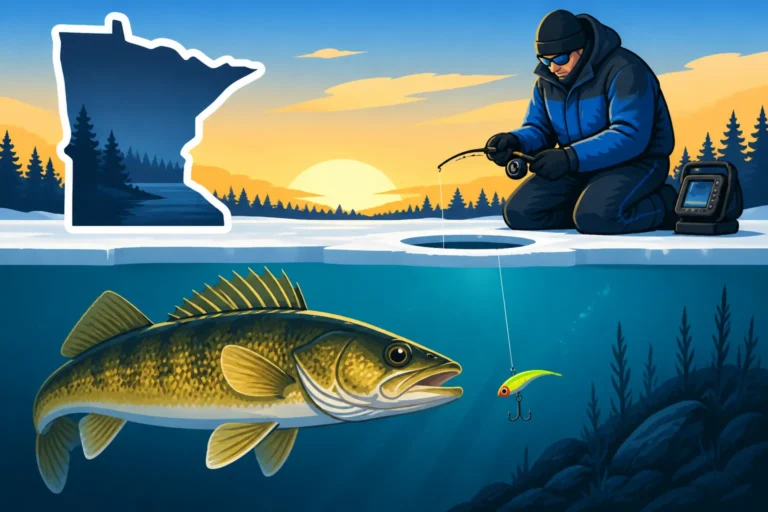
Don't hang up your rods when winter hits! Ice fishing for sauger can be incredibly rewarding, and some of the best fishing occurs during the hardwater season.
- Deep Water Focus: Just like open water, sauger in winter will be in the deeper sections of lakes and rivers. On large lakes, target the main lake basin, deep points, or holes. On rivers, look for those deep bends and holes where current is present but manageable.
- Aggressive Jigging and Deadsticking: A classic one-two punch for ice fishing sauger is to have two lines down (where legal, remember how many lines can you use ice fishing in Minnesota).
- Active Jigging Rod: Use a medium-light ice rod with a small jigging spoon (like a Northland Forage Minnow, VMC Tingler, or Salmo Chubby Darter) or a heavy tungsten jig. Pound the bottom, make some aggressive lifts, and then hold it still for a few seconds. The vibration and flash can draw them in.
- Deadstick Rod: In a second hole, suspend a plain hook with a live minnow just a few inches off the bottom on a deadstick rod. This provides a subtle, natural presentation for less aggressive fish. Many of the Best Lures for Ice Fishing Walleye are also excellent for sauger.
- Patience and Persistence: Sauger can be finicky. If you're marking fish on your flasher but not getting bites, experiment with different jigging cadences, colors, and baits. Sometimes the subtlest jigging motion or a completely still minnow is what triggers them. Being able to adapt based on what your electronics are telling you, and understanding how to read a flasher, is paramount.
Maximizing Your Sauger Catch
Catching sauger consistently isn't just about using the right techniques; it's also about understanding their environment and behavior to put yourself in the best possible position.
Best Times and Conditions
Sauger generally prefer low-light conditions, but because they inhabit deeper, murkier waters, they are often less affected by bright sun compared to walleye in clearer lakes.
- Low Light Periods: Dawn and dusk are always good times, but sauger can be caught throughout the day, especially if the water is stained or there's good cloud cover.
- Murky Water: Sauger thrive in turbid water. Don't be afraid to fish after a rain event that stirs up the river or when a lake has some color to it. This provides them with cover and can make them more aggressive feeders.
- Stable Weather: Like most fish, sauger prefer stable weather patterns. Sudden drops in temperature or major front movements can make them finicky.
- Current: For river sauger, the presence of current is key. Look for those breaks and seams where current is present, but not overwhelmingly strong. Too much current and they won't hold; too little and they might disperse.
Locating Sauger
Finding sauger is often about finding specific underwater features that meet their habitat preferences.
- Bottom Contour and Structure: Use your lake maps and fish finder to identify deep holes, channel edges, submerged humps, and points that drop into deeper water. In rivers, scout for wing dams, bridge pilings, and scour holes created by current. Sauger will be tightly associated with these features.
- Current Breaks: This is perhaps the most important aspect of river sauger fishing. Look for anything that breaks the current – a large boulder, a log jam, a deep eddy behind a point. These are ambush points where sauger wait for food to drift by with minimal effort.
- Follow the Bait: If you can locate schools of baitfish (like shiners or shad) in deeper water, sauger are likely nearby. Your fish finder will be crucial for this, showing bait schools as clouds or arcs. Learning how to identify these on your electronics will lead you to the fish.
Handling and Releasing Sauger
Sauger are fantastic eating fish, often praised for their firm, white flesh. However, adhering to catch and release best practices is essential for sustainable fishing, especially if you catch more than your limit or don't intend to keep a fish.
- Minimize Handling: Handle fish as little as possible. If you're releasing them, try to unhook them while they're still in the water.
- Wet Hands: Always wet your hands before touching a fish. Dry hands can remove the fish's protective slime coat, making it more susceptible to disease.
- Proper Hook Removal: Use those long-nose pliers or a hook remover. If the fish is deeply hooked, it's often best to cut the line as close to the hook as possible rather than risk further injury trying to remove it.
- Quick Release: Get the fish back in the water quickly. If it seems disoriented, hold it gently upright in the water, facing into a slight current, until it swims away under its own power. Following these Catch and Release Best Practices in Minnesota helps ensure healthy fish populations for years to come.
Sauger vs. Walleye Regulations
We've touched on this, but it bears repeating: it is your responsibility as an angler to correctly identify your catch and adhere to the specific regulations for that species. In Minnesota, the daily bag and possession limits for sauger can sometimes differ from those for walleye, even in the same water body. For example, some river sections might have a combined walleye and sauger limit, or separate limits for each species. Always verify the current Minnesota Fishing Limits: Bag & Possession (2026) for the body of water you're fishing before you head out. A simple misidentification could lead to a fine, so take the time to learn the differences!
Disclaimer
Fishing regulations, seasons, and limits are subject to change. Always consult the latest Minnesota Department of Natural Resources (DNR) fishing regulations booklet or website before heading out on the water. This guide is for informational purposes only and should not replace official DNR publications.