Vexilar vs Humminbird Ice Flasher: Which to Buy?
Ah, the age-old debate on the ice! If you've spent any time at all chasing walleye or panfish on a frozen Minnesota lake, you've probably either heard passionate arguments for Vexilar or Humminbird, or you're wrestling with the decision yourself. Choosing the right ice flasher can feel overwhelming, like trying to pick the perfect lure for a finicky fish. You want to make an informed decision because this isn't just a toy; it's a vital tool. This guide is here to cut through the noise, validate your frustrations, and help you understand the nuances between these two iconic brands so you can pick the best flasher for your specific needs on the ice.
The Indispensable Role of an Ice Flasher on Minnesota Ice
Let's be real: ice fishing without a flasher is like driving in a blizzard without headlights. You're just guessing. The ice fishing game has evolved dramatically, and a quality flasher isn't just a luxury anymore; it's practically a requirement for consistent success, especially here in Minnesota where fish can be incredibly subtle. The frustration of setting up on a promising spot only to pull up empty-handed, wondering if there were even any fish below, is something every angler knows. A flasher eliminates that guesswork.
Why a Flasher is More Than Just a Gadget
At its core, an ice flasher provides real-time sonar feedback, showing you what's directly beneath your hole. It's not a historical log like some open-water graphs; it's a live, immediate display. You can see the bottom, any fish swimming by, and most importantly, your bait. Imagine dropping a jig and watching a red line (a fish!) rise to meet it. That's pure adrenaline! This immediate feedback allows you to adjust your presentation, jigging cadence, or depth with precision. You can tell if fish are ignoring your offering, if they're aggressive, or if they're simply spooked. This interactive element transforms a slow day of staring at a hole into an engaging game of cat and mouse. For a complete overview of getting started, check out our Ice Fishing in Minnesota: Complete Beginner-to-Pro Guide.
Understanding the Basic Principles of Flasher Technology
Flashers work by sending sound waves down into the water and interpreting the echoes that bounce back. The time it takes for the echo to return tells you the depth of an object, and the strength of the echo often indicates the size of the object. Flashers typically use different colors to represent signal strength: green for weak returns (small fish, soft bottom), orange for medium returns, and red for strong returns (big fish, hard bottom, or multiple fish). The "cone angle" of your transducer is also crucial; a narrower cone is great for deep water precision, while a wider cone covers more area in shallower water. Understanding these basics is key to interpreting what you see and maximizing your time on the ice. If you want to dive deeper into how to interpret what you're seeing, our guide on How to Read a Flasher Vexilar/Humminbird is an excellent resource.
Diving Deep into Vexilar Ice Flashers
Vexilar is a name that often evokes a sense of nostalgia and reliability among seasoned ice anglers. They've been around for decades, refining their analog flasher technology, and their reputation for rugged, dependable units is legendary in the fishing world. Many anglers feel that a Vexilar just works, year after year, no matter how harsh the Minnesota winter gets.
The Vexilar Legacy: Dependability and Simplicity
The core of Vexilar's appeal lies in its analog display. When you look at a Vexilar, you're seeing raw, unfiltered sonar data presented in real-time on a spinning LED dial. There's no processing delay, no software to update, just an instantaneous readout. This directness is what many anglers love; it feels intuitive once you get the hang of it. Models like the classic FL-8 are still widely used, known for their bulletproof construction and straightforward operation. The FL-18 introduced a zoom feature, allowing you to magnify a specific portion of the water column, which is incredibly useful for seeing fish right near the bottom. The FL-20 and FLX-28 series took things even further with improved target separation, brighter displays, and adjustable settings for interference rejection. The Vexilar FLX-28, in particular, offers impressive customization, a digital depth readout, and multiple color palettes while maintaining that classic analog feel. It's a testament to the "if it ain't broke, don't fix it" philosophy, but with thoughtful enhancements.
Who is a Vexilar Best Suited For?
If you're a traditionalist who values simplicity, raw data, and a unit that can withstand a lifetime of abuse, a Vexilar is probably right up your alley. They're often seen as the workhorses of the ice fishing world. Beginners can quickly grasp the basic concept, and advanced users appreciate the immediate feedback for precise jigging. Vexilar units are incredibly robust; dropping one on the ice or in a slush puddle usually results in nothing more than a few scratches. They excel at target separation, meaning they can distinguish between your small jig and a fish just inches away, which is critical when a walleye is subtly sniffing your bait. Anglers who primarily target species like walleye or crappie, where seeing those subtle movements matters, often swear by their Vexilar. For those looking for the best gear, regardless of brand, consider our comprehensive guide on Best Ice Fishing Gear for Minnesota 2026 Guide.
Exploring Humminbird Ice Flashers
Humminbird has taken a slightly different path, integrating modern digital technology into their ice fishing offerings. While they still offer traditional flasher views, their emphasis on feature-rich displays, GPS capabilities, and versatility has carved out a dedicated following, especially among anglers who want more than just a sonar signal from their unit.
Humminbird's Digital Edge and Feature-Rich Offerings
Humminbird's ice flasher lineup ranges from simpler, dedicated ice units like the ICE 35, 45, and 55, to their incredibly popular ICE HELIX series. These HELIX units are essentially open-water fish finders adapted for ice fishing, offering a vibrant, full-color LCD screen. This means you get a wealth of features: traditional 2D sonar, a dedicated flasher view, graph view, adjustable zoom, and on higher-end models, built-in GPS with LakeMaster mapping. Being able to mark waypoints, follow contour lines, and even record sonar data can be a huge advantage when you're exploring new water or trying to return to a productive spot. Imagine fishing a new lake and having detailed contour maps right on your flasher display – that’s a game-changer! Units like the Humminbird Ice Helix 7 Chirp GPS G4 are incredibly popular for their versatility and packed feature set.
Ideal Users for Humminbird's Advanced Systems
A Humminbird ice flasher, particularly an ICE HELIX model, is ideal for the tech-savvy angler who wants maximum versatility and information at their fingertips. If you're someone who uses a fish finder in your boat during open water season and wants a similar experience on the ice, the Humminbird HELIX line bridges that gap beautifully. The ability to use the same unit year-round, swapping transducers from your boat to your ice fishing shuttle, offers significant value. Anglers who frequently move around, need precise mapping for deep structure, or enjoy exploring new areas will greatly benefit from the integrated GPS. While there might be a steeper learning curve compared to a traditional analog Vexilar, the wealth of information and customization options make it incredibly powerful. If you're specifically targeting species like lake trout in deep water or exploring expansive walleye flats, the detailed mapping can be invaluable. This versatility also ties into being able to use it for different fish like crappie, where knowing the exact depth and structure can make all the difference, as covered in our article on Ice Fishing for Crappie & Panfish.
Direct Comparison: Vexilar vs. Humminbird Head-to-Head
When you line them up, Vexilar and Humminbird present two distinct philosophies to ice fishing electronics. It’s not about one being inherently "better" than the other, but rather which aligns more with your fishing style and priorities.
Key Differences in Display and User Experience
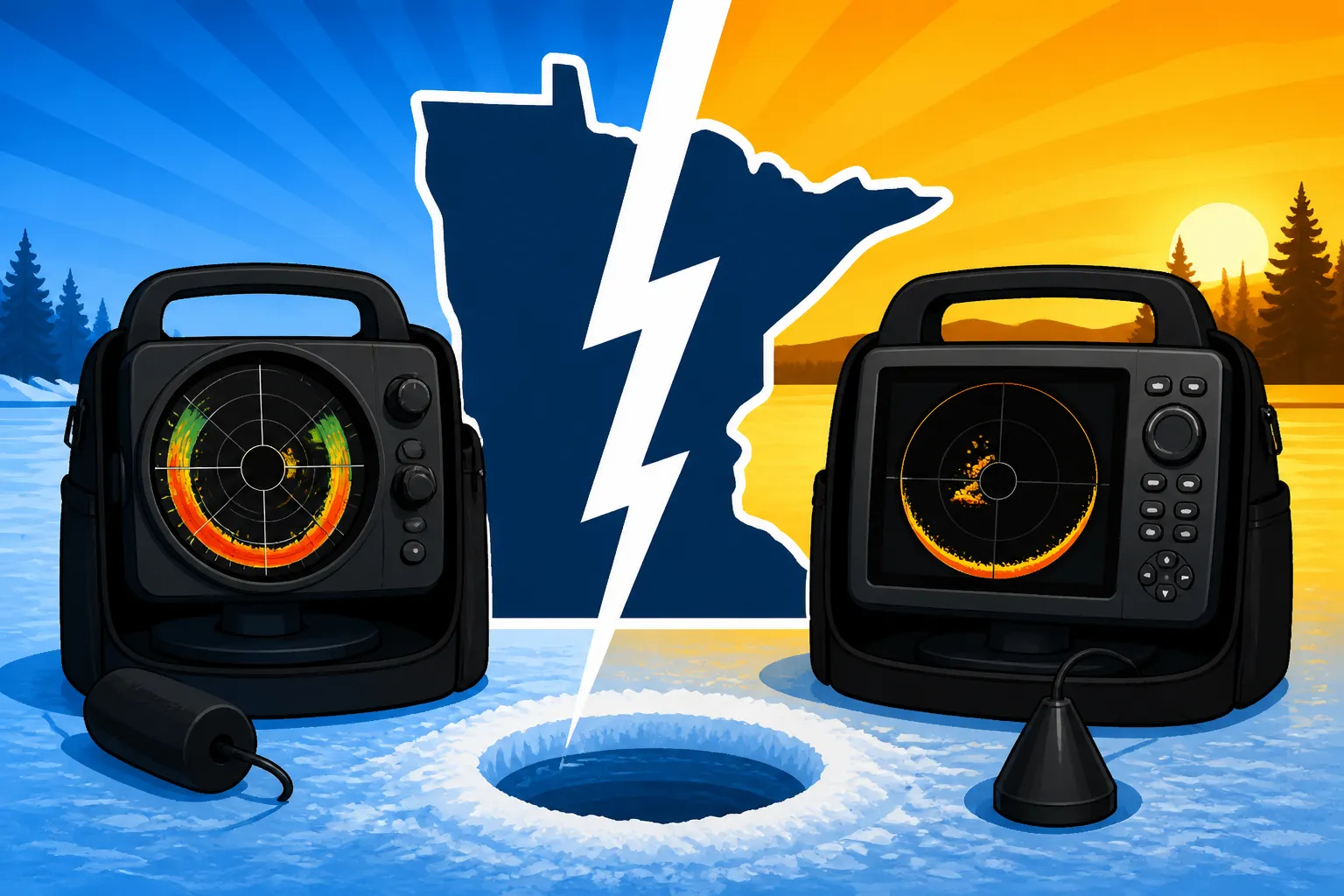
The most glaring difference is the display: Vexilar's iconic analog dial versus Humminbird's digital LCD screen. The Vexilar's analog display offers a "pure", unfiltered view of the sonar signal. What you see is happening right now. This can feel more immediate and responsive to some anglers, as the mechanical flasher has no refresh rate or processing lag. The colors are typically bold and clear: green, orange, red.
Humminbird's digital display, on the other hand, offers a crisp, often full-color, customizable screen. While incredibly fast, the signal is digitally processed before being displayed, which some purists argue introduces a tiny, almost imperceptible delay. However, the benefits are clear: more detailed graphics, split-screen options (e.g., flasher view alongside a traditional graph view), and the ability to overlay information like GPS maps. Reading a digital screen can also be easier on the eyes over a long day on the ice, especially with customizable color palettes.
Features, Versatility, and Price Points
Let's break down some of the core differences and how they might impact your decision.
| Feature / Aspect | Vexilar (e.g., FL-8, FLX-28) | Humminbird (e.g., ICE 35, ICE HELIX 7) |
|---|---|---|
| Display Type | Analog LED Flasher | Digital LCD (flasher, graph, map views) |
| Real-time Feedback | Extremely fast, direct analog signal | Very fast, digitally processed |
| Target Separation | Excellent (often 1/2" on higher models) | Excellent (often 1/2" on higher models) |
| Core Features | Gain, Range, Zoom, SFL (SupraFineLine), IR, Day/Night modes | Gain, Range, Zoom, Interference Rejection, Depth, Temperature, A-Scope |
| Advanced Features | Multiple color palettes (FLX-28) | GPS, LakeMaster Mapping, Sonar Record, MEGA Imaging compatibility (on some Helix models) |
| Durability | Legendary; highly robust, "bulletproof" | Very good; digital screen requires more care |
| Learning Curve | Low for basic operation; moderate for advanced interpretation | Moderate for basic flasher view; high for advanced features (GPS, mapping) |
| Open Water Use | Primarily ice-specific (some transducers for boat use available, but less common) | Many HELIX models are 2-in-1, usable year-round with appropriate transducers |
| Battery Life | Generally excellent | Very good, though high-brightness screens/GPS can drain faster |
| Price Range (Entry-High) | ~$300 – $700+ | ~$200 – $1000+ (significantly more for large Helix models) |
When it comes to purchasing, both brands are widely available. You can find a great selection of both Vexilar and Humminbird models at large outdoor retailers like Bass Pro Shops, where you can often see them in action and talk to knowledgeable staff. Online, sites like Amazon offer competitive pricing and a vast array of user reviews, which can be invaluable for making your final choice.
Making Your Decision: Which Flasher for Your Minnesota Ice Adventures?
Ultimately, the "best" flasher isn't a universal truth; it's the one that best suits your individual fishing style, preferred species, and budget. There's no wrong answer here, only the right answer for you.
Assess Your Fishing Style and Needs
Think about how you typically fish. Are you a "run-and-gun" angler who drills dozens of holes, quickly checks for fish, and moves on? Or do you prefer to set up a comfortable Ice Shelter Removal Deadlines in Minnesota and wait out the fish?
- For the traditionalist or minimalist: If you appreciate simplicity, ruggedness, and direct, instantaneous feedback, a Vexilar is probably a fantastic choice. You want to see the fish, see your bait, and react. The FL-8 or FL-12 are solid entry points, while the FLX-28 offers modern enhancements without losing that classic feel.
- For the tech-enthusiast or versatile angler: If you crave more information, appreciate detailed mapping, and want a unit that can transition from ice to open water, a Humminbird ICE HELIX unit is likely your winner. The GPS and mapping capabilities can unlock new fishing grounds, especially on large, complex lakes like Mille Lacs or Lake of the Woods. If you already have a Humminbird unit for your boat, getting an ICE HELIX that shares transducers can be incredibly convenient and cost-effective.
Consider the species you target. If you're primarily after walleye, especially in deep water, the target separation and instantaneous feedback of either brand will serve you well. For panfish like crappie and sunfish, seeing those tiny jigs and their subtle movements is key, and both brands offer excellent sensitivity. Our guide on How to Catch Walleye Through the Ice in Minnesota covers tactics that depend heavily on precise flasher readings.
Budget and Future-Proofing Your Investment
Your budget will always play a role. Vexilar units tend to be very stable in price and hold their value well due to their durability. Humminbird units, especially the HELIX series, can range from entry-level to quite expensive, particularly if you opt for larger screens or advanced features like MEGA Live compatibility.
- Entry-Level (under $400): You'll find solid performers in both camps. A Vexilar FL-8 or FL-12, or a Humminbird ICE 35 or 45, will get you on the ice with reliable sonar. These are excellent choices for beginners or those not needing all the bells and whistles.
- Mid-Range ($400-$700): This is where you start seeing significant feature upgrades. The Vexilar FLX-28 is a standout, offering excellent performance. On the Humminbird side, the ICE HELIX 5 or 7 series provides GPS, mapping, and the versatility of a digital display.
- High-End ($700+): Humminbird's larger ICE HELIX units (9, 10, 12) fall into this category, often offering bigger screens, more processing power, and compatibility with advanced sonar technologies. Vexilar's top-tier units, while not reaching the same price points, deliver peak analog performance.
Think about how long you want this unit to last and if you anticipate needing more advanced features down the road. A Vexilar could truly be a "buy it for life" piece of gear. A Humminbird HELIX offers a path to increasingly advanced technology, and many models can even be updated with new software features. Considering your overall ice fishing setup, from Best Ice Augers for Minnesota Electric vs Gas to your preferred fishing shelter, ensures your flasher integrates seamlessly into your adventures.
Disclaimer
The information provided in this guide is for general informational purposes only and is not intended as professional advice. Fishing regulations, product specifications, and availability can change rapidly. Always consult the most current Minnesota DNR fishing regulations and manufacturer documentation for the most accurate and up-to-date information. Always prioritize safety while on the ice.