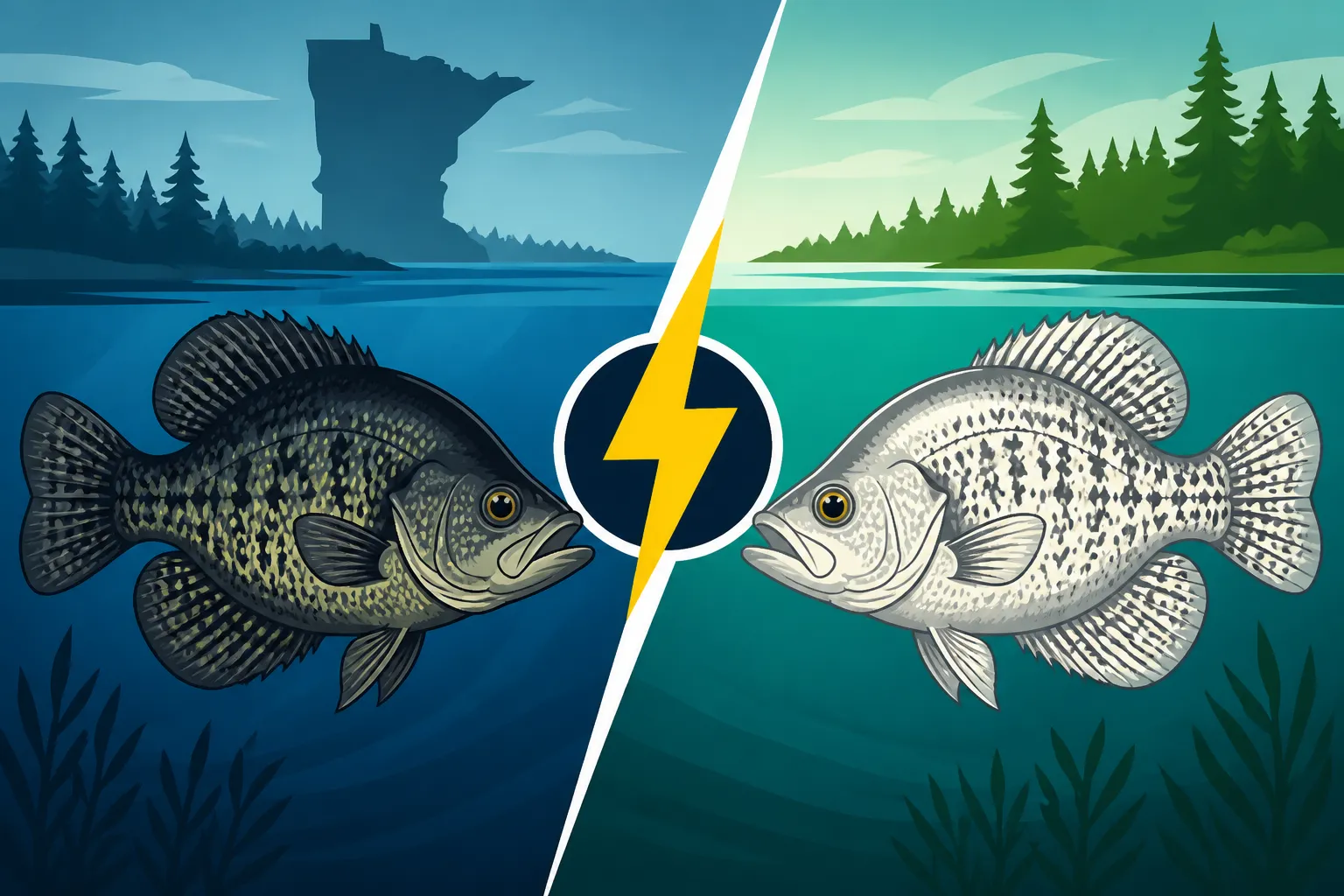
Black Crappie vs White Crappie
It's incredibly frustrating when you're out on the water, seeing crappies bite, but you're not entirely sure if you've got a black crappie or a white crappie on the line. They look so similar at a glance, and in Minnesota, knowing the difference isn't just about curiosity; it can sometimes influence where you fish and how you approach them. This comprehensive guide will clear up all that confusion, helping you confidently identify, locate, and catch both black and white crappies across our beautiful state.
The Basics of Minnesota Crappie Fishing
Before we dive into the nitty-gritty of telling these two speckled beauties apart, let's talk about why crappies, in general, hold such a special place in the hearts of Minnesota anglers. They're often seen as the perfect panfish – accessible, feisty, and absolutely delicious on the dinner plate.
Why Crappie are So Popular
Crappies are truly a Minnesota staple. They're widespread, found in countless lakes and rivers, and they offer fantastic fishing opportunities almost year-round. From the first open water days in spring, when they stack up in shallow bays, to the intense bite beneath the ice in winter, crappies provide consistent action. For many families, crappie fishing is an introduction to the sport, offering plenty of success and fun for anglers of all ages. There's a simple joy in watching a bobber dip when a crappie takes your bait, and their abundance means you can often put together a good meal without too much effort. If you're looking for a more in-depth understanding, check out our guide on Crappie & Panfish in Minnesota: Complete Guide
General Crappie Behavior
Crappies, both black and white, are schooling fish, meaning where you find one, you're likely to find more. They're also highly influenced by light conditions. They prefer low light, which is why dawn, dusk, and overcast days are often prime times to target them. In clearer waters, they tend to stay deeper during the bright parts of the day, moving shallower as the light fades. They are predatory, feeding primarily on small baitfish, insects, and crustaceans. Their large, upward-facing mouths are perfectly adapted for ambushing prey from below. Understanding these fundamental behaviors is the first step to becoming a more successful crappie angler, regardless of the species.
Identifying the Black Crappie
Often referred to as "specks" or "calico bass," black crappies are a favorite target for many Minnesota anglers. They tend to be a bit more robust and rounder-bodied than their white crappie cousins.
Distinctive Physical Characteristics
The most prominent feature of a black crappie is its irregular, blotchy pattern of black spots scattered across its silvery to greenish-gold body. These spots don't form distinct vertical bars like you might see on a white crappie. If you look closely at the dorsal fin (the fin on the top of its back), a black crappie will almost always have 7 or 8 spines. This is a crucial identifier that sets them apart from white crappies. Their mouths are also quite large, extending back to at least the middle of the eye, sometimes even past it. They tend to have a slightly more compressed, panfish-like body shape, giving them that round, dinner-plate profile.
When you hold a black crappie, you'll notice how deep-bodied they are. Their overall color can vary based on the water clarity and vegetation of their specific lake. In darker, tannic waters, they might appear much darker, almost olive-green, with very pronounced black markings. In clearer, sandy lakes, they might be lighter and more silvery. The key is that irregular spotting. Imagine someone splattered black paint randomly on a silvery canvas; that's the black crappie's pattern.
Preferred Habitat and Environment
Black crappies generally prefer clearer, cooler water with abundant vegetation and structure. Think of lakes with lily pads, submerged timber, weed lines, and brush piles – these are prime black crappie real estate. They thrive in lakes with good water quality and tend to be less tolerant of turbidity (cloudiness) compared to white crappies. In Minnesota, you'll find them in many of our pristine northern lakes, as well as the clearer sections of larger reservoirs. They often associate with complex cover that provides both ambush points for feeding and protection from predators.
During the spring spawn, black crappies will move into very shallow, vegetated areas, often in less than 5 feet of water, to lay their eggs. After the spawn, they might retreat to deeper weed lines or brush piles, sometimes suspended over deeper water near structure. As temperatures rise in summer, they'll seek out thermal refuges, often relating to submerged islands, deep weed edges, or offshore humps. Come winter, they're found suspended in the water column, often near basin structure or deep weed beds, making them a prime target for ice anglers. You can learn more about their spawning habits in our Crappie Spawn in Minnesota: When and Where
Behavior and Feeding Habits
Black crappies are active predators, particularly during low-light conditions. They're often found patrolling the edges of weed lines or suspended above structure, waiting for an opportunity to ambush small baitfish like minnows or shiners. They also feed heavily on aquatic insects, insect larvae, and small crustaceans. Their feeding can be quite aggressive at times, but they're also known for their subtle bites, especially during colder water periods or when they're less active.
They are visual feeders, relying on their keen eyesight to spot prey. This is why clear water is often favored. When targeting them, a slow, subtle presentation is usually key. Think small jigs, tiny minnows, or a slip bobber rig hovering just above a brush pile. Their schooling behavior means that once you locate a few, you're often in for a treat, filling your pail with panfish relatively quickly. Their overall disposition is generally a bit more skittish than white crappies, and they can be spooked more easily by loud noises or sudden movements, especially in shallow water.
Identifying the White Crappie
White crappies, sometimes called "silver crappies," are equally popular in Minnesota, especially in certain river systems and larger, more fertile lakes. They have a slightly different look and often tolerate different conditions than their black crappie counterparts.
Distinctive Physical Characteristics
The easiest way to identify a white crappie is by its vertical bars. Unlike the black crappie's irregular spots, the white crappie typically displays 5 to 9 distinct dark vertical bands or bars along its sides. These bands are more organized and run from their back down towards their belly. Another key identifier, and perhaps the most reliable, is the number of spines on their dorsal fin. White crappies consistently have 6 spines on their dorsal fin, rarely deviating. Their bodies tend to be more elongated and slender, sometimes described as having a "taller" profile rather than the roundness of a black crappie.
Their coloration is generally more silvery, often with a hint of gold, especially towards their belly. The dark vertical bars stand out clearly against this lighter background. Their mouth is similar to the black crappie, extending to about the middle of the eye. If you're ever in doubt, count those dorsal fin spines! It's the simplest and most accurate way to distinguish between the two species when visual patterns might be ambiguous due to water conditions or individual variations.
Preferred Habitat and Environment
White crappies are more tolerant of turbid (cloudy) water and silty environments than black crappies. They often thrive in large rivers, reservoirs, and eutrophic lakes that might have higher nutrient levels and therefore more suspended particles in the water. While they still appreciate structure, they might not be as tightly bound to dense vegetation as black crappies. Instead, they'll utilize submerged timber, rock piles, bridge pilings, and river channels.
In Minnesota, you'll often find thriving populations of white crappies in sections of the Mississippi River, particularly in the pooled areas, and in some of the larger, shallower, and more fertile lakes that experience a bit more turbidity. During spawning season, they'll also move shallow, but they might prefer harder bottoms like gravel or sand, or submerged brush, rather than dense aquatic vegetation. Post-spawn, they might roam more openly in schools, often suspended in the water column, following baitfish schools.
Behavior and Feeding Habits
White crappies are also schooling predators, and their feeding habits are similar to black crappies, focusing on small baitfish, insects, and crustaceans. However, their tolerance for lower light and more turbid water means they might be more active during daylight hours in these conditions than black crappies would be in clear water. They are opportunistic feeders, often suspending in open water or near vertical structures like bridge pilings, waiting for schools of baitfish to pass by.
They can be quite aggressive when feeding, especially when competing within a large school. Like black crappies, a slow, gentle presentation is often best. However, their tendency to suspend in open water or near defined structures means that techniques like vertical jigging or trolling small crankbaits can be highly effective, especially when searching for scattered schools. Knowing How to Catch White Crappie in Minnesota (Step by Step) can really help refine your approach.
Key Differences Side-by-Side
To really drive home the distinctions, let's put these two panfish side-by-side. Sometimes, in the heat of the moment on the boat or ice, it can be tough to remember all the nuances. This quick comparison should help.
Visual Cues for Quick Identification
The easiest way to tell them apart is to literally count the spines on their dorsal fin and look at their body pattern.
| Feature | Black Crappie | White Crappie |
|---|---|---|
| Dorsal Fin Spines | 7 or 8 (usually) | 6 (consistently) |
| Body Pattern | Irregular, scattered dark spots | 5-9 distinct dark vertical bars |
| Body Shape | More round, deep-bodied, compressed | More elongated, slender, "taller" |
| Mouth | Extends to or past middle of eye | Extends to about middle of eye |
| General Color | Silvery to greenish-gold, often darker | More silvery, lighter base color, distinct bars |
Imagine you've just pulled up a fish. First thing, look at its side. Does it have obvious bars, like a barcode? Probably a white crappie. Does it look like someone flicked paint at it? Probably a black crappie. If you're still not sure, gently feel or count the rigid rays in that front dorsal fin. Six? White. Seven or eight? Black. This simple trick is almost foolproof.
Habitat Preferences Compared
While both species can occasionally be found in similar waters, they definitely have their preferences, and understanding this can help you decide which type of lake or river to target.
Black crappies lean towards the cleaner, clearer, and often deeper lakes with plenty of submerged vegetation, brush piles, and timber. They prefer stable environments where water clarity allows for effective visual feeding. Think of the pristine lakes in northern Minnesota or certain clear-water reservoirs. They appreciate hiding within the cover.
White crappies, on the other hand, are more adaptable. They'll thrive in murkier, more turbid waters like those found in river systems or shallower, fertile lakes. They can handle higher nutrient loads and often relate more to hard structure like bridge pilings, rock reefs, or fallen trees in open water rather than dense weeds. The Mississippi River pools are a classic example of white crappie strongholds in Minnesota.
This difference in habitat preference means that if you're fishing a clear, weed-filled lake up north, you're likely targeting black crappies. If you're on a big river or a slightly murkier, shallower lake, you might encounter more white crappies.
Spawning and Life Cycle Variations
Both black and white crappies spawn in the spring when water temperatures reach around 60-70 degrees Fahrenheit, typically from late April through June in Minnesota. However, there can be subtle differences in their preferred spawning sites.
Black crappies often seek out shallow, vegetated areas for nesting. They'll fan out a small depression in the substrate among lily pads, cattails, or submerged weeds. The males guard the nests until the eggs hatch. They seem to prefer the cover and protection that dense vegetation provides for their young.
White crappies also move into shallow water for spawning but might favor areas with harder bottoms like sand or gravel, or submerged brush and roots rather than dense weeds. They are often found nesting in slightly more open areas, provided there's some form of cover. Their nests might be a bit more exposed compared to their black crappie cousins.
Growth rates and maximum sizes can also vary. While both species can grow quite large, white crappies sometimes have a slightly faster growth rate in fertile waters and can reach impressive sizes, though individual lake conditions play a much larger role than species alone. Minnesota's Crappie & Sunfish Limits apply to both, so make sure you're always checking the specific regulations for the waterbody you're fishing.
Fishing for Black Crappie in Minnesota
Now that we know how to tell them apart, let's talk about how to get them into the boat (or onto the ice)! Black crappies are a blast to catch, offering a spirited fight for their size.
Best Lures and Baits
When targeting black crappies, think small and subtle. Their primary diet often consists of small baitfish and insects, so matching the hatch is key.
- Live Bait: Hands down, small fathead minnows or crappie minnows are incredibly effective. A single minnow hooked lightly through the lip or back and suspended under a bobber is a classic, unbeatable presentation. Small leeches can also be very good, especially in warmer water.
- Jigs: Tiny jigs, typically 1/32 to 1/16 ounce, tipped with a small plastic grub or a live minnow, are deadly. Colors like white, chartreuse, pink, and black are consistent producers. For finesse, try a small tube jig or a micro-swimmer.
- Soft Plastics: Small soft plastic baits, often 1-2 inches long, resembling minnows or insect larvae, are excellent. These can be fished on a bare jig head or under a float. Brands like Berkley PowerBait or Mister Twister offer a wide range of effective crappie plastics.
- Tiny Spoons & Blade Baits: For vertical presentations, especially through the ice or when fish are deep, small spoons like a Lindy Rattl'n Flyer or a Northland Forage Minnow are fantastic. Tip them with a minnow head or a couple of wax worms for added attraction.
The key is often a slow retrieve or a subtle jigging motion. Black crappies can be finicky, so experimenting with different sizes, colors, and presentations is crucial.
Effective Techniques and Spots
Black crappies are often found relating to structure and cover.
- Slip Bobber Rigs: This is a go-to for many anglers. A slip bobber allows you to present your bait at a precise depth, which is critical when crappies are suspended. Focus on the edges of weed lines, around submerged brush piles, or over deep humps. Adjust your depth until you find the fish. This technique is outlined in depth in our guide, How to Use a Slip Bobber for Walleye & Crappie.
- Jigging: Whether from a boat or through the ice, vertical jigging is highly effective. Drop a small jig or spoon down to the fish, which you've ideally located with your electronics. A slight lift-and-drop motion, pausing frequently, will often trigger a bite. When fishing from shore, casting small jigs or plastics parallel to weed lines can also produce.
- Trolling: While less common for black crappies than white, slow trolling small crankbaits or spinner rigs along weed edges or over deep structure can be effective, especially during summer months when fish are scattered. However, for targeting specific schools of black crappies, a more precise approach is usually better.
- Ice Fishing: Black crappies are a premier ice fishing target. They'll often suspend in deep basins or near deep weed edges. A good fish finder is invaluable for locating these suspended schools. Small tungsten jigs tipped with a spike, wax worm, or minnow head, fished very slowly, are incredibly productive. Our Ice Fishing for Crappie & Panfish article has even more tips.
The key to consistently catching black crappies is to be patient, experiment with presentations, and pay close attention to your electronics. Once you find a school, you can often stay on them for a while.
Fishing for White Crappie in Minnesota
White crappies, with their tendency to roam and tolerate murkier waters, require slightly different approaches, but they are just as rewarding to catch.
Best Lures and Baits
Similar to black crappies, small offerings are key, but white crappies might be a bit more aggressive and less hesitant in certain situations.
- Live Bait: Again, small minnows (fatheads, crappie minnows) are king. Suspended under a bobber near structure or jigged vertically, they are irresistible. In river systems, some anglers also find success with small pieces of cut bait if legal and appropriate for the target species.
- Jigs and Plastics: White crappies respond very well to small jigs, particularly those paired with plastic grubs, tubes, or small paddle-tail swimbaits. Due to their tolerance for stained water, brighter colors like chartreuse, orange, and neon green can be exceptionally effective, along with classic white and black.
- Small Crankbaits & Trolling Lures: Because white crappies often suspend in open water or relate to more expansive structures, small crankbaits that dive to a few feet can be very effective, especially when trolled slowly. Tiny Rapala or Bandit crankbaits in shad or perch patterns can work wonders.
- Blade Baits: For vertical presentations in deeper water or strong current, blade baits offer vibration and flash that can call in white crappies from a distance. Tip them with a minnow head for added scent.
Don't be afraid to try slightly larger presentations for white crappies, especially if you're in a highly productive system where they are aggressively feeding on abundant baitfish.
Effective Techniques and Spots
White crappies' habitat preferences lead to some distinct fishing techniques.
- Drifting/Trolling Open Water: White crappies often suspend in large schools over deep water or along river channels. Slow trolling with small crankbaits or a spider rig (multiple rods with jigs or minnows at different depths) is a highly effective way to cover water and locate these roaming schools. This is especially true in large reservoirs or the broad stretches of rivers like the Mississippi.
- Fishing Vertical Structure: Bridge pilings, docks, fallen trees in open water, and deep rock reefs are magnets for white crappies. Vertical jigging or pitching jigs and minnows tight to these structures can be incredibly productive. They use these features as ambush points.
- Casting and Retrieving: In shallower areas, especially during the spring, casting small jigs or crankbaits and retrieving them with a slow, steady pace can entice bites. Focus on areas where current breaks or eddies form in rivers, as crappies will congregate there to conserve energy and ambush prey.
- Ice Fishing: White crappies are also fantastic ice fishing targets. They tend to school tightly, often suspending over deeper parts of lakes or in river channels. Keep an eye on your flasher; when you mark a school, drop down tungsten jigs or small spoons. A slower, more subtle jigging motion is usually preferred. Try different depths within the water column, as they might be just a few feet off the bottom or suspended much higher.
Remember that white crappies can often be found deeper than you might expect, especially during the summer and winter. Don't be afraid to fish vertically and cover the entire water column until you locate their preferred depth. Learning How to Catch White Crappie in Minnesota (Step by Step) is an excellent resource for refining your approach.
Conservation and Regulations for Crappie
Being responsible anglers is paramount, especially when fishing for popular species like crappies in Minnesota. The Minnesota DNR manages our fisheries carefully to ensure healthy populations for future generations.
Understanding Bag and Possession Limits
Minnesota has statewide bag and possession limits for crappies, but it's critical to remember that many individual lakes and rivers have special regulations that supersede these general rules. The statewide daily bag limit for crappies is typically 10, with a possession limit of 20. However, some lakes might have reduced bag limits (e.g., 5 or even less) or protected slot limits, where you can only keep fish within a certain size range.
For instance, certain lakes might implement a special regulation like "all crappies between 10-12 inches must be immediately released." This is done to protect the spawning population and allow larger fish to contribute more to the fishery. Always, always consult the current Minnesota Fishing Regulations handbook or the DNR website for the specific lake or body of water you intend to fish. Our article on Minnesota Fishing Limits: Bag & Possession (2026) provides a great overview, but local exceptions are vital. Ignoring these local regulations can lead to hefty fines and loss of fishing privileges.
Catch and Release Best Practices
Even if you plan on keeping some crappies for a delicious fish fry, practicing responsible catch and release for the fish you don't keep is essential for maintaining robust populations. Crappies, especially larger ones, are valuable breeders.
- Minimize Handling: Try to handle the fish as little as possible. If you can, unhook them while they are still in the water.
- Wet Hands: Always wet your hands before touching a fish. Dry hands can remove the fish's protective slime coat, making it vulnerable to disease.
- Support the Fish: If you must lift the fish for a photo, support its body horizontally, especially larger crappies, to avoid damage to internal organs or jaw.
- Quick Release: Release the fish quickly and gently. If a fish seems sluggish, hold it gently in the water, facing into the current if possible, until it regains strength and swims off on its own.
- Use Barbless Hooks: Consider using barbless hooks or pinching down the barbs on your hooks. This makes de-hooking much easier and faster, reducing stress on the fish.
By following these simple practices, we ensure that both black and white crappies continue to thrive in Minnesota waters, providing endless enjoyment for anglers for years to come.
Disclaimer
Fishing regulations and conditions can change. Always consult the latest Minnesota Department of Natural Resources (DNR) regulations before heading out on the water. This guide is for informational purposes only and should not be considered a substitute for official DNR publications.