Using Leadcore Line for Walleye Trolling
We’ve all been there: it’s late July on Mille Lacs, the sun is high, and the walleyes have abandoned the shallow rock piles for the deep, cool sanctuary of the mud flats. You see them on your electronics, suspended at 30 feet, but your standard monofilament just won't get your favorite crankbait down to the strike zone without 200 feet of line out. This guide solves that depth dilemma by teaching you the art of leadcore trolling, a veteran technique that turns deep-water walleyes into a sure thing.
Understanding Leadcore Line and Its Role in Deep Trolling
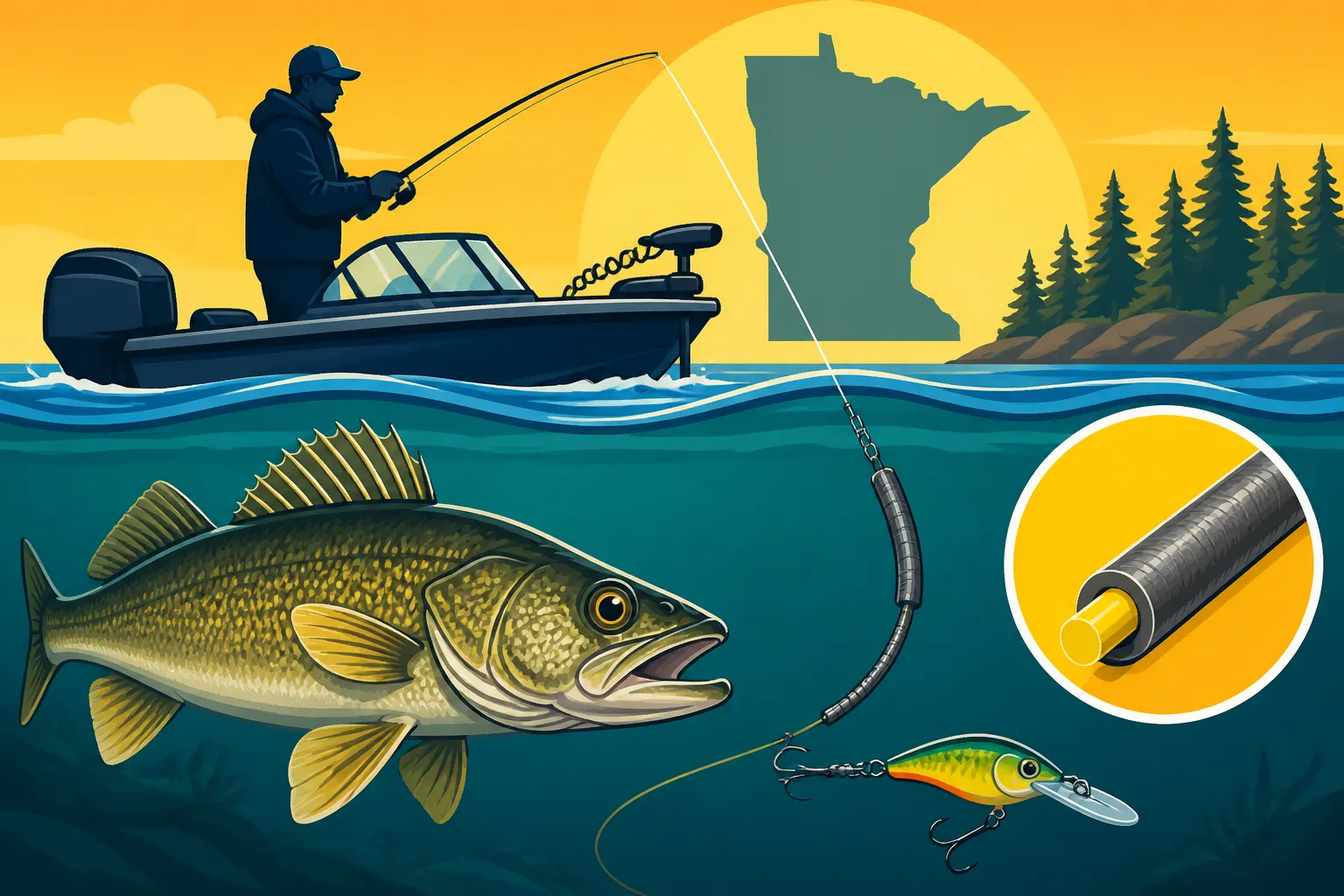
Leadcore is exactly what it sounds like: a thin strand of lead wire wrapped in a braided nylon or Dacron sleeve. For many Minnesota anglers, it is the ultimate "heavy lifting" tool. Unlike traditional braided line or monofilament, leadcore is designed to sink on its own. It allows you to deliver lightweight lures to depths that would otherwise require heavy snap weights or downriggers, both of which can be cumbersome and less sensitive to the "tick" of a walleye strike.
The Anatomy of Leadcore Line
The line is color-coded, usually changing every ten yards. This isn't just for aesthetics; it’s your primary measurement tool. When someone says they are catching fish "five colors out," they mean they have deployed 50 yards of leadcore. The lead inner core provides the weight, while the outer sheath provides the strength and the color. Because the line is thicker than standard braid, it creates more drag in the water, which actually helps the line achieve a predictable dive curve. You can find various brands and pound tests on Amazon, though 18-pound test is the industry standard for walleye because it balances sink rate with manageable diameter.
Depth Control and the Sink Rate
The beauty of leadcore is its predictability. At a standard trolling speed of 2.0 mph, most leadcore lines will sink approximately five feet for every color (10 yards) deployed. If you’re targeting fish at 25 feet, you let out five colors. However, this is highly dependent on your boat speed. If you slow down to 1.5 mph, the line sinks deeper; if you speed up to 2.5 mph, the line rises. This allows you to "target" specific depths just by adjusting your throttle. It’s a dynamic way to fish that keeps your lure in the "danger zone" longer than almost any other method. To master the broader context of these moves, I recommend reading our Trolling for Walleye: Crankbaits & Leadcore guide.
The Stealth Factor in Deep Water
One of the most overlooked benefits of leadcore is the stealth it provides. In the clear waters of northern Minnesota, walleyes can be spooked by the shadow of a boat or the hum of an engine. Because leadcore allows you to get deep with a relatively short amount of line compared to "long-lining" mono, you can keep your lure far behind the boat but still precisely at the fish's eye level. Furthermore, the leadcore line has a "harmonic" dampening effect. It doesn't vibrate as much in the wind or water as thin braid, which can sometimes result in a more natural lure presentation that weary mid-summer walleyes find irresistible.
Essential Gear for Leadcore Trolling
You cannot simply spool leadcore onto your standard spinning reel and head out to the lake. The weight and diameter of the line require specialized equipment. If you try to cut corners here, you’ll end up with a "bird’s nest" of lead and nylon that is nearly impossible to untangle, likely forcing you to buy a whole new spool on Amazon before your next trip.
Choosing the Right Trolling Rod
A leadcore rod needs to be a workhorse. It requires a "parabolic" action, meaning the rod bends consistently from the tip down through the mid-section. This is crucial because leadcore has zero stretch. When a 28-inch walleye hits a lure on leadcore, there is no "give" in the line. The rod has to act as the shock absorber to prevent the hooks from tearing out of the fish's mouth. Look for rods in the 7'6" to 8'6" range, specifically labeled as trolling or "planer board" rods. For a deeper dive into rod selection, see our list of the Best Walleye Rods & Reels.
Line Counter Reels: Non-Negotiable
If you aren't using a line counter reel, you are guessing, and guessing doesn't catch limits. A line counter reel tells you exactly how many feet of line are out. While leadcore is color-coded, the line counter provides a second layer of precision, especially when you are using "half colors" to fine-tune your depth. Brands like Okuma and Penn are favorites among Minnesota guides. When shopping on Amazon, look for reels with a large line capacity, as leadcore is very bulky and takes up a lot of room on the spool. A "size 30" reel is usually the minimum required to hold a full 10 colors of 18-lb leadcore plus backing.
Leaders and Backing
You never spool leadcore directly to the reel arbor. You start with "backing," usually 15-20 lb monofilament or braid. This fills up the reel so the leadcore sits near the outer edge of the spool, which makes the line counter more accurate. On the business end, you need a leader. Typically, a 10 to 20-foot leader of fluorocarbon is attached to the leadcore. This provides a clear, invisible connection to the lure. In stained water like Lake of the Woods, you might get away with a shorter leader, but in the clear depths of Lake Vermilion, a longer leader is often necessary to avoid spooking fish. For more on how to handle these fish once they're at the boat, check the Minnesota Walleye Limit & Size Rules.
How to Spool and Set Up Your Leadcore Rig
Spooling leadcore is a bit of a craft. Because the line has a physical lead center, it doesn't behave like standard fishing line. It can kink, and if you're not careful, the lead can poke through the outer sheath. Setting it up correctly at home will save you hours of frustration on the water.
Calculating Capacity and Spooling Technique
The biggest mistake beginners make is not leaving enough room on the reel. A full 100-yard spool of leadcore is thick. I usually put about 100 feet of 20-lb monofilament backing on first. Then, attach the leadcore using a double uni-knot or a Willis knot. When spooling, keep firm, consistent tension on the line. I often have a friend hold the spool with a screwdriver through the center while I reel. If you're doing this solo, you can find line-spooling stations on Amazon that make the process much smoother. Ensure the line is laying flat and not piling up on one side of the reel.
The Willis Knot and Connection Points
The Willis Knot is the "gold standard" for leadcore. To tie it, you pull back the nylon sheath to expose about four inches of the lead wire. You snip off that lead wire and discard it, leaving an empty tube of nylon. You then tie an overhand knot in the nylon but don't tighten it. Slide your fluorocarbon leader into the empty nylon tube until it hits the lead wire, then pull the overhand knot tight over the leader. This creates a slim, incredibly strong connection that slides through rod guides effortlessly. If you're nervous about this knot, practicing with old line is a great way to build confidence before a big trip to the Mille Lacs Lake Fishing Guide: Walleye, Bass & More.
Marking Your Line for Precision
While the line is color-coded, many pros like to add their own marks. Every five colors, I might wrap a small piece of neon electrical tape or use a permanent marker to create a "double stripe." This helps you identify your depth at a glance without having to count every single color as it passes through the level-wind. This is especially helpful during a "hot bite" when you’re trying to get lines back into the water as quickly as possible. Precision is the difference between a "fishing trip" and a "catching trip."
| Water Depth (Feet) | Target Lure Depth | Colors of Leadcore (at 2.0 mph) | Leader Length (Feet) |
|---|---|---|---|
| 15 – 20 | 17 | 3 Colors | 15 |
| 20 – 25 | 22 | 4 Colors | 15 |
| 25 – 30 | 27 | 5 Colors | 12 |
| 30 – 35 | 32 | 6 Colors | 10 |
| 35 – 45 | 37 | 7-8 Colors | 10 |
Trolling Techniques and Speed Management
Once you’re on the water, leadcore trolling is a game of geometry and physics. You aren't just driving the boat; you are managing a submerged "wing" that responds to every turn and speed change. Mastering this movement is what separates the weekend warriors from the tournament pros.
The Rule of Five and Depth Calibration
As mentioned, the general rule is five feet of depth per color. However, this is a starting point, not a law. Lure choice matters. A deep-diving crankbait will pull the leadcore deeper than a shallow-running stickbait. I always recommend "calibrating" your setup. Find a flat bottom at 25 feet and let out line until you feel the lure start to "tick" the bottom. If it takes 4.5 colors to hit bottom at 2.0 mph, you know exactly where your lures are. This kind of tactical knowledge is core to any Walleye Fishing Techniques: Complete Minnesota Guide.
S-Turns and Speed Changes
Walking a straight line is the most common mistake in trolling. When you drive in a straight line, your lures move at a constant speed and depth. By driving in an "S" pattern, the lures on the inside of the turn slow down and sink deeper, while the lures on the outside speed up and rise. Often, a walleye will follow a lure for minutes, undecided, until a change in speed triggers a "reaction strike." If you see a fish on your Garmin but it won't bite, execute a hard turn. The sudden drop or rise of the lure often mimics a wounded baitfish, which is a dinner bell for a hungry walleye.
Using Electronics to Track Your Path
Modern GPS and sonar are vital for leadcore. You want to stay on the "contour." If you are fishing the edges of the mud flats on Mille Lacs, you want to keep your boat in that sweet spot where the flat meets the transition zone. Use your "trail" feature on your GPS to ensure you aren't covering the same unproductive water twice. If you're looking for the best electronics to pair with your trolling rig, checking the reviews on Amazon for the latest Humminbird or Lowrance units can provide some real-world perspective on what works in the field. To see how these patterns change throughout the year, refer to our guide on Best Seasonal Pattern for Walleye in Minnesota.
Best Minnesota Lakes for Leadcore Walleyes
While you can use leadcore anywhere, certain Minnesota lakes are tailor-made for this technique. These are generally larger bodies of water with expansive basins or deep flats where walleyes congregate in the summer months.
Mille Lacs Mud Flats
Mille Lacs is perhaps the world capital of leadcore trolling. In July and August, the walleyes move to the sprawling mud flats in the center of the lake. These flats are 26 to 34 feet deep and feature very little "structure" other than the occasional small rise. Leadcore allows you to cover vast swaths of these flats efficiently. I like to start on the edges of the "Seven Mile Flat" and work toward the center. Using Best Walleye Lures: Jigs, Cranks & Spinners, specifically #5 or #7 Shad Raps, is the local "secret" for consistent success here.
Lake of the Woods Open Water
Up at the "Big Traverse" on Lake of the Woods, the water is massive and the fish are nomadic. During the heat of the summer, walleyes follow the schools of tullibee and perch into the open basin. You might be fishing in 35 to 40 feet of water with no land in sight. Leadcore is essential here because the fish are often suspended 5 to 10 feet off the bottom. You need the precision of leadcore to put your lure right in their "window." If you’re heading north, don’t miss our specific Lake of the Woods Walleye Fishing Tips.
Leech Lake and Rainy Lake Deep Basins
Leech Lake’s Walker Bay and the deep basins of Rainy Lake are also prime leadcore territories. In these lakes, you aren't just looking for flats; you're looking for deep-water humps. You troll the "saddle" between two humps where the wind pushes baitfish. Leadcore is perfect for this because it's heavy enough to stay deep even if the wind picks up and you have to increase your boat speed to maintain control. For those who want to mix it up, these lakes also offer incredible Trolling Crankbaits for Walleye: Speed & Depth opportunities for other species.
Troubleshooting Common Leadcore Mistakes
Even the pros have "bad hair days" with leadcore. Because the line is heavy and behaves differently than mono, it presents a unique set of challenges that can ruin a morning if you aren't prepared.
Preventing and Fixing Tangles
The "Leadcore Tangle" is a nightmare. It usually happens during a turn or when a fish crosses multiple lines. To prevent this, always ensure your outside lines are further back than your inside lines. If you do get a tangle, do not pull! Because of the lead core, the line can "kink" and lock onto itself. Gently untangle the loops. If the line is severely kinked, it’s often safer to cut that section out and re-splice it using a Willis knot. Carrying an extra spool of line from Amazon in your boat is a cheap insurance policy against a ruined day.
Dealing with Bottom Snags
When a leadcore rig snags the bottom, you have a lot of weight and pressure on the line. Do not try to "rip" it off. Instead, circle back behind the snag. Because leadcore sinks, the line is often draped over the rock or log. By driving back the way you came, you can often "lift" the line off the snag. This is where the parabolic action of your trolling rod is your best friend—it will give you the leverage needed to pop the lure free without snapping the expensive leadcore.
Managing Multiple Lines
In Minnesota, you are generally limited to one line per angler (with some exceptions on border waters). If you have three people in the boat, managing three leadcore lines requires coordination. The "staggered" approach is best: let the first line out 6 colors, the second 5 colors, and the third 4 colors. This spreads the lures out vertically and horizontally in the water column, minimizing the chance of a "cluster" if a big walleye decides to go on a run. Keeping your setup organized is a hallmark of the Walleye Fishing Techniques: Complete Minnesota Guide.
Minnesota Fishing Regulations Disclaimer
Fishing regulations in Minnesota are subject to change annually and can vary significantly by lake and season. Always consult the official Minnesota Department of Natural Resources (DNR) handbook or website for the most current rules regarding bag limits, size restrictions, and gear requirements for the specific body of water you plan to fish. Failure to follow these regulations can result in significant fines and the loss of fishing privileges. Stay informed to ensure the sustainability of our beautiful northern fisheries.