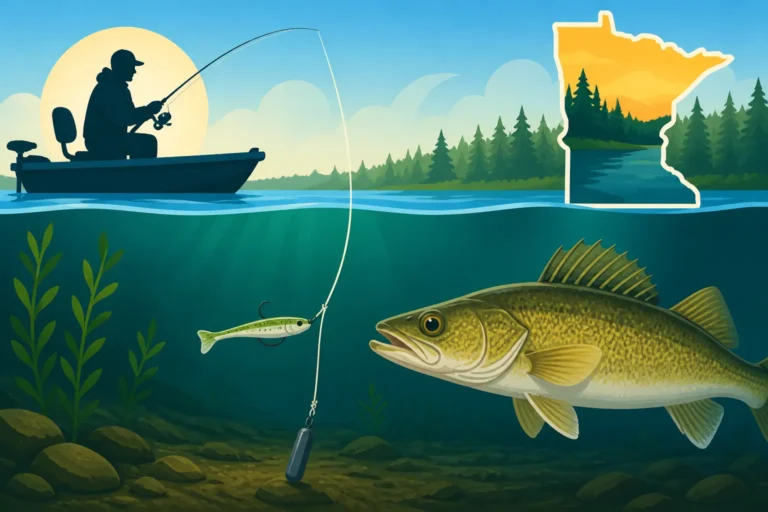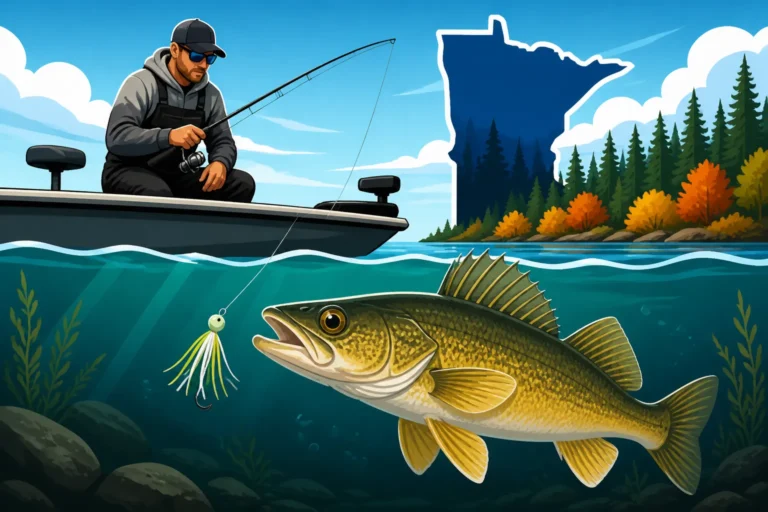
Trolling Crankbaits for Walleye: Speed & Depth
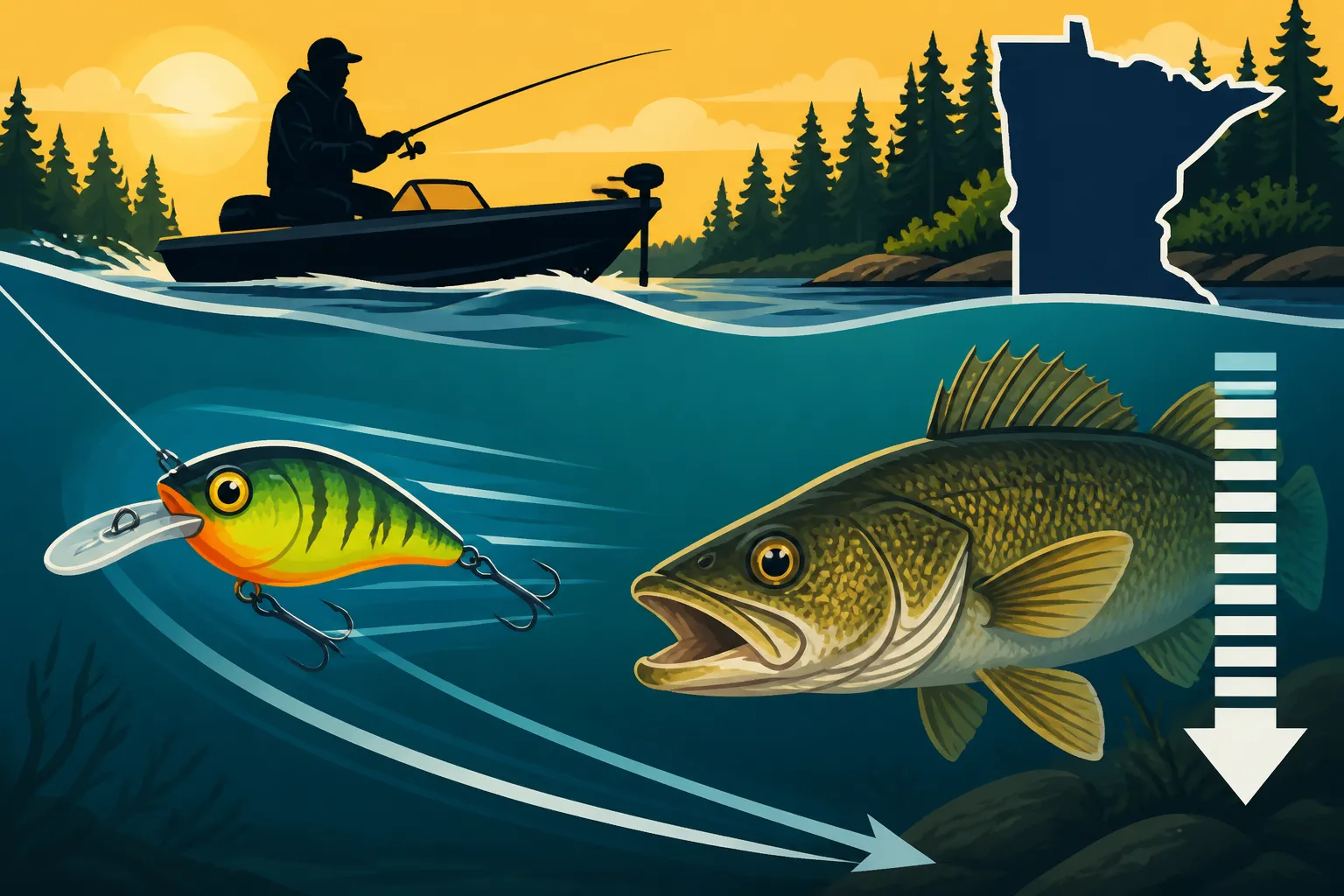
You are out on Mille Lacs or perhaps trolling the expansive flats of Lake Winnibigoshish, and you can see the fish on your electronics. They are sitting right there, holding just off the bottom or suspended in the middle of the water column, but no matter how many times you pass over them, your rods stay silent. It is one of the most frustrating experiences in Minnesota fishing, but the reality is that your speed and depth are likely just a few inches or a fraction of a mile-per-hour off. This guide solves the mystery of trolling crankbaits by showing you exactly how to calculate your lure's depth and dial in the perfect speed to trigger those stubborn Minnesota walleyes.
Understanding the Walleye Strike Zone in Minnesota Lakes
The strike zone isn't a fixed location; it’s a moving target that changes based on the lake's personality. In Minnesota, we have everything from the stained, tea-colored waters of Upper Red Lake to the crystal-clear depths of some of our northern Shield lakes. In stained water, a walleye's world is smaller. They rely heavily on their lateral line to feel vibrations because visibility is low. This means your crankbait needs to be much closer to their face—often within two to three feet—to get a reaction. If you are trolling too high in the water column in these conditions, the fish simply won’t know your lure is there until it has already passed them by.
On the flip side, when you are fishing clear water, walleyes can see a lure from a significant distance. However, clear-water fish are also much more prone to being "boat shy." If you are trolling directly over their heads in fifteen feet of water, the shadow and noise of your outboard or even a quiet trolling motor can spook them. This is where understanding Mille Lacs Walleye Regulations (2026) becomes part of your strategy, as the way you approach these fish often dictates how many you can actually keep within the legal framework. In clear water, you might actually want your lure to run five feet above the fish, drawing them up to strike, which feels counterintuitive but is often the only way to catch them without scaring the school.
To truly master the strike zone, you have to be obsessed with your electronics. You aren't just looking for fish; you are looking for the "gap." If the walleyes are tight to the bottom, your crankbait needs to be occasionally "digging" or puffing up silt to grab their attention. If they are suspended, you need to identify the exact depth of the baitfish schools. Using modern tools and learning How to Catch More Fish With a Fish Finder will help you realize that a walleye suspended at 18 feet in 30 feet of water will almost never swim down to hit a lure. They always look up or stay level. If your lure is at 20 feet, you are fishing for ghosts.
How Water Clarity Influences Depth
In the legendary "walleye chop" of Lake Pepin or the St. Croix River, water clarity can change by the hour. When the wind kicks up and stirs up the mud, walleyes move shallower because the murky water gives them a predatory advantage. During these times, you might find yourself trolling in six to eight feet of water, where a short-lipped crankbait is all you need. The lack of light penetration means the fish are looking for that silhouette against the surface. If you try to use deep divers here, you’ll spend your whole day cleaning weeds and debris off your hooks.
In the deep, clear basins of the Brainerd Lakes area, the opposite occurs. Light penetrates deep into the water, pushing the walleyes down toward the thermocline during the bright midday sun. Here, you might need to reach depths of 25 to 30 feet. Achieving this requires a combination of thin-diameter lines and lures with massive diving lips. Many anglers make the mistake of thinking one lure can do it all, but seasoned trollers know that your "depth map" is the most important piece of information you have. If you aren't hitting the depth where the active feeders are, the most expensive lure in the world is just a piece of plastic taking a bath.
Using Electronics to Locate Schools
The days of just "blind trolling" across a bay are mostly over if you want to be consistent. When I’m out on the water, I spend at least thirty minutes just driving the boat before I ever let a line out. I’m looking for transitions—places where the bottom changes from hard gravel to soft muck, or where a weed edge drops off into a basin. Walleyes love these "highways." By using side imaging, you can see if the fish are tucked into the weeds or scattered across the flats. This tells you exactly where to put your boat and, more importantly, how far back to set your lines.
Once you find a school, pay attention to their posture. Fish that are "plastered" to the bottom are often in a neutral or negative mood, perhaps recovering from a cold front. These fish require a very slow, methodical troll with a lure that occasionally bounces off the bottom. Fish that are sitting a foot or two off the bottom are usually active and looking to eat. If you see fish suspended high in the water column, those are your "money fish." They are actively hunting and are the easiest to trigger with a well-placed crankbait. Checking the latest reviews for high-definition electronics on Amazon can give you an idea of the gear needed to see these subtle differences in fish behavior.
Dialing in Your Trolling Speed
Speed is the "throttle" of your fishing success. Most beginners troll too fast because it feels like they are covering more ground, but walleyes are often more lethargic than we give them credit for. In the early season, particularly when you are dealing with Early Season Walleye After the Opener, the water temperatures are still in the 40s or low 50s. At this temperature, a walleye's metabolism is sluggish. If your crankbait is screaming by at 2.5 mph, they simply won't exert the energy to chase it. During this window, 1.1 to 1.3 mph is often the "sweet spot" that triggers a bite.
As the summer heat sets in and the water temperature climbs into the 70s, everything changes. The baitfish are faster, the walleyes are more active, and they often require an erratic, high-speed presentation to trigger a "reaction strike." This is when you see the pros on Leech Lake or Lake of the Woods kicking their speed up to 2.2 or even 2.8 mph. At these speeds, the crankbait is vibrating violently and darting side-to-side. A walleye doesn't have time to inspect the lure; it has a split second to decide whether to eat it or let it go. Usually, their predatory instinct wins out.
Early Spring vs. Late Summer Speed Adjustments
In the spring, you want your lure to have a subtle, wandering action. This is the time for "minnow-style" baits that don't have a lot of aggressive kick. If you go too fast with these, they can "blow out" or spin, which looks completely unnatural. I’ve found that using a GPS-based speed over ground (SOG) is the only way to be precise. A difference of 0.2 mph might sound like nothing to us, but to a fish in 45-degree water, it’s the difference between a meal and a blur. You can find very accurate handheld GPS units or boat-mounted ones on Amazon if your current fish finder doesn't have a reliable GPS speed reading.
By the time August rolls around, you are often competing with an abundance of natural forage. The lakes are full of young-of-the-year perch and shiners. To stand out, your lure needs to be the "loudest" thing in the water. High-speed trolling with "shad-style" baits that have a high-pitched rattle can be the ticket. Also, don't be afraid to try "S-turns." By turning the boat in a wide S-pattern, the lures on the inside of the turn slow down and sink slightly, while the lures on the outside speed up and rise. This speed variance often tells you exactly what the fish want that day.
The Impact of Water Temperature on Metabolism
It is a biological fact that a fish's energy needs are dictated by the temperature of the water around them. In the cold waters of a late October afternoon on the Rainy River, a walleye might only eat once every few days. Your trolling speed needs to reflect that. You are looking for a "death simmer"—just enough speed to make the lure wiggle. Many veteran Minnesota anglers actually switch to electric trolling motors during this time because outboards often can't idle down low enough to hit those 0.8 to 1.0 mph speeds.
Conversely, in a shallow, dark-water lake that warms up quickly in June, those fish are burning calories like crazy. They are aggressive. If you find yourself catching small northern pike or perch but no walleyes, try bumping your speed up by half a mile per hour. Walleyes are remarkably fast when they want to be, and sometimes "outrunning" the smaller, nuisance fish is the only way to get your crankbait in front of a heavyweight walleye that is looking for a real chase.
Managing Your Lure Depth with Precision
The most common question I get is: "How do I know how deep my lure is actually running?" It isn't just about the lure's design; it’s a physics equation involving line diameter, the amount of line let out (lead length), and speed. If you are using a thick 20-lb monofilament line, the water resistance (drag) on the line will actually pull the lure upward, preventing it from reaching its maximum depth. If you switch to a thin-diameter braided line, the lure will dive much deeper with less effort. Understanding Best Fishing Line for Walleye (Braid vs Mono vs Fluoro) is crucial for this very reason.
To be precise, you need to use a "Dive Chart" or a mobile app like Precision Trolling. These tools tell you that if you have 100 feet of 10-lb Fireline out with a #7 Shad Rap, you will be at exactly 15 feet deep at 2.0 mph. Without this knowledge, you are just guessing. I highly recommend investing in line-counter reels, which you can easily find on Amazon, to ensure that when you find a "pattern" (e.g., 85 feet back is catching fish), you can replicate it exactly on every other rod in the boat.
| Lure Type | Recommended Speed (MPH) | Typical Depth Range (FT) | Best Season |
|---|---|---|---|
| Minnow Body (Shallow) | 1.0 – 1.5 | 3 – 8 | Early Spring / Fall |
| Deep Diving Minnow | 1.5 – 2.2 | 12 – 20 | Late Spring / Summer |
| Shad Style (Rattling) | 1.8 – 2.5 | 8 – 15 | Summer / Mid-August |
| Leadcore Setup | 1.2 – 2.0 | 20 – 40 | Mid-Summer (Deep Basin) |
Flat Line Trolling and Line Diameter
Flat lining is the simplest form of trolling—just a rod, a line, and a lure. But don't let the simplicity fool you; it requires a lot of attention to detail. If you are fishing a shallow flat on Leech Lake in 10 feet of water, you want a line that has some "give." Monofilament is great here because it acts as a shock absorber when a big walleye hits a moving lure. However, monofilament is buoyant and thick. If you need to get that same lure down to 14 feet to tick the tops of the weeds, you'll need to switch to a thin braid.
The "blow back" effect is real. The faster you troll, the more the water pushes against your fishing line, creating a curve. This curve actually lifts the lure. This is why, when you increase your speed from 1.5 to 2.5 mph, you often have to let out significantly more line to maintain the same depth. It's a constant balancing act. If you aren't catching fish, the first thing you should do is check if your lure is fouled with "slime" or weeds, and the second thing is to adjust your lead length by 10 or 20 feet to see if a depth change triggers a strike.
Diving Deeper with Leadcore and Snap Weights
When walleyes head for the deep basins of Lake Mille Lacs or Lake Winnibigoshish in July, a standard crankbait won't reach them. This is when we turn to "weighted" systems. Leadcore line is a color-coded line with a lead wire inside. It sinks at a very predictable rate—usually about 5 feet of depth per "color" (30 feet of line) at a speed of 2.0 mph. Using Trolling for Walleye: Crankbaits & Leadcore allows you to put a small, snack-sized lure 30 feet deep, which is something you could never do with a flat line.
Another option is the "Snap Weight" system. This involves clipping a weight (usually 1 or 2 ounces) onto your line about 20 to 50 feet in front of the lure. This acts as a "dropper," pulling the line down steeply. It’s a great way to use your favorite shallow-running lures in deep water. You can buy kits of snap weights on Amazon that include various sizes for different depths. The key with weights is to be consistent. If you use a 1-ounce weight on the left side of the boat, use a 1-ounce weight on the right so you can keep your "depth story" straight.
Selecting the Right Crankbaits for Minnesota Waters
Walking into a bait shop in Garrison or Baudette can be overwhelming. There are thousands of crankbaits, but most Minnesota walleye experts narrow them down into two categories: Minnow-style and Shad-style. Minnow baits (like the original Rapala or the Smithwick Rogue) have a slender profile and a tight, subtle wiggle. These are world-class lures for cold water or when walleyes are feeding on emerald shiners. Because they don't have much water resistance, they are also easier to troll at very slow speeds.
Shad-style baits (like the Berkley Flicker Shad or the Rapala Shad Rap) have a wider body and a much more aggressive "thump." You can actually feel the rod tip vibrating when these are running correctly. These lures are designed to mimic bluegills, perch, or shad. Because they move so much water, they are excellent in stained water or during the heat of summer when you need to "call" fish in from a distance. For the best variety, checking the "best sellers" in the fishing category on Amazon can reveal which lures are currently producing for anglers across the Midwest.
Minnow-Style Baits for Cold Water
When the ice first leaves the lakes and we are all gearing up for the opener, the minnow-style bait is king. At this time of year, walleyes are often in very shallow water—sometimes as shallow as four feet—recovering from the spawn. A shallow-running minnow bait that just "shimmies" along is irresistible. I prefer natural colors during this time: silver/black, gold/black, or the classic "glass" patterns that disappear and reappear in the water column.
The key to minnow baits is the "pause." Even when trolling, you can create a pause by occasionally pumping the rod forward and then letting it back slowly. This causes the minnow bait to stall and then "flee." Often, a walleye will be following the lure for a hundred yards, and it’s that one change in cadence that makes them commit. Using Best Lures & Baits for Minnesota by Species can give you a deeper dive into which specific minnow patterns work best for the forage base of the lake you are fishing.
Shad-Style Baits for Aggressive Summer Bites
In the "Dog Days" of August, the water is buzzing with life, and walleyes are often focused on the biggest, easiest meal they can find. This is where the Shad-style bait shines. These lures dive deep and they dive fast. A #7 or #9 Shad Rap can easily reach 15 to 20 feet on a long cast or troll. The aggressive vibration acts like a dinner bell. If you are trolling a large flat and seeing fish scattered, the "thump" of a shad bait will often pull fish in from ten feet away to investigate.
I also like to use "loud" colors in the summer. Firetiger, chartreuse, and "pink lemonade" are staples in my boat when the water is warm. It seems like the fish are more willing to hit something that looks completely unnatural when their metabolism is high. If you find that you are getting "short strikes" (fish hitting the lure but not getting hooked), try downsizing your shad bait but keeping the speed high. Sometimes they want the vibration of a big lure but the profile of a small one.
Essential Gear for a Successful Trolling Run
Trolling is hard on gear. You aren't just casting a light lure; you are dragging a diving plug that is constantly pulling against the rod. If you use a standard medium-light jigging rod, you’ll find it doubled over just from the tension of the water, leaving no "backbone" left to hook a fish. You need a dedicated trolling rod with a "moderate" action. This means the rod bends throughout the top half, which helps keep the hooks pinned in the fish's mouth during the fight. A soft tip is essential to see the "pulse" of the lure; if the tip stops vibrating, you know you've picked up a piece of weed.
The reel is just as important. I cannot stress enough the value of a line-counter reel. Trolling is a game of numbers. If you catch a fish at 72 feet back, you need to be able to put your lure back at exactly 72 feet. Trying to guess by "pulls" or "seconds" is a recipe for a slow day. Most modern line counters are very affordable and can be found in bundles on Amazon. Pair these with a quality rod, and you have a system that takes the guesswork out of the equation.
Rods and Reels Built for Tension
When selecting Best Walleye Rods & Reels, look for something in the 7'6" to 8'6" range. The extra length helps you spread your lines away from the boat, and it gives you more leverage when a big fish is surging behind the motor. Many Minnesota anglers prefer telescoping rods because they can be easily stored in boat lockers but provide the reach needed for a multi-rod trolling spread.
For the reel, make sure the drag is smooth. When a walleye hits a crankbait at 2.2 mph, it’s a violent collision. If your drag is stuck or too tight, the fish will simply snap the line or tear the hooks out. I always set my trolling drag a little lighter than I think I need. I want to hear that "clicker" sing for a second when the fish hits. This not only protects your gear but also acts as an audible alarm so you know you've got a fish on without having to stare at the rod tips every second.
Planer Boards and Their Role in Spreading the Lines
If you really want to level up your trolling game, you need to start using planer boards. These are small devices that attach to your line and "sail" out to the side of the boat. This allows you to run four, six, or even eight lines (where legal) without them tangling. More importantly, it gets your lures away from the "vibe" of the boat. In clear water, this is often the only way to catch trophy walleyes.
By using planer boards, you can cover a path that is 100 feet wide instead of just the 8-foot path behind your motor. When considering Casting vs Trolling for Walleye: When to Use Each, remember that trolling with boards is essentially "power fishing." You are searching for the active pods of fish across a massive area. It takes some practice to learn how to read the boards—they will "sag" or "hop" when a fish is on—but once you master it, you will never want to troll without them again. You can find high-quality board sets from brands like Off Shore Tackle on Amazon, which are the industry standard here in the Midwest.
Minnesota Fishing Regulations Disclaimer
Fishing regulations in Minnesota are subject to change annually and can vary significantly by lake and river. While the information provided here is based on general best practices and current knowledge, anglers must always consult the official Minnesota Department of Natural Resources (DNR) Fishing Regulations handbook before heading out. Specific lakes like Mille Lacs, Upper Red, and border waters have unique slot limits, bait restrictions, and season dates that are strictly enforced. Always ensure you have a valid Minnesota fishing license and are aware of the Aquatic Invasive Species (AIS) laws to protect our state's beautiful waters.