Fly Fishing the Driftless Area: A Beginner’s Guide
Stepping onto a trout stream for the first time can feel like walking into a library where you do not speak the language. Between the Latin names for bugs and the expensive-looking gear, it is easy to feel out of place and overwhelmed by the technical jargon. This guide is here to strip away the pretense and show you exactly how to tackle fly fishing in Minnesota’s Driftless Area with confidence.
Understanding the Magic of the Driftless Geography
The Driftless Area is a geological anomaly that makes Southeast Minnesota a world-class destination for trout. While the rest of the state was flattened by massive glaciers thousands of years ago, this specific corner was left untouched. The result is a landscape of deep, carved valleys, towering limestone bluffs, and hundreds of spring-fed streams that remain cold enough for trout to thrive even in the middle of a humid Minnesota July.
Why the Glaciers Missed Us
When you drive south of the Twin Cities, the flat cornfields suddenly drop away into rugged coulees. This is the heart of the Driftless. Because the glaciers bypassed this region, the ancient river systems were never buried under glacial "drift"—the silt and rocks usually left behind. Instead, the water continued to cut through the soft limestone, creating the steep hills and narrow valleys we see today. For the angler, this means high-gradient streams with plenty of oxygen and structure.
In a practical sense, the lack of glacial drift means the bedrock is close to the surface. This limestone is the secret sauce for fly fishing. It filters the groundwater, keeping it at a consistent 48 to 52 degrees Fahrenheit year-round. It also adds calcium and minerals to the water, which supports a massive population of aquatic insects like scuds and cressbugs. This constant food supply is why our trout grow so fat and healthy compared to mountain streams that are often nutrient-poor.
Limestone Springs and Year-Round Cooling
The spring-fed nature of these streams is a blessing for the beginner. Unlike northern freestone rivers that can get dangerously warm in the summer or freeze solid in the winter, the Driftless streams are remarkably stable. When it is 95 degrees in Rochester, the water in a small tributary might still be 55 degrees. This thermal stability allows for a longer fishing season and more predictable fish behavior.
However, this limestone also makes the water very "clear" most of the time. This means the trout can see you just as well as you can see them. You will quickly learn that stealth is more important than a perfect cast. If you go stomping through the water like a herd of cattle, every trout in the pool will be gone before your fly ever touches the surface. It is a game of patience and observation, which is exactly what makes it so rewarding when you finally land that first wild Brown Trout.
Navigating Public Access and Easements
One of the biggest hurdles for beginners is knowing where they are allowed to stand. In Minnesota, the state has been incredibly proactive in purchasing "Angling Easements" from private landowners. These easements allow you to walk along the stream bank and fish, even if the surrounding land is a private farm. You will usually see green and white signs marking these areas, but it is always smart to double-check the DNR maps.
Understanding these boundaries is crucial for maintaining good relationships with the farmers who make this fishing possible. Always stay within the designated easement corridor—usually about 66 feet from the center of the stream—and never climb over fences or leave trash behind. Many of these streams flow through active pastures, so do not be surprised if you find yourself sharing the bank with a few curious cows. Just remember that you are a guest on that land.
Gearing Up Without Breaking the Bank
There is a common misconception that you need a thousand-dollar setup to catch a trout. In reality, some of the most successful anglers I know are using rods that have seen twenty years of abuse and reels that are basically just line-holders. For the Driftless, your gear needs to be functional and durable rather than flashy.
Choosing Your First Rod and Reel
For Southeast Minnesota streams, a 4-weight or 5-weight fly rod that is 8.5 to 9 feet long is the "Goldilocks" setup. A 5-weight is versatile enough to handle windy days and slightly larger streamers, while a 4-weight offers a more delicate presentation for those tiny dry flies. If you are just starting out, you can find very capable beginner kits on Amazon that include the rod, reel, line, and even a few flies to get you started.
The reel is actually the least important part of the equation when trout fishing in this region. Unlike salmon or saltwater fishing where the fish will "run" and pull line off the reel, most Driftless trout are fought by hand—a process called "stripping" the line. As long as the reel can hold your line and has a basic drag system to prevent tangles, it will do the job. Spend your extra money on a high-quality fly line instead; a good weight-forward floating line will make learning to cast significantly easier.
The Importance of Good Waders and Boots
You are going to spend a lot of time in the water, and in the Driftless, the stream bottoms are a mix of slippery limestone, jagged rocks, and occasionally deep, sticky mud. Breathable chest waders are the standard choice because they keep you dry without making you sweat through your clothes. You can often find reliable entry-level waders on Amazon that will last several seasons if you take care of them.
When it comes to boots, you have two main choices: felt soles or rubber soles with studs. Felt is king for gripping slippery rocks, but it can also trap invasive species. If you choose felt, you must be extremely diligent about cleaning them. Rubber soles are better for hiking between spots and are required in some states to prevent the spread of New Zealand Mudsnails. Regardless of the sole type, make sure they have good ankle support. A twisted ankle in a remote valley is a quick way to ruin a weekend.
The Essential Accessories for Your Vest
Beyond the rod and waders, there are a few "must-haves" that you should always have pinned to your vest or pack. First is a pair of nippers (think heavy-duty nail clippers) for cutting fishing line. Second is a pair of forceps for removing hooks from a trout’s mouth without hurting the fish. You will also need "floatant"—a gel or powder that keeps your dry flies from sinking.
I also highly recommend carrying a small thermometer. Because trout are so sensitive to water temperature, knowing if the water is 58 degrees or 70 degrees tells you everything you need to know about whether the fish will be active. If you are looking for a gift for yourself, a decent pair of polarized sunglasses is non-negotiable. They cut the glare off the water, allowing you to see the underwater rocks, the fish, and where your fly is drifting.
Mastering the Local Fly Box
Walking into a fly shop and looking at the "wall of bugs" can be intimidating. There are thousands of patterns, but for a beginner in the Driftless, you only need to master about a dozen. Trout in these streams are opportunistic, but they do have preferences based on the time of year and the time of day.
Matching the Hatch: The Dry Fly
Dry fly fishing is the "purest" form of the sport because you get to see the fish rise and gulp your fly off the surface. In the Driftless, the Blue-Winged Olive (BWO) is a staple. These tiny greyish-green mayflies hatch in the spring and fall, often on overcast or drizzly days. Seeing a dozens of trout rising in a single pool during a BWO hatch is a sight you will never forget.
Another essential is the Elk Hair Caddis. This fly mimics a moth-like insect that skitters across the water. It is very buoyant and easy to see, making it a great choice for beginners. If you are fishing in the middle of summer, you cannot go without terrestrials. These are flies that mimic land-based bugs like ants, beetles, and grasshoppers that accidentally fall into the water. A "Hopper-Dropper" rig—where you tie a large grasshopper on top and a small nymph on a stringer below it—is a deadly summer tactic.
Nymphing: Going Subsurface
About 90% of a trout's diet consists of insects that are still underwater in their larval stage. These are called nymphs. If you aren't seeing any fish rising to the surface, you need to go deep. The Gold-Ribbed Hare’s Ear and the Pheasant Tail Nymph are the two most famous patterns in history for a reason: they work everywhere. They look like a generic "bug" and are irresistible to hungry trout.
To fish these effectively, you will use a "strike indicator"—which is basically a tiny, fancy bobber. It tells you when a fish has grabbed your fly underwater. It might seem less "sophisticated" than dry fly fishing, but nymphing is how you catch fish consistently throughout the day. For more on the specifics of this approach, you might want to check out Best Stream Trout Fishing Tactics in Minnesota to refine your presentation.
Streamers for Aggressive Fish
Streamers are larger flies that mimic minnows, crayfish, or leeches. Instead of letting them drift with the current, you "strip" them, making them dart and dive through the water. This triggers a predatory response in larger trout. The Wooly Bugger is the undisputed king of streamers. In black, olive, or brown, it imitates almost anything a trout wants to eat.
Streamer fishing is often most effective when the water is slightly "stained" or murky after a rain. Because the fish can’t see as well, they become less cautious and more likely to lash out at a big, moving target. It is a more physical way to fish and often leads to the biggest fish of the season. If you are targeting trophy fish, learning Where to Catch Brown Trout in Minnesota will help you find the deep holes where these predators lurk.
| Hatch Season | Common Insect | Recommended Fly Pattern |
|---|---|---|
| Early Spring | Blue-Winged Olive | BWO Sparkle Dun (Size 18-20) |
| Late Spring | Hendricksons | Red Quill (Size 12-14) |
| Summer | Terrestrials | Foam Grasshopper (Size 8-12) |
| Summer Evenings | Tricos | Trico Spinner (Size 22-24) |
| Early Fall | Isonychia | Prince Nymph (Size 10-12) |
| Late Fall | Blue-Winged Olive | Parachute Adams (Size 18-22) |
Reading the Water Like a Pro
One of the hardest things for a beginner to do is look at a stretch of river and know where to cast. Trout are not distributed evenly; they live in very specific spots that provide two things: protection from the current and protection from predators. If you can find the "seams" where fast water meets slow water, you will find the fish.
Finding the Sweet Spot in Riffles
Riffles are the shallow, bumpy sections of the stream where water flows over rocks. These areas are the "grocery stores" of the river because the churning water provides lots of oxygen and dislodges insects from the rocks. While the water might only be a foot deep, trout will hold in the small pockets behind larger stones.
When fishing a riffle, look for the "bubbles." Bubbles usually follow the main current line where the most food is traveling. If you can drift your fly down that bubble line, you are putting your bait right in the trout’s kitchen. Riffles are great for beginners because the broken surface of the water hides your silhouette, making the fish less likely to spook.
The Mystery of the Undercut Bank
Imagine a bend in the river where the current has carved a hollow space beneath the grassy bank. This is an undercut bank. It is the most prized real estate in the Driftless. A trout can sit in the dark, cool shadows under the sod, protected from the sun and birds, and wait for the current to bring food directly to its nose.
Fishing these spots requires a bit of bravery. You have to cast your fly as close to the grass as possible—sometimes even bumping the bank. If you land it six inches too far away, the fish might not come out to get it. If you land it on the grass, you’re stuck. But if you get it just right, a big Brown Trout will often explode out from the shadows to grab your fly. This is a key part of How to Catch Stream Trout in the Driftless Area and is a skill that separates the novices from the veterans.
Deep Pools and Log Jams
At the end of a long run or on a sharp bend, the water often slows down and deepens into a pool. These are holding areas where trout rest. The "head" of the pool (where the water enters) is usually the best spot because that is where the food is freshest. The "tail" of the pool (where the water leaves) is also good, especially in the evening when fish move into the shallows to feed.
Log jams and fallen trees are also high-percentage spots. Wood provides cover, but it is a nightmare for fly anglers. You will lose flies. It is part of the game. However, if you can navigate your fly along the edge of a sunken log, you are often rewarded with the biggest fish in the reach. Just make sure your Minnesota Trout Stamp & Trout Regulations are up to date before you head out, as some of these trophy waters have specific rules.
Seasonal Patterns and Timing
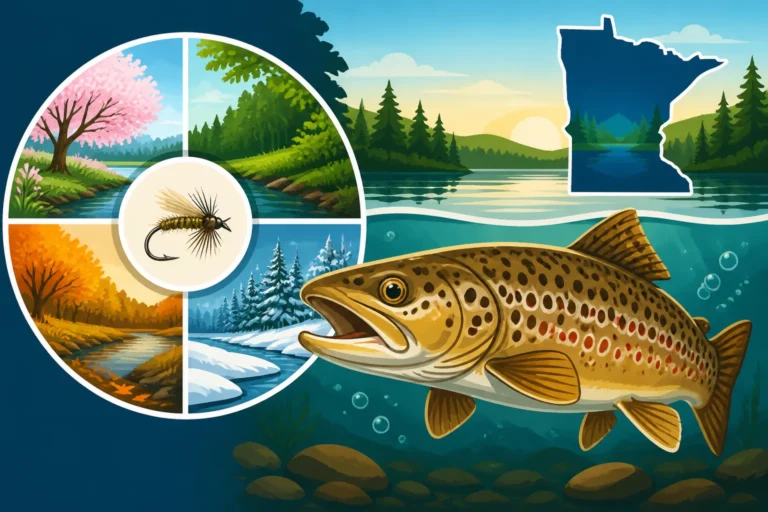
The Driftless Area changes dramatically with the seasons, and so does the behavior of the trout. Understanding the calendar will help you decide which stream to visit and which flies to tie on.
Spring: The Awakening
Fishing in March and April can be a bit of a gamble with the weather, but it is often the most productive time of year. As the snow melts and the sun begins to warm the water, the trout’s metabolism kicks into high gear. This is the time for the "Early Black Stonefly" hatch and the first of the Blue-Winged Olives.
The water is often higher and a bit colder in the spring, so you’ll want to fish slowly and deep. The fish aren't going to move far to chase a fly yet. If you are planning a spring trip, pay close attention to the Minnesota Trout Season Dates & Streams to make sure the specific water you want to fish is open, as there are different catch-and-release seasons versus harvest seasons.
Summer: The Long Days
June, July, and August are the "glory days" of terrestrial fishing. This is when the valley is lush and green, and the meadows are full of grasshoppers, crickets, and ants. On a hot afternoon, a large foam hopper dropped near a high bank can result in some of the most aggressive strikes of the year.
The challenge of summer is the "midday slump." When the sun is high and bright, the fish often retreat into the deepest, darkest holes. Your best bet is to fish early in the morning—starting at dawn—or late in the evening during the "spinner fall," when insects return to the water to lay their eggs and die. It is a magical time to be on the water, with the fireflies coming out as the last light fades over the bluffs.
Fall: The Color Change and the Spawn
September and October are arguably the most beautiful months in the Driftless. The maples and oaks on the bluffs turn brilliant shades of orange and red, and the air turns crisp. This is also when the Brown Trout begin their spawning run. They become very aggressive and territorial, often striking at large streamers just to drive them away.
While the fishing can be incredible, it is also a time for conservation. Once the fish begin to sit on their "redds" (their gravel spawning nests), you should leave them alone to ensure the next generation of trout. Focus your fishing on the deeper runs and pools away from the shallow gravel flats. For a complete look at the ethics of this season, reviewing Catch and Release Best Practices in Minnesota is highly encouraged.
Etiquette and the Unwritten Rules of the Stream
Because many of these streams are small, it doesn't take much to "crowd" another angler. Fly fishing has a long-standing tradition of etiquette that helps everyone have a better time on the water.
Crowding and Giving Space
The golden rule of the Driftless is: if you see a car parked at a bridge or an access point, that section of the stream is "taken." In these small valleys, a single angler can spook the fish for several hundred yards. It is much better to drive to the next access point or another stream entirely than to crowd someone who is already fishing.
If you do happen to run into another angler on the water, the standard practice is to give them a wide berth. If they are fishing upstream, you should walk far around them and get back in the water well above where they are heading. A friendly wave and a "Any luck?" are fine, but keep your distance. Everyone is out there for the solitude.
Catch and Release Best Practices
Most of the trout in the Driftless are wild, meaning they were born in the stream rather than in a hatchery. These are precious resources. If you plan to release your fish, it is vital to do it correctly. Use barbless hooks (or pinch the barbs down with your forceps) to make removal easier.
The most important rule is to "Keep 'em Wet." A trout's gills are incredibly fragile. If you take them out of the water for a long photo session, it is like someone holding your head underwater after you just ran a marathon. If you must take a photo, keep the fish in the water until the very last second, lift it for a quick snap, and put it right back. Never use a net made of knotted nylon, as it scrapes off the fish's protective slime coating; instead, use a soft rubber net like those found on Amazon.
Leave No Trace and AIS Prevention
The Driftless is a fragile ecosystem. We are currently facing threats from Aquatic Invasive Species (AIS) like didymo (rock snot) and New Zealand Mudsnails. These tiny pests can hitch a ride on your waders and destroy a stream's food chain. Always "Clean, Drain, and Dry" your gear. You can find detailed steps on How to Decontaminate Your Boat (AIS), which apply just as much to your wading boots.
Finally, always carry out what you carry in. It is heartbreaking to find a tangle of discarded fishing line or a beer can on a pristine trout stream. I always try to pick up at least one piece of trash left by someone else every time I go out. It’s a small way to pay back the river for the fish it provides.
Top Streams to Start Your Journey
While there are hundreds of miles of trout water in Southeast Minnesota, a few spots are particularly "beginner-friendly" due to their easy access and high fish populations.
Whitewater State Park and River
Whitewater State Park is the crown jewel of the Minnesota Driftless. The park contains segments of the Main, Middle, and North branches of the Whitewater River. It is a great place to start because the banks are well-maintained, the access is easy, and the fish are plentiful. The park also offers "Fly Fishing 101" clinics during the summer months.
Because it is a state park, the fish here see a lot of flies and can be a bit more "educated" than those in more remote areas. However, the sheer volume of water means you can always find a quiet corner. If the river in the park is crowded, you can follow the river downstream into the Whitewater Wildlife Management Area for miles of additional public access.
The Root River System (Preston and Lanesboro)
The Root River, particularly the South Fork near Preston and the stretches near Lanesboro, is legendary. Lanesboro is often called the "Trout Capital of Minnesota" and for good reason. The town is built around the river, and you can literally walk from a coffee shop to a prime trout pool in five minutes.
The South Fork of the Root is famous for its large Brown Trout and beautiful scenery. It is a bit larger than some of the tiny tributaries, which gives you more room to practice your casting without getting caught in the trees. If you find the rivers too high after a rain, you might look into Best Stocked Trout Lakes in Minnesota in the area, which offer a different but equally fun experience.
Smaller Tributaries and Secret Blue Lines
Once you gain some confidence, the real fun begins in exploring the "blue lines"—the tiny unnamed streams on the map. Places like Trout Run Creek (near St. Charles) or Gribben Creek (near Whalan) are classic Driftless streams. They are narrow, often only 10 to 15 feet wide, and require short, accurate casts.
These smaller streams are where you will find the most beautiful, vibrant wild Brook Trout—Minnesota's only native stream trout. They are smaller than the Browns but are incredibly aggressive and will hit almost any well-presented fly. Exploring these valleys feels like stepping back in time, and you will often have the entire stream to yourself.
Disclaimer
The information provided in this guide is for educational and informational purposes only. Fishing regulations, including seasons, bag limits, and gear restrictions, are subject to change by the Minnesota Department of Natural Resources (DNR). Always consult the most current Minnesota Fishing Regulations handbook before heading to the water. Additionally, fly fishing and wading in moving water involve inherent risks; always prioritize your safety and be aware of weather conditions and water levels. The mention of brands like Amazon is for contextual reference regarding gear availability and does not constitute a formal endorsement.