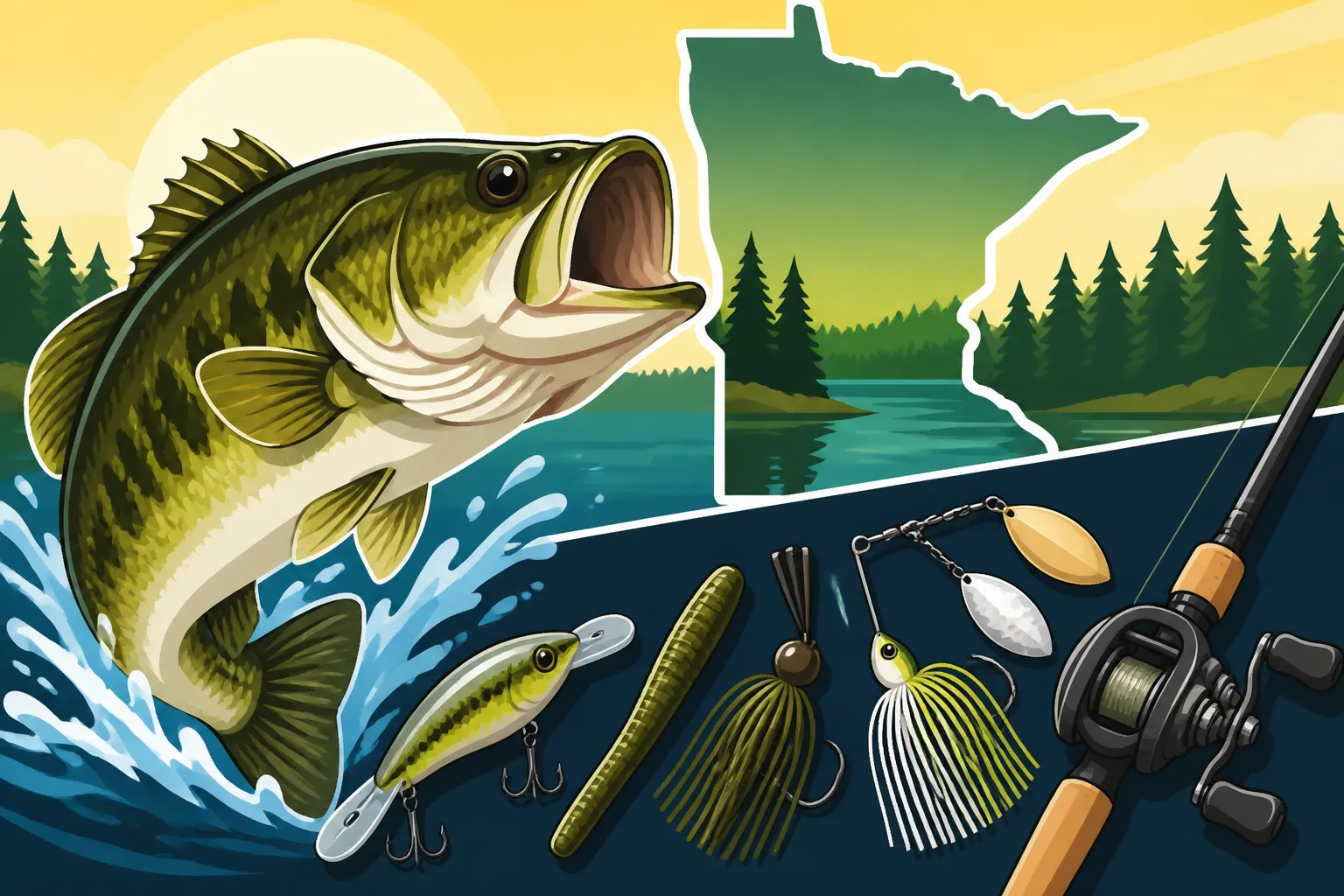
Best Tackle for Largemouth Bass in Minnesota
Finding the right tackle for largemouth bass in Minnesota can feel like a never-ending quest, especially with our diverse lakes ranging from shallow, weed-choked waters to deeper, clearer fisheries. It's frustrating to be out on the water, see those prime bass spots, and realize your gear just isn't cutting it – maybe your rod lacks the backbone to pull a hawg out of lily pads, or your line snaps on every hookset. This comprehensive guide is here to unravel the mysteries of largemouth bass tackle, ensuring you're perfectly equipped for success on Minnesota's fantastic bass waters.
Rods and Reels Tailored for Minnesota Largemouth
When you're chasing largemouth bass across Minnesota, whether it's in the urban lakes of the Twin Cities or the sprawling wild rice beds up north, your rod and reel are your primary tools. They need to be matched to the presentation and the environment. There's no single "best" setup, but rather a few key combinations that will cover almost every scenario you'll encounter.
The Versatility of Casting Rods and Baitcasters
For most serious largemouth bass anglers in Minnesota, baitcasting setups are the bread and butter. They offer superior power, accuracy, and control, especially when dealing with heavier lines and baits, or when trying to extract a stubborn bass from dense cover. Think about the sheer joy of pitching a jig into a tiny pocket in the cattails on Lake Minnetonka and having the rod power to turn that fish away from the snags immediately.
When choosing a casting rod, consider its length, power, and action. A good starting point for all-around bass fishing is a 6'8" to 7'3" medium-heavy (MH) or heavy (H) power rod with a fast or extra-fast action. The power refers to the rod's strength or lifting ability, while the action describes where the rod bends. A fast action means it bends mostly in the tip, giving you sensitivity for detecting subtle bites and quick hooksets. For flipping and pitching jigs or Texas rigs into thick vegetation, a heavy power rod, perhaps 7'6" or longer, is indispensable. This kind of setup allows you to handle big bass that are buried deep in the weeds, minimizing the chances of them wrapping you up.
Pairing your casting rod with a quality baitcasting reel is crucial. Look for reels with a smooth drag system and a good gear ratio. Gear ratios around 6.4:1 to 7.1:1 are excellent all-around choices, offering a balance of power and speed. Faster retrieve ratios (8.1:1 and up) are fantastic for techniques where you need to pick up a lot of line quickly, like frogging over mats or burning spinnerbaits. Slower ratios (5.0:1 to 6.3:1) are better for techniques that require more torque, such as deep cranking or slow rolling big swimbaits. Brands like Shimano, Daiwa, and Abu Garcia offer a wide range of reliable baitcasting reels that can withstand the abuse of pulling big Minnesota bass out of heavy cover. You can find excellent options online at retailers like Amazon or in person at a Bass Pro Shops if you want to feel them in hand.
Spinning Rod and Reel Setups for Finesse
While baitcasters handle the heavy lifting, spinning gear absolutely has its place in a Minnesota bass angler's arsenal, particularly when finesse techniques are required. When bass are pressured, the water is clear, or they're just not aggressive, you'll need lighter lines and smaller baits – something a casting reel struggles with. Imagine fishing a clear-water lake like Lake Vermilion where the bass are spooky; a spinning setup lets you present a light shaky head or a drop-shot rig with unmatched subtlety.
A 6'6" to 7'0" medium (M) or medium-light (ML) power spinning rod with a fast action is ideal for most finesse applications. This lighter power provides the sensitivity to feel the lightest bites and the flexibility to properly work smaller baits. Paired with a 2000-3000 series spinning reel, spooled with 6-10 lb fluorocarbon or braided line with a fluorocarbon leader, you're set for a wide array of techniques. This setup shines when fishing Ned rigs, wacky worms, small swimbaits, or drop-shot rigs. It's also perfect for fishing around docks or skipping baits under overhanging cover where precision and a delicate entry are key. When you're trying to coax a bite out of finicky largemouth, especially after a cold front or during bright, sunny conditions, a good spinning setup can be the difference between a tough day and a successful one. If you're just getting started, a good quality spinning combo can serve as a versatile "Best Rod and Reel Combo for Beginners".
Essential Lures and Baits for Bass in Minnesota
Minnesota's largemouth bass love a diverse diet, and their preferences can change hourly depending on weather, water conditions, and forage. Having a well-rounded tackle box stocked with a variety of lures is paramount to consistent success. From topwater explosions to deep-water presentations, here’s what you’ll want to have on hand. For deeper dives into specific presentations, consider checking out guides on the "Best Largemouth Bass Fishing Tactics in Minnesota".
Soft Plastics for Versatility and Stealth
Soft plastics are undoubtedly one of the most versatile and productive lure categories for largemouth bass, especially in Minnesota's often weedy environments. Their ability to imitate crawfish, baitfish, and worms, combined with their weedless rigging options, makes them indispensable.
- Texas-Rigged Worms and Creatures: When fishing lily pads, coontail, or submerged grass beds, the Texas rig is your best friend. A standard 7-inch plastic worm (think Zoom Trick Worms or Berkley PowerBait MaxScent worms) rigged with a bullet weight and an EWG hook can slip through almost any cover. Creature baits, like a Strike King Rage Bug or a YUM Dinger, are fantastic for imitating crawfish on the bottom or punching through heavy mats. The beauty of these is their natural action and how effectively they get into places other lures can't, allowing you to target those big bass hidden in dense vegetation.
- Jigs with Trailers: Bass jigs, often tipped with a soft plastic craw or creature trailer, are phenomenal for mimicking crawfish and offer a compact, weedless presentation. Flipping jigs (1/4 to 1/2 oz) are excellent for targeting specific pieces of cover like docks, laydowns, or dense weed clumps. Swim jigs, designed with a more hydrodynamic head, can be retrieved through sparse cover or open water, providing a subtle swim bait profile. A good quality jig can be incredibly effective, especially when fishing "How to Catch Bass in Weedy Lakes".
- Wacky Rigs and Ned Rigs: For finesse situations, nothing beats a wacky-rigged Senko-style worm or a Ned rig. A 5-inch Senko (or similar stick bait) hooked through the middle, with both ends wiggling seductively on the fall, is deadly around docks, sparse weeds, or even open water. The Ned rig, a short stick bait on a mushroom-style jig head, is incredibly effective for lethargic bass, offering a subtle, standing presentation that's hard for fish to resist.
Hard Baits for Covering Water and Reaction Bites
While soft plastics excel in close quarters, hard baits are designed to cover water efficiently and trigger aggressive reaction strikes.
- Crankbaits: These are fantastic for exploring different depths and imitating baitfish. Squarebill crankbaits (like a Strike King KVD 1.5) are perfect for shallow cover, deflecting off wood and rocks without snagging, often triggering vicious strikes. Deeper diving crankbaits can reach offshore humps and ledges in larger lakes. Colors should mimic local forage, but firetiger, shad, and crawfish patterns are always solid choices. To maximize their effectiveness, understanding "How to Fish Crankbaits for Walleye" (and applying similar principles for bass) can be very helpful.
- Spinnerbaits and Chatterbaits: When bass are actively feeding or you need to cover a lot of water quickly, spinnerbaits and bladed jigs (Chatterbaits) are hard to beat. Spinnerbaits, with their flashing blades and pulsating skirts, are excellent in stained water or around sparse cover. Bladed jigs provide an aggressive vibration and flash, making them incredibly effective for triggering reaction strikes around weeds, wood, and riprap. A white or chartreuse spinnerbait or bladed jig can be deadly in early spring or on cloudy days.
- Topwater Lures: Few things in bass fishing are as exciting as a topwater strike. Poppers, walking baits (like a Heddon Super Spook), and hollow-bodied frogs are essential for surface action. Frogs are particularly effective when fishing over dense lily pads or matted vegetation, where they can be worked without snagging, enticing explosive blow-ups from bass hiding beneath. The key with topwater is patience, letting the fish fully engulf the lure before setting the hook.
A Quick Reference Table for Popular Largemouth Bass Lures in Minnesota
| Lure Type | Best Use Case | Preferred Cover/Conditions | Typical Tackle Setup (Rod/Line) |
|---|---|---|---|
| Texas Rigged Worm | Flipping/Pitching, subtle presentation | Dense weeds, lily pads, submerged timber | MH/H Casting, 15-20lb Fluoro/Braid |
| Bass Jig | Bottom presentation, mimicking crawfish, punching | Docks, laydowns, heavy mats, rock piles | H Casting, 17-25lb Fluoro/Braid |
| Wacky Rig Worm | Finesse, pressured fish, subtle fall | Open water, sparse weeds, docks, clear water | M Spinning, 6-10lb Fluoro/Braid to Fluoro Leader |
| Ned Rig | Ultra-finesse, tough bites, cold water | Hard bottoms, rocky areas, sparse grass | ML/M Spinning, 6-8lb Fluoro/Braid to Fluoro Leader |
| Squarebill Crank | Covering shallow water, reaction strikes | Shallow wood, rocks, riprap, sparse grass | MH Cranking Rod, 12-17lb Fluoro |
| Spinnerbait | Covering water, stained water, active fish | Sparse weeds, brush, muddy water | MH Casting, 15-20lb Fluoro/Mono |
| Bladed Jig | Aggressive vibration, reaction strikes | Edges of weeds, transition areas, open water | MH/H Casting, 15-20lb Fluoro/Braid |
| Hollow Body Frog | Topwater, fishing over heavy cover | Thick mats, lily pads, emergent vegetation | H/XH Casting, 50-65lb Braid |
| Walking Topwater | Topwater, open water, active fish | Open water, shallow flats, calm conditions | MH Casting, 15-20lb Mono/Braid |
Fishing Line Choices and Strategies
The fishing line is often the unsung hero of your tackle setup, directly connecting you to the fish and influencing everything from casting distance to hook-setting power. Choosing the right line type and pound test for largemouth bass in Minnesota is critical.
The Power of Braided Line
For heavy cover applications – flipping jigs, pitching Texas rigs, frogging over slop – braided line is an absolute game-changer. Its zero-stretch properties mean unparalleled sensitivity, allowing you to feel every subtle bite or weed tick. More importantly, its incredible strength and abrasion resistance are vital for ripping bass out of dense vegetation or pulling a snagged lure free. Imagine a 65-pound braided line slicing through lily pad stems; that's the kind of advantage you get.
For baitcasting setups used with jigs, Texas rigs, or frogs, 30-65 lb braided line is standard. The heavier pound test isn't just for bigger fish; it's about handling the cover. For instance, when you're fishing a thick mat on a lake like Prior Lake, 50-65 lb braid is almost a necessity to confidently horse a bass out. The only real downside is that braid can be highly visible in clear water, which leads us to leaders. Many anglers will tie a fluorocarbon leader (15-25 lb test) to their braid for added stealth, especially when fishing in clearer water or less dense cover.
The Subtlety of Fluorocarbon and Monofilament
While braid dominates the heavy cover scene, fluorocarbon and monofilament still have crucial roles.
- Fluorocarbon: This line is nearly invisible underwater, making it excellent for clear water conditions or when bass are particularly line-shy. It has low stretch, offering good sensitivity and solid hook-setting power, though not quite as much as braid. Its abrasion resistance is also superior to monofilament, making it a great choice for fishing around rocks or wood. For crankbaits, jigs, or even finesse presentations where a leader is too cumbersome, 10-20 lb fluorocarbon is a fantastic main line choice. Its sinking properties also help get certain lures, like crankbaits, a little deeper.
- Monofilament: The old reliable, monofilament line still has its place. Its primary advantage is its stretch, which acts as a shock absorber. This makes it ideal for topwater lures, as the stretch helps prevent hooks from tearing out of a fish's mouth during aggressive surface strikes. It also helps with casting distance for lighter lures and is generally the most affordable option. For topwater fishing or spinnerbaits in open water, 12-17 lb monofilament provides the perfect amount of give.
Deciding between these lines can drastically impact your fishing experience. Many veteran anglers carry multiple rods, each spooled with a different line type, to adapt to changing conditions.
Beyond the Basics: Essential Accessories
While rods, reels, lines, and lures form the core of your tackle, a few essential accessories can make your largemouth bass fishing trips in Minnesota much more enjoyable and successful.
Hooks, Weights, and Terminal Tackle
Don't overlook the importance of good terminal tackle. Sharp, strong hooks are non-negotiable. For Texas rigging, wide gap (EWG) hooks are popular, allowing plastic worms and creatures to collapse easily for a solid hookset. Sizes typically range from 3/0 to 5/0 depending on your bait. For jigs, ensure the hook is stout enough to handle a powerful fish.
Weights are equally important. Bullet weights (often tungsten for increased sensitivity and a smaller profile) are used for Texas rigs, ranging from 1/8 oz for lighter presentations to 1 oz or more for punching through heavy mats. Tungsten weights transmit vibrations better than lead, allowing you to feel subtle changes in bottom composition and light bites. Having a variety of sizes is key.
Swivels, snaps, and split rings might seem minor, but having the right ones can prevent line twist and allow for quick lure changes.
Pliers, Scissors, and Hook Removers
A good pair of fishing pliers is invaluable. They're essential for cutting line, crimping sleeves, and, most importantly, safely removing hooks from a feisty bass. Long-nosed pliers are great, but dedicated fishing pliers (like those from Gerber or Rapala) with integrated line cutters are even better. Similarly, a sharp pair of braid scissors or clippers is crucial, as braided line can be tough to cut cleanly with standard tools. A hook remover can save a deeply hooked fish and your fingers.
Tackle Storage and Organization
Keeping your tackle organized saves time and reduces frustration. Invest in quality tackle boxes or bags with adjustable compartments. Flat utility boxes (like those from Plano or Bass Mafia) are excellent for keeping specific lure types separated. Many anglers use soft-sided tackle bags that can hold multiple utility boxes, making it easy to grab what you need and go. This organization is especially helpful when you have a wide array of specific baits, perhaps even specialized ones like those from the "Best Bass Lures for Minnesota Lakes" list.
For shore fishing or smaller boats like a kayak, a compact tackle bag that's easy to carry is a must. If you're frequently changing locations or fishing different water bodies, efficient storage will ensure you spend more time fishing and less time digging through a disorganized mess. Retailers like Bass Pro Shops offer a huge selection of tackle storage solutions to fit any angler's needs and budget.
Ultimately, having the right tackle for largemouth bass in Minnesota isn't about owning the most expensive gear, but rather having the appropriate gear for the techniques you'll be employing and the conditions you'll be facing. By understanding the nuances of rods, reels, lines, and lures, you’ll significantly increase your chances of landing those bucket-mouthed beauties our great state is known for. Get out there, experiment, and enjoy the chase!
Disclaimer
The information provided in this guide is for general informational purposes only and is based on common angling practices and regulations in Minnesota. Fishing conditions, regulations, and fish behavior can change rapidly. Always consult the most current Minnesota Department of Natural Resources (DNR) fishing regulations before heading out on the water. Fishing inherently carries risks, and responsible angling practices, including proper safety measures and catch-and-release techniques, should always be followed.