Best Hand Auger vs Electric Auger for Minnesota
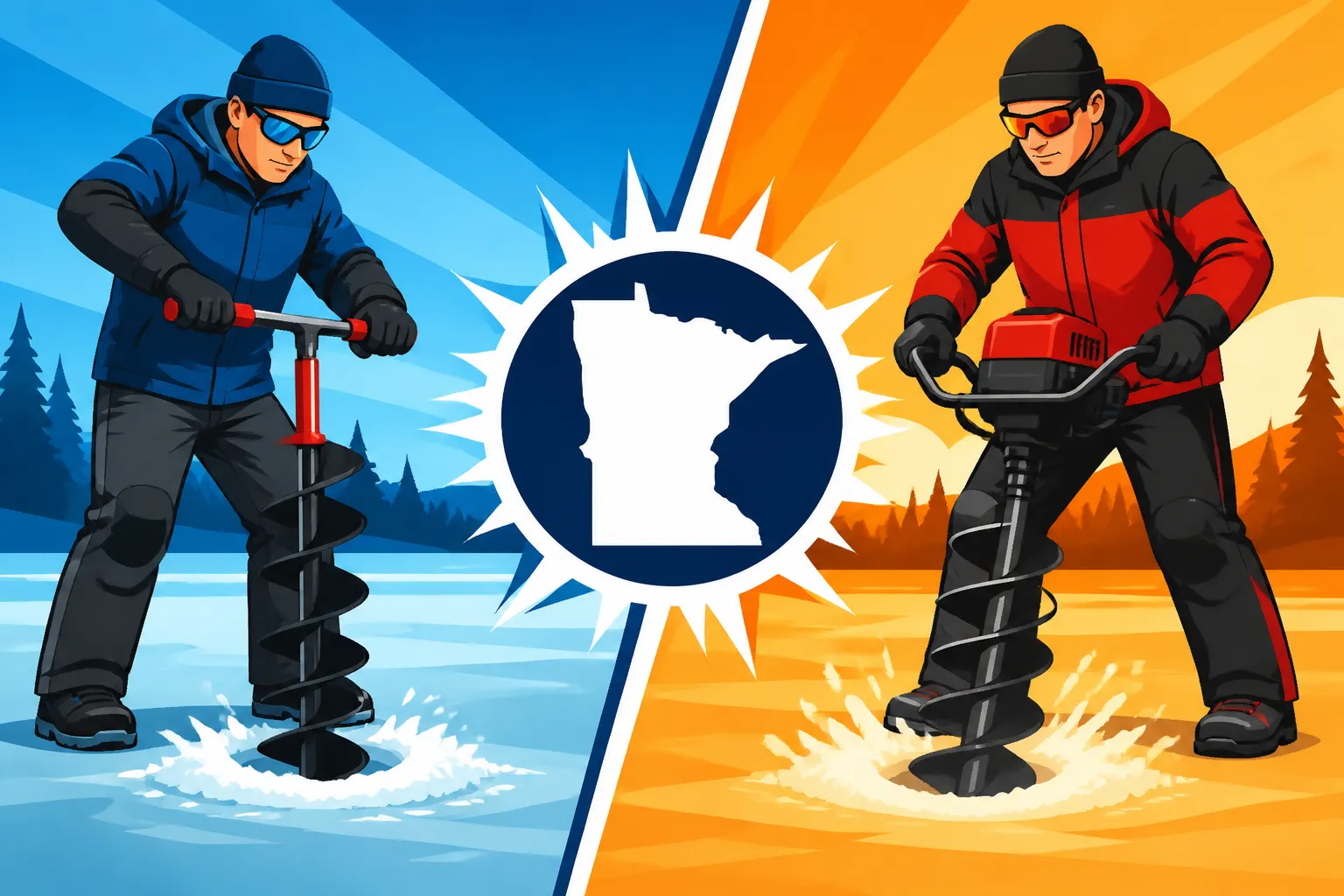
Few things are as frustrating on a crisp Minnesota morning as the thought of drilling a dozen holes through a foot or two of solid ice. Your arms ache just imagining it, and sometimes it feels like you spend more energy cutting holes than actually fishing! Choosing the right ice auger is a game-changer for your comfort, efficiency, and overall enjoyment on the hard water, and this guide will dive deep into the pros and cons of hand augers versus their electric counterparts.
The Classic Choice: Hand Augers for Minnesota Ice
Ah, the hand auger. For many of us who grew up ice fishing in Minnesota, this was our first introduction to cutting through the ice. It’s a simple, reliable tool, a true workhorse that has put countless fish on the ice for generations. You twist, you push, you grunt a little, and eventually, you've got a hole. There's a certain satisfaction that comes with earning your fishing spot through sheer effort, isn't there?
When a Hand Auger Shines: Portability and Simplicity
The beauty of a hand auger lies in its straightforward design and minimal fuss. There are no batteries to charge, no fuel to mix, and very few moving parts to break down. You just grab it and go. For anglers who prefer to walk out onto the ice, especially in areas with limited vehicle access or when exploring smaller, walk-in only lakes, the lightweight nature of a hand auger is a huge advantage. Picture yourself trekking across a frozen lake near Grand Rapids or navigating a snowy path to a quiet trout pond in the Driftless Area; a bulky power auger can quickly become a burden.
Furthermore, a hand auger offers unparalleled simplicity. There's no fear of a dead battery when you're miles from the truck, or an engine that won't start in sub-zero temperatures. It’s always ready when you are, assuming your blades are sharp, of course. For the casual angler, the kid just starting out, or someone who only drills a few holes a season, the low cost of entry and ease of use make it an obvious choice. You can often pick one up at a local bait shop or even through retailers like Bass Pro Shops without breaking the bank.
The Physical Toll and Limitations
While the simplicity is appealing, the physical demand of a hand auger is its most significant drawback. Drilling a single hole through 18 inches of hard ice can be a workout, especially if you're not in peak physical condition or if you're trying to fish in really cold temperatures where the ice is dense. When you're trying to quickly scout for fish and need to drill a half-dozen holes or more, the effort quickly adds up, leaving your arms and back tired before you even drop a line. This can severely limit your mobility and willingness to "hole-hop" – a crucial tactic for finding active fish.
Moreover, hand augers become less efficient as ice thickness increases. Early ice of 6-8 inches is manageable, but once you're dealing with 2-3 feet of ice in late winter on larger lakes like Lake of the Woods, the prospect of hand-drilling can be daunting. You'll spend more time and energy clearing the slush and ice shavings from the hole as you go, which further slows you down. If you're planning on an all-day trip with friends or family, and everyone wants to spread out and fish their own spots, relying solely on a hand auger for multiple holes can quickly dampen the fun.
Stepping Up to Power: Electric Augers
The world of ice fishing has seen some incredible innovations over the years, and perhaps none more impactful than the rise of reliable electric augers. Gone are the days when a power auger meant a loud, smelly, and heavy gas-powered beast. Modern electric augers have truly revolutionized how many anglers approach ice fishing, offering convenience, power, and a much quieter experience.
The Revolution of Cordless Power
Electric augers, often powered by robust lithium-ion batteries, bring a level of convenience that was previously unthinkable. With the push of a button, these machines effortlessly chew through even the thickest Minnesota ice, making short work of what would be a strenuous task with a hand auger. This means you can drill more holes, faster, and with far less physical exertion. Imagine being able to cut ten holes in the time it takes to hand-drill two or three, allowing you to quickly pinpoint active fish schools.
This efficiency is especially beneficial for serious anglers who rely on mobility to find biting fish, or for families with kids who want to get lines in the water without delay. Brands like StrikeMaster, ION, and Eskimo have led the charge, offering powerful, lightweight, and surprisingly quiet options. These augers are also much cleaner than their gas counterparts, eliminating exhaust fumes and spilled fuel, which is a huge plus for those who fish inside ice shelters or for anyone who values a more environmentally friendly approach. This is why many anglers are starting to choose them over gas models, finding a perfect balance of power and convenience.
Battery Life and Cold Weather Performance
One of the primary concerns many anglers have about electric augers is battery life, especially when facing extreme Minnesota cold. Modern lithium-ion batteries, however, are far more resilient than older battery technologies. While extreme cold will reduce their efficiency, many high-quality electric augers can still drill dozens of holes on a single charge, even in sub-zero temperatures. It's not uncommon for a good electric auger to power through 50 or more holes of 12-inch ice on a fully charged battery.
To maximize battery life in the cold, it’s always a good practice to keep your spare batteries in a warm place, like an insulated bag or inside your jacket, until you need them. Some anglers even prefer to keep the battery disconnected from the auger itself until they're ready to drill, only popping it in when it's time to make a hole. Manufacturers like StrikeMaster, with their Lithium 40V, have developed batteries specifically designed to perform well in harsh conditions, making them reliable choices for our long Minnesota winters. Investing in an extra battery or two can provide peace of mind for those extended trips or when ice conditions are exceptionally thick, ensuring you're never left without power.
Performance Showdown: Speed, Power, and Efficiency
When you're out on the ice, especially when the fish are biting in a specific area, the speed and power of your auger can directly impact your success. Time spent drilling is time not spent fishing, and every minute counts when you're trying to capitalize on a hot bite or locate elusive fish.
Drilling Through Thick Minnesota Ice
This is where electric augers truly leave hand augers in the dust. A good electric auger, like an ION G2 or a StrikeMaster Lithium 40V, can cut through two feet of ice in mere seconds. You simply press a button, apply light downward pressure, and watch the auger blade churn through the frozen layer effortlessly. This stark contrast becomes incredibly apparent during late-season ice fishing, particularly on big lakes like Leech Lake or Lake Vermilion, where ice can easily exceed two or even three feet in thickness. Trying to hand-drill through that much ice is not only exhausting but also incredibly time-consuming, often taking several minutes per hole, compared to the 10-20 seconds for an electric model.
The power of electric augers also means consistent performance, regardless of how many holes you've drilled previously. Your last hole will be cut with the same efficiency as your first, as long as the battery has charge. With a hand auger, the 10th hole feels exponentially harder than the first, and your technique can falter as fatigue sets in. This efficiency frees you up to focus on finding fish and enjoying your time on the ice, rather than constantly battling the ice itself.
Hole-Hopping Agility
Hole-hopping is a core strategy for many successful ice anglers, especially when pursuing active fish like walleye or crappie. It involves drilling multiple holes across a structure or area until you locate fish. The ability to move quickly from spot to spot, drilling new holes as needed, is paramount. This is where electric augers excel. Their quick drilling capability means you can cover a lot of ground and test many spots in a short amount of time. If you're fishing a large flat on Mille Lacs Lake and need to find the specific contour where the walleyes are holding, an electric auger allows you to efficiently crisscross the area.
While hand augers are lighter to carry, the physical effort required to drill multiple holes makes frequent hole-hopping impractical for most anglers. You might be less inclined to move if each new hole means another few minutes of strenuous work. This can lead to staying in unproductive areas longer than you should, simply because moving is too much effort. For this reason, many experienced anglers who value mobility have transitioned to electric augers, finding that the trade-off in weight is more than compensated by the ease and speed of drilling. The ability to make quick work of cutting new holes truly defines modern ice fishing tactics, and electric augers are at the forefront of this evolution.
Portability and Weight Considerations
When heading out onto the frozen lakes of Minnesota, what you bring with you and how you transport it can greatly impact your overall experience. Whether you're pulling a sled across a vast expanse of ice or loading up a portable shelter, every pound and every inch of gear matters.
Carrying Your Ice Fishing Kit
For solo anglers or those who prefer to walk out to their fishing spots, the weight of a hand auger is a clear advantage. A typical 6 or 8-inch hand auger weighs significantly less than an electric model, often somewhere between 5 to 10 pounds. This lighter load is easier to carry over snow and ice, especially when you're also lugging a bucket, a tackle box, and a few rods. If your fishing plans involve hiking into remote areas of the Boundary Waters or targeting smaller, less accessible lakes, then minimizing weight is crucial.
Electric augers, while certainly lighter than their gas-powered predecessors, still carry more heft than a hand auger. An electric auger with its battery often weighs between 15 to 25 pounds, depending on the model and battery size. This added weight, combined with other gear, can make long treks more challenging. However, for many, the benefit of effortless drilling outweighs the extra pounds, especially if they are using a sled or an ATV to transport their gear. The newer lithium-ion batteries have also contributed to reducing the overall weight compared to older lead-acid battery systems, making electric options more viable for various types of anglers.
Space in the Sled or Vehicle
Beyond just the weight, the overall bulk of an auger needs to be considered when packing for a day on the ice. Hand augers are generally more compact, especially the models that break down into two pieces, making them easy to fit into a sled, a trunk, or even strapped to a backpack. Their slender profile doesn't take up much precious space, which is a blessing when you're trying to fit a portable ice shelter, bait buckets, electronics, and food into your vehicle.
Electric augers, while often featuring collapsible handles, still have a larger head unit and a wider diameter flighting, making them a bit bulkier. While they'll still fit in most vehicles, they might require a bit more strategic packing, especially if you're driving a smaller car. Many anglers using electric augers invest in specialized auger carriers that attach to snowmobiles or ATVs, or they simply lay the auger carefully in their ice fishing sled. For those who frequently fish with large groups or have extensive gear, this space consideration becomes even more important. However, the convenience of not having to deal with fuel cans or the occasional oil spill makes their slightly larger footprint a minor inconvenience for most power auger enthusiasts.
Cost and Maintenance: An Investment in Comfort
Fishing, especially ice fishing, can be as budget-friendly or as high-tech as you want it to be. The choice between a hand auger and an electric auger often comes down to balancing initial cost with long-term value and convenience.
Initial Purchase Price Comparison
Here's where hand augers truly shine for the budget-conscious angler. A decent quality 6-inch or 8-inch hand auger, perfectly capable of getting you through Minnesota ice, can typically be purchased for $60 to $120. Brands like Eskimo, Mora, and StrikeMaster (their hand auger line) offer reliable options at this price point. This low entry cost makes ice fishing accessible to everyone, from beginners to seasoned veterans who prefer simplicity. You can often find these at local tackle shops or large retailers like Amazon.
Electric augers, on the other hand, represent a more significant upfront investment. While prices vary by brand and power, you can expect to pay anywhere from $400 to $800, or even more for premium models with larger batteries or advanced features. This includes the auger unit itself and at least one battery and charger. For example, a quality StrikeMaster Lithium 40V or an ION G2 will fall squarely in this range. For many, this price jump might seem steep, but it's an investment in comfort, speed, and efficiency that can enhance countless ice fishing trips over the years. Considering this, many anglers weigh their frequency of use and the conditions they typically fish before making the leap to electric.
Long-Term Care and Battery Replacement
Maintaining a hand auger is incredibly straightforward and inexpensive. The primary maintenance involves keeping the blades sharp or replacing them when they become dull or chipped. A set of new blades typically costs $20-$40 and can be easily swapped out at home. Beyond that, a quick wipe down after each use to prevent rust is usually all that's required. The longevity of a hand auger is practically indefinite with proper care.
Electric augers have a few more considerations. While the motor itself is generally maintenance-free, the rechargeable lithium-ion batteries are the key component that will eventually degrade over time. A typical lithium-ion battery for an ice auger is rated for hundreds of charge cycles, but its capacity will gradually diminish. Replacing a battery pack can be a significant expense, often costing $150 to $250 or more, depending on the brand and capacity. This is an important factor to consider in the overall cost of ownership. Additionally, proper storage of batteries (keeping them partially charged and in a moderate temperature) will extend their lifespan. Blade replacement costs are similar to hand augers. Overall, the convenience of electric power does come with a slightly higher long-term maintenance curve, predominantly due to battery considerations.
Noise and Environmental Impact
The sounds and smells of the ice fishing experience are deeply ingrained in our memories. From the crackle of a small heater to the sizzle of a freshly caught walleye on the portable stove, these elements contribute to the atmosphere. When it comes to augers, however, noise and environmental impact are increasingly important factors for many anglers.
Quiet Operation on the Ice
This is a significant win for both hand and electric augers compared to their gas-powered counterparts. A hand auger is virtually silent, with the only noise being the rhythmic crunching of ice as you twist and turn. This quiet operation is fantastic for not spooking nearby fish, especially in shallow water or when targeting finicky species. It also allows for peaceful conversations with fishing buddies and a more serene overall experience. There's something truly special about the quiet solitude of ice fishing, and a hand auger definitely preserves that tranquility.
Electric augers are also remarkably quiet. While they produce a distinct whirring sound from the electric motor and cutting blades, it's a world away from the roar and vibration of a gas engine. You can easily hold a conversation while an electric auger is running a few feet away, and the noise dissipates quickly, causing minimal disturbance to wildlife or other anglers. This is a huge benefit for those who fish in areas with multiple ice houses, as the constant drone of gas augers can be disruptive. The reduced noise also means less stress on your ears over a long day of drilling many holes, making the entire experience much more enjoyable.
Emissions and Eco-Friendliness
Another clear advantage for electric and hand augers is their environmental footprint. Hand augers produce zero emissions – they are powered solely by human effort. This makes them the ultimate eco-friendly choice for ice fishing, leaving no trace of carbon emissions or fuel byproducts on the pristine frozen landscape of Minnesota. For anglers who are deeply committed to conservation and minimizing their impact on nature, the hand auger is an obvious choice.
Electric augers also boast zero direct emissions. They run on battery power, meaning no noxious exhaust fumes are released onto the ice or into the air. This is a massive improvement over gas augers, which produce carbon monoxide, hydrocarbons, and other pollutants. The absence of fumes is particularly appreciated when fishing inside a portable or permanent ice shelter, where ventilation can sometimes be limited. The only environmental consideration for electric augers is the eventual disposal or recycling of their lithium-ion batteries, but responsible recycling programs are becoming more widespread. Overall, both hand and electric augers offer a far more environmentally conscious way to enjoy ice fishing than traditional gas-powered alternatives.
Here’s a quick overview of how these two auger types stack up:
| Feature | Hand Auger | Electric Auger |
|---|---|---|
| Cost | Low ($60 – $120) | High ($400 – $800+) |
| Weight | Very Light (5-10 lbs) | Moderate (15-25 lbs) |
| Speed | Slow (Strenuous, several minutes/hole) | Fast (Effortless, seconds/hole) |
| Noise | Silent (only ice crunching) | Quiet (electric whir, no exhaust) |
| Maintenance | Low (blade sharpening/replacement) | Moderate (blade replacement, battery care/replacement) |
| Best Use Case | Walk-in access, few holes, budget-friendly, tranquil fishing | Hole-hopping, thick ice, frequent use, convenience, family trips |
Making Your Decision: Which Auger is Right for You?
Choosing between a hand auger and an electric auger isn't about one being inherently "better" than the other. It's about matching the tool to your specific fishing style, needs, and priorities. Minnesota offers such a diverse array of ice fishing opportunities, from small panfish lakes to vast walleye factories, that one size definitely doesn't fit all.
The Solo Angler and Light Traveler
If your ideal ice fishing trip involves strapping on a small pack, grabbing a bucket of minnows, and trekking across the ice to a secluded spot, then a hand auger might be your best friend. For the minimalist angler who enjoys the peace and quiet of nature and only plans to drill a few holes for crappies or sunfish, the lightweight and simple design of a hand auger is unbeatable. This is especially true if you frequently visit smaller lakes, private ponds, or those walk-in only spots that reward effort with solitude. The physical exertion of drilling a few holes becomes part of the experience, a way to connect with the raw beauty of winter. It also means less gear to worry about, less to charge, and less to maintain, allowing you to focus on the fishing itself. For those who enjoy the simplicity of Shore & Bank Fishing in Minnesota No Boat, a hand auger is a natural fit.
Furthermore, if budget is a primary concern, a hand auger allows you to get onto the ice without a significant financial outlay. You can put those savings towards other essential gear, like a quality ice fishing rod and reel combo, or a comfortable portable chair. For many, the charm of a hand auger lies in its unpretentious effectiveness and its connection to the traditional roots of ice fishing.
The Family Angler and Hardcore Hole-Hopper
On the flip side, if your ice fishing trips involve the whole family, a group of friends, or if you’re a dedicated angler who covers a lot of ground in search of active fish, then an electric auger is likely to be a game-changer. Imagine taking the kids out for a day of panfishing on a popular lake; an electric auger allows you to quickly set up multiple spots for everyone without tiring yourself out, keeping the little ones engaged and warm. The speed and ease of drilling mean more time with lines in the water and less time struggling with ice.
For the serious walleye or pike angler who meticulously searches for structure, breaks, or weed lines on lakes like Upper Red Lake or Lake Winnibigoshish, an electric auger enables aggressive hole-hopping tactics. You can drill 20 or 30 holes in a morning without breaking a sweat, testing depths and locations until you find where the fish are concentrated. This efficiency directly translates to more fish in the bucket and a more productive day on the ice. While the initial investment is higher, the convenience, speed, and reduced physical strain often make an electric auger an invaluable tool for those who spend significant time on the ice or fish with larger groups. It’s an investment in comfort and success that many anglers find well worth it.
Final Considerations for Minnesota Anglers
Beyond the core decision of hand versus electric, there are a few other aspects worth thinking about to ensure your ice fishing adventures are safe, successful, and enjoyable here in Minnesota. Our winters can be unforgiving, and being prepared is key.
Safety First on the Ice
No matter what type of auger you choose, safety on the ice should always be your number one priority. Always check ice thickness before venturing out, and be aware of conditions like slush, snow cover, and recent temperature fluctuations. While an auger is a tool for cutting holes, it can also be a vital tool for checking ice depth as you move across the lake. Drill a test hole early and often, especially when venturing into new areas or early in the season. Consider carrying ice picks, a rope, and knowing how to use them.
With electric augers, always handle the battery carefully and keep the blades covered when not in use. Ensure the power switch is off before moving the auger or performing any maintenance. For either type of auger, sharp blades are safer blades, as they cut more efficiently and reduce the risk of kickback or slips. Always wear sturdy boots with good traction, especially when drilling holes, to prevent slips on slick ice or around slush. Your safety is paramount, and a good auger is just one piece of the puzzle for a responsible day on the ice, along with knowledge of Minnesota Ice Fishing & Shelter Rules.
Accessorizing Your Auger Setup
Once you've made your auger choice, consider a few key accessories that can enhance its performance and your overall experience. For hand augers, a good pair of blade covers is essential for both safety and preserving blade sharpness during transport. Many anglers also appreciate an extension handle, especially if they are tall or if they frequently encounter thick ice later in the season.
For electric augers, spare batteries are almost a necessity, particularly for extended trips or when temperatures plummet. A durable carry bag can protect your auger from bumps and scratches, and some even have pockets for extra batteries or tools. Many anglers also find a sturdy auger stand or holder useful for keeping the auger upright and accessible while fishing. Lastly, regardless of your auger choice, investing in a high-quality ice scoop is crucial for clearing slush out of your freshly drilled holes, ensuring a clean fishing experience. You can find these accessories at most sporting goods stores or online retailers. Consider visiting your local Bass Pro Shops or searching on Amazon for a wide selection of accessories.
Disclaimer
The information provided in this guide is for general informational purposes only and is not intended as legal or professional advice. Fishing regulations and ice conditions in Minnesota can change rapidly. Always consult the latest Minnesota Department of Natural Resources (DNR) regulations before fishing and exercise extreme caution on the ice. Ice thickness can vary, and no ice is 100% safe. Stay safe and enjoy your time on the water!